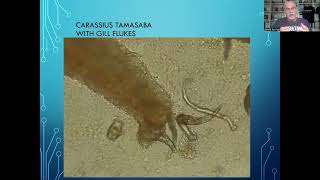
Gerald Bassleer presents case nr. 242: a Japanese Tamasaba goldfish (Carassius tamasaba) diagnosed with a gill fluke infection. He documents clinical signs (labored respiration, flared gills), microscope findings of heavy gill-fluke infestation and damaged gill tissue, and kidney lesions consistent with secondary bacterial invasion. He explains that gill-fluke eggs can lodge in filters (≈one week, temperature-dependent) and recommends prompt treatment with anthelmintics (he names flubendazole and "praziicanthal"/praziquantel–like products), improved husbandry (avoid overcrowding), supportive functional feed, and possible antibiotic therapy depending on disease stage. He points viewers to his Illustrated Guide to Fish Diseases and training courses for more details.
Questions this video answers
Case nr. 242.
Carassius tamasaba (Tamasaba goldfish).
May 21, 2024.
Flubendazole and prazicanthal (praziquantel-like product) are mentioned.
About one week (sometimes longer or shorter, depending on temperature).
Chapters
Hello. Dear Akrist, Dear Goldfish keeper. Yes. You selected this video because you want to learn something about diseases of goldfish. In this case it will be a special goldfish that came from Japan. Yes, usually we can get high quality from there, but fish or live animals are always a risk to get a disease. And also this one is an interesting case and I want to share with you my. Well, my PowerPoint that I made after seeing the problems when I used my microscope. And the case 242 is about the goldfish Carousius tamasaba. It's a Tamasaba, It's a Japanese goldfish variety. And here we found Gulf flukes, information about treatment about goldfish diseases, all available, particularly in the new Illustrated Guide to Fish Diseases. There's a large chapter on diseases of goldfish, also koi and other cold water fish and treatments. Here we see the Carassis tamasaba goldfish. Very nice, interesting species. And some you might notice there's heavy respiration. The gills are a little bit flared open, not always easy to see. But still it's a chance to find out when the fish has a respiration problem that you might check what is going on. Maybe it's the water quality, maybe overcrowding, but can be a disease. And when we examined this Tamasaba goldfish, we saw damage in the gills. You can see here some parts badly damaged, some whitish parts. So the gills are not nice, perfectly red like it should be. And then we took parts of the gills and then we could see. Well, you can see the large quantity of gill flukes. Of course those gill flukes are damaging the gill tissue. The fish will suffer. The fish will get secondary infections because the gill tissue is damaged. Here we see it in a higher magnification. And the problem with gill flukes, they lay eggs and the eggs can be transferred to the filter. They can remain there for one week, sometimes longer, sometimes shorter, depending on the temperature. And then the larvae can reinfect the other fish in the aquarium or in the pond. And here we took a sample of the kidney of this Tamasaba goldfish. And you could see the some tubercles or bad parts infected of the kidney tissue. So the kidney is also in bad shape. You can imagine when there is a problem with the gills, that bacteria can come in into the bloodstream. And then in fact, of course also the kidney. So what kind of treatment can I suggest for this Tabassaba goldfish? Well, treat as soon as possible against the flukes. I usually recommend flubendazole or prazicanthal or some other products. Maybe you know some already or see my books. I explain in detail what products are available. Avoid certainly overcrowding because overcrowding makes it easier for the parasites to spread and to reinfect and it causes also stress for the fish. You can help also with a functional fish food that helps repair the fish like we recommend Dr. Basler buy fish food garlic which is the sponsor of this videos that I'm making. You might think about this treatment antibacterial well depending how advanced the disease stage is. Then you can check with your veterinarian or your fish doctor for applying an antibiotic maybe in the food, maybe in the water to help repair this fish. More information you can get in my books which is are available in different languages. Or you can get your training as becoming a fish doctor or specialized person that can examine fish. Follow my training courses at my Patreon channel. So I thank you for watching this video. As a consultant, I may be wrong, but usually I try to put my efforts in using a microscope and give you some detailed information do it also. Thank you for watching.