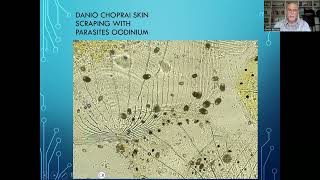
Gerald Bassleer shows how to diagnose velvet disease in Danio choprai using microscope scrapings of skin and gills. Treatment requires copper-based products over 7-10 days, salt at 5 g/L, and quarantine to prevent spread.
Questions this video answers
May 30, 2024
Velvet disease (Oodinium parasitic infection)
Up to 5 grams per liter
Several treatments during the first 7–10 days (retreatment depending on product)
Usually copper sulfate–based products
Chapters
Hello. Dear aist, today you selected my video on a danio, a Daniel Choprai, which were suffering from a disease we couldn't see with the naked eye. So I used my microscope and I prepared for you a PowerPoint so I could show you the disease that with a microscope it's easily detectable, but not with the naked eye. So the danio chopperi in this case was suffering from velvet disease or oodinium. You can have a lot of information on oodinium, how to treat, how to control, how to diagnose in my books on fish diseases which are available in different languages. Here we could see the diniotroprii, if a few darker ones between this group, which are becoming skinny, slowly wasting away. And that's the ones, well, you have to pull out and to use for examination. Here we see it in another video. The few darker skinny ones, that's the ones which are usually badly infected and a good example for saving the other fish. When you find the correct diagnosis and you can apply the correct medication. And on the skin scraping, well, we could detect the parasites oodinium. Here they are sitting here. They're not moving, they're sitting still. They are rooted, you can say inside the scales or on the scales. They also are inside the gill tissue. And you can see already here some gill damage, secondary bacterial infections or can occur. Here we can see those black specks. Those are the parasites oodinium. At the same time, the fish can get secondary bacterial infection like you could see here, the spleen and the liver, which are badly infected. Yes, because through the gills that are damaged, the bacteria can come inside the fish and cause internal bacterial infections. So the treatment, what you have to do is treat as soon as possible. You have to act within time because the longer you wait, the worse it will become to cure the fish, the more difficult. There are many good products available in the shop. Usually they're based on copper sulfate and they're available well in most of the shops. But ask for your information from the shop or the fish care manager in the shop because you have to follow carefully the directions when applying this medication because you need to retreat depending on the product. Just not one treatment, but several treatments in the first seven to 10 days. So I just warn you that you have to be careful by administrating this treatment. Adding Salt up to 5 grams per liter also helps when combined with the medication. I just recommend this, avoid overcrowding and you can help with a functional fish food like our Dr. Basler. Buy food forte that helps the immune system and the defense of the fish, more information on treatments and on fish diseases in my books in different languages. Or you can become a good fish doctor or learning about quarantining fish, learning about what is the cause of fish diseases, what you can do as prevention on my Patreon channel. So I hope this helped you to understand on this, Daniel, that just become a little bit dark, wasting away that there was a velvet disease or didium and that you can cure it when you act on time. Thank you for watching.