Gerald Bassleer examines wild-caught Corydoras melini catfish infected with trematode larvae. The parasites settle in gills, liver, and spleen, causing scratching, weight loss, and darkening. He explains the life cycle involving snails and birds, then covers farm biosecurity and treatment options.
Chapters
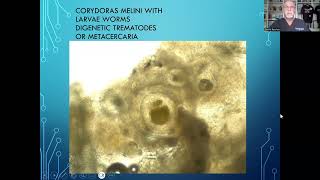
Hello, dear aquarist. You like Corydoras, the nice catfish that are lovely to keep in your aquarium, to clean the bottom and remove the waste. Well, these fish many times are available from the wild. And coming from the wild, those fish can bring in certain diseases. That doesn't mean they will die from it, but they can have some parasites that can survive a long time in these fish. It's part of nature. Like we as humans also can carry diseases and not being susceptible to get sick from or to die from it. That means we are carrying pathogens and pathogens are all over in the world and we have to deal with it depending on your immune system and how we are behaving in our lifestyle. And it's the same for the fish. And here we share about the Corydoras millenni coming from the wild. And of course coming from the wild, it is easy interaction with nature and also an easier impact to get internal worm infections, particularly when there is no biosecurity. We can do it in breeding farms. We can install biosecurity that there is no or little risk for worm infections. I explain a lot about that in my books on fish diseases, which are available in different languages. Here we see the Millenni corydoras. You see some are scratching, you see like. Like they are. Something is bothering them. They become darker, like this one here up front. And some are wasting away and some die after a couple of weeks. And some don't die and stay healthy for, well, permanently. When we had them, when we checked the fish, we found some parts of the gills that were badly affected. Also some of the finch were attached and here was the. The gills. You can see the parts here, the part here I wrote here, fins, but that's not correctly. It's part of the gills, like this part here and these parts here. Well, that means the gills are not doing a proper job anymore. And internally we found metacercaria, that is larvae of the digenetic trematode worms. You can see them here. And they've taken away a healthy tissue. They are troubling the immune system of the fish, making the fish weak. The fish are more vulnerable to get other infections, like bacterial infections, like kill infections for example, or less interest to eat, have less appetite. All things that can trouble that fish so they become more sick. Here we see a closer observation of 1, 2, 3, 4 and here, 5, 6, 7. Trimatodes larvae or metacercaria. This is the life cycle. I explain in several of my videos that there is a bird around in the river system he drops off eggs or they can larvae swim out. Well, let's go back Gerald. Let's go back and see here that the larvae gets through the snails and from the snail another larvae comes into the fish and the fish is eaten by the bird. So this is cycle. That's why it's called digenetic trimatodes. They need some hosts, intermediate hosts, and that's the snail in this case. And the fish, intermediate host for the big worm will live in the birds. So avoiding the birds. Well, in the nature it's not possible. At a fish farm you can do that at the same time, while the Melenia had well, larva, the organs here, the liver were badly infected. Here we can see some of the encapsulated parts. Here we see the spleen in the middle which is badly affected. We see organs which are not in a healthy state. So that's a secondary bacterial infection which is troubling of cause the fish and that we have to sometimes also fight off. Here we see another larvae here in the video of some parts of the organs which I wanted to show to you. So internal examination reveals this problem in the Corydora malini. The treatments. Well, the badly affected fish might survive maybe only a few days or weeks. You don't know. Some survive permanently. See the not badly infected fish, you should just give them a good fish care, health care and a good functional food. So the fish can survive with it? Yes, they can survive with it sometimes. Well, depending how the situation is on the group of the fish, an antibiotic could help to control the secondary bacterial infection. And this is a way that a functional food can be a help to repair the fish in a condition where there is a bacterial infection. With the help of Dr. Basler, Biofish Food, grapefruit seed extract and moringa Training and health issues can be solved by reading my books on fish diseases or obtaining some training at my Patreon channel. So I hope this corridor with its disease infection of larvae of worms explains you what situation you can have when you particularly deal with wild imported Corydoras. See more of my videos in Corydoras. You know, I provide a link at the end of my screen that you can see more Corydoras with this kind of diseases and try to understand then you know how to handle the problem. Thank you for watching.