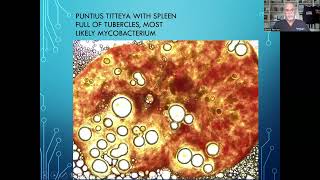
Gerald Bassleer examines a cherry barb with tubercles caused by Mycobacterium, a bacterial infection that's difficult to treat in ornamental fish. He emphasizes biosecurity and prevention as the best defense against this persistent pathogen.
Chapters
Hello, dear acurist, dear fish keeper, thanks for selecting this video. You want to learn something about a specific disease that occurred with the cherry barb. The tita cherry barb, a very common small barb that is very common in our aquarium. And this fish came from a breeder facility. Well, that had some serious problems. I will not mention the origin of, of the country because I would be in trouble these days if I would say the origin. But anyway, breeders can have a risk of creating problems. That's normal. So prevention measures and biosecurity could help to solve it. And this case was a specific fish. Well, that was difficult to deal with. On the moment you receive that fish, well, they look nice and you have to work with it. And it was a serious bacterial infection in this cherry barb, in my case, 247 more details on fish diseases and treatments is available in my books, the large book, the new illustrated guide, or the smaller book, which is available in seven languages. Maybe you can find your good literature in the link below. Here we see the tita. Some look fine, some had a big belly and some were dying. So in generally you could see this fish look pretty healthy. Well, if you have some losses, it means there is a trouble going on in this group of fish or in the society of this cherry bar, which have been raised for certainly six months. They are so big, they're nice, red, colorful. But some are dying. So we examined the fish and we found the spleen full of tubercles. The spleen has hardly anything healthy tissue left. And of course if that organ fails, that fish will suffer and will die eventually. So here are these bubbles here and here, the smaller bubbles. So this is some healthy tissue, the red parts, but that's most of the spleen is gone and is infected. And it looks like it's mycobacterium. Well, we can send it to the laboratory for diagnosing. But we know in scientific research that if you find tubercles in the organs of ornamental tropical fish, in 85% of the cases it's caused by Mycobacterium. I have discussed this in my first videos I made. I showed it in my studies on mycobacterium. That is probably the origin and it's a problem when you deal with ornamental, particularly in tropical waters. So this cherry barb, the treatment. Well, as you have learned from my previous videos, maybe it's difficult to treat mycobacterium because it's encapsulated. Some people tried antibiotics so it might help for the less infected ones. Some people use minocycline, oxytetracycline, but to be honest, the results are very different. Some have good, some have bad. In most cases, it's not working well. Some fish can live for a long time and some, heavily infected, die within weeks and months. And it can spread to the other fish in the aquarium. So it's better not to sell this fish. Not certainly not to trade in this fish, because it can affect the whole community in your beautiful tropical aquarium. Because when it dies or the fish eat on the dead fish species, or even the bacteria can be spread through the excrements in the aquarium. And that's a problem. You have that moment. You can help the more healthy fish which are doing well and eating well with a functional fish food. And we would recommend in this case the Dr. Basler B. Fish food professional treat. That doesn't mean that this is there is a medication in the food. No, there is functional ingredients that helps the fish to become better, to have a better immune system and to defend itself better. Our food do not have medications. Be aware of that. Our food have functional needs for the fish. Read my books, available in different languages. So you get well advised what to do in certain diseases or what medications you can apply or you can get a good training on fish health management and controlling fish diseases at my Patreon. So I hope this video explained you this specific case coming from a breeder that was breeding Mycobacterium in the cherry bark. Thank you for watching.