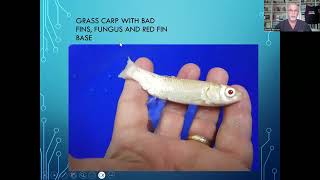
A Gerald Bassleer YouTube case study of an albino grass carp (Ctenopharyngodon idella) presenting with a complex mix of infections: heavy bacterial colonization of the skin and internal organs, saprolegnia fungal growth on the tail, ectoparasites including Hylodonella and gill flukes, and encapsulated metacercariae in the gills. Microscopy confirmed necrotic gill lamellae and multiple parasite types; Bassleer emphasizes that bacterial infections causing gill damage should be treated first (fish are effectively suffocating), followed by parasite control and then antifungal treatment for secondary saprolegnia. He also advises avoiding overcrowding and using supportive functional feed; additional details are available in his books and Patreon.
Chapters
Hello, dear Akrist, dear fish keeper, hear about a cold water fish, a pond fish, a grass carp? Yes, those are fish that are. Well, are likely to be kept by dudes that have ponds outside that are cleaned by the grass carps. A practical fish to be kept and it's a very popular for the puntinus Le. So sometimes I make these kind of videos for you. I did it on koish and goldfish and different kind of fish. And today it's about a grass carp. It had a complex issue. Yes. Watch this video and you will see a mix of infections that was troubling this. This grass carp, the grass carp came from a breeder. I do not tell whether breeder. Where is he located would be not interesting. And I would well, maybe be attacked by telling what origins these fish can come from. Well, these fish, the carp, it's the albino grass carp had a mix of infections. I talk about diseases, infections and treatments in my books. See the link below to get more details and where you can purchase them. The grass carp had bad fins. You could see the bad tails. There was even already some fungus on the tail and a red fin base. You can see it more than other parts of this fish, which I show holding the fish alive in my hand before I use it for examination. And here you see the red parts at the anus, at the anal fin, the pectoral fins. Well, if you see this, well, you know by experience, or you know, from the literature, or you know, from my books, that is usually a bacterial infection causing these red markings. But maybe it's not only bacteria that's causing it. Of course. We took a skin scraping and you see the massive bacteria loaded on the scales. These are all a whole big colony of bacteria. We found fungus on the tail of the fish. Here you see the saprolegnia, the fungal threads. And at the same time we found between the fungus, we found some parasites already invading of the fish of the damaged tissue. This is Hylodonella parasite. You see them here. There are a couple here, in between, maybe more on other parts of the tissue. Of course, the tissue is damaged. And you see many different here. There are 3, 4, 5, 6 here. Moving around to the little parasites, Hylodonella, we examined the gills and you could see the gills were damaged, the rheus, some necrotic. Well, and then you take an observation with the microscopy. You see the necrotic gills, lamella, which are completely devoid or damaged or necrotic by bacterial infection. At the same time we found some gill flukes, a few Gill fruits, not many, but again another parasite like Halodonella, like gill flukes, that is troubling the fish. So you have the bacteria, you have the fungus, have the Halodonella, you have the gill flukes. And then we had encapsulated Metacercaria here, also taking away healthy tissue of the gills, larvae of a digenetic trimatode. And then we had internally in the organs also bacterial infection in the liver and the spleen. You can imagine that this fish was suffering. This is usually maybe a secondary infection, the bacteria. I don't know what is the history of the fish? Well, I can tell you that the fungus that we seen obviously on the tail of the fish and a lot of people observe it and try to treat it. Yes, because you see the fungus. But usually this fungus is a secondary infection. After damage caused by bacteria or by parasites or both of them. The bacterial infection should be treated first of all, because that's the one who is killing the fish. Destroying the gills. So the fish are suffocating. They have like a pneumonia by humans. You have to treat the gills, you have to treat the bacterial infection. Afterwards you treat the parasites. And the fungus like FMC could be chosen for this. Avoid overcrowding, because overcrowding is make it easier for the fish to get disease to be spread amongst each others. And you can help with a functional fish food that helps to repair the fish. Like Dr. Basler Biofish food Forte read my books to get information on the treatments, on the prevention and the control of fish diseases or follow my patreon to get your adequate training. Well, I hope this video had explained you how complex fish diseases can be and what kind of mix can occur on what you have to treat. First of all. But check with the breeder here because this breeder supplied you with a serious cause of diseases. Thank you for watching.