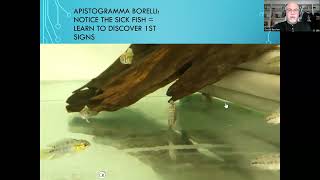
Gerald Bassleer examines a bacterial infection in an Apistogramma borelli dwarf cichlid. The video covers diagnosis, antibiotic treatment options, and how to prevent the infection from spreading to other fish in the tank.
Chapters
Hello, dear Aquarist, welcome again to one of my videos on a fish disease case. And today you will see the one on Apistogramma, a dwarf cichlid, Apistogramma borrelli, which is a common, well known small ornamental accordion fish. And it is usually available for breeders. I think 99% of the apistogrammas are coming for breed breeders. And like I explained before in my presentations, it's good to have breeding fish available for breeders, but you have to be realizing that breeding fish sometimes can also have the consequences that the breeder is breeding. Also a fish disease or fish diseases. And in many cases we found bacterial infections like on this Apistogramma BORRELLI, in my case, 252. You can find a lot of details on fish diseases, preventions, diagnosis and treatments in my books. The link is below where you can purchase them. And here I show you a group of Apistogramma that came from a breeder. And it's important for you as a hobbyist or as an importer or a pet shop, that you learn to diagnose or to see the first signs. The first fish that shows abnormal behavior, like the one here in the back, is getting dark, I see a little bit. Popeye is breathing heavily and is dying. Well, that fish tells you something that you should be aware to check. Other fish in the aquarium, like here in the left in the corner, getting skinny, getting dark. Also, this one is not so well filled as this one here, or this one that is behaving normally, but sitting at the corner, at the edges. This is a sign you have to learn to discover. Like this black one here at the back, or this one behaving abnormally. Look, breathing heavily, hanging abnormally. That means the fish will die within a couple of days or a couple of hours. And the other ones might also become sick in the coming week. So that's why you have to check this one, for example. This one already also showed some tail, rod and fin rot. Well, perfect fist for examination. And we took out some gills. And we could see parts of the gills had gill rods. This is damaged tissue. And these gills, you can see they're getting in a bad stage here. Also another gill part which is gone, going bad. And here another gill arch that is completely, well, devoid by bacterial infection. So the fish will die first from this particular incidence of pathology of the gills. And at the same time the organs were infected, the liver here and on the right here, the spleen, which are not in a normal healthy stage. And during that examination of this male Apistogrammatic we found this moving little tiny things which are sperm, the male sperm. So don't get confused that this might be a parasite. It's much smaller than most of the parasites and it's found in the gonads. It's the sperm of a male apistogramma. Here I show you another picture of it. So you don't confuse it with for example spironucleus or hexameter. Just I want to show you that it teaches you some lessons on normal, healthy tissue, healthy organ with moving sperm. Well, that pistogramma, the treatment, what can we advise? Of course we noticed that this was a bacterial infection. You saw the signs of the fish was getting dark, some had Popeyes, some had a swollen belly, some had fin rot, some become skinny. All different signs in this case due to a bacterial infection. Where we can recommend that you use an antibiotic or a good antibacterial medication that you can ask from your aquarium shop or from your fish doctor or from your veterinarian. Try to detect the first fish that gets sick as soon as possible because the longer you wait, the worse the problems will be and more difficult to treat. So look for the origin of the infection. It could have been the water quality pollute. Polluted frozen or live food can be a cause. And usually it already starts at the fish farm or the breeder. And you can help the fish with a functional fish food that helps the fish. Like we can recommend or Dr. Basler biofish food. Grapefruit seed extract, moringa or the fuko or the professional treatment. These all help in a case like with bacterial infection. More details on fish diseases in my books. The link is below. Or you can get a training at my Patreon or finding more information at my website. I thank you for watching this video on this dwarf cichlid Apistogramma and subscribe to learn more about fish diseases, how to diagnose, how to prevent and how to treat. Thank you for watching.