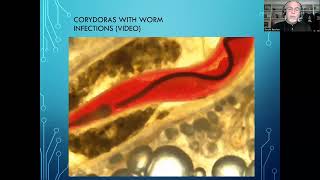
YouTube case video (Fish disease case nr.255) by Gerald Bassleer about a wild-caught Corydora axelrodi suffering multiple parasitic worm infections. The presenter shows clinical signs (darkening, wasting, low activity), dissects a specimen to reveal nematodes and encapsulated metacercaria in the gut and organs, and discusses sources (wild collection, season, handling) plus mitigation: improved husbandry, several anti-worm medications (praziquantel, levamisole, mebendazole, ivermectin), and functional foods or his books for further guidance.
Chapters
Dear Aquarist, welcome to this video where I will talk about a deceased corydora. Catfish. Yes, corydoras, that's a kind of catfish everybody likes to keep in the aquarium because it's very popular, because it's behavior, because it's cleaning the substrate at the bottom of the aquarium. And there are so many nice varieties available. And today it will be about the Corydora axorrodi, which is a wild corydora that will be shown in the next presentation. Also coming in with a risk for diseases, because it's wild. Wild fish can bring in wild diseases. And here we found in this case 255, several parasitic worm infections in this corydora. Details on prevention, diagnosis and treatments on fish diseases available in my books in different languages. The link is below, where you can purchase them. Here, the Corydora Axorrodi. Some are suffering. They're getting black, dark, skinny, wasting away. They're not so actively swimming anymore. And maybe one will die each week or after a couple of months, hard to say, and so will do well. But after dissection, you could see here the organ which we took out of this corydora. You see something red is moving here in the organs, in here, in the gut, in the intestine. A little red worm. Looks like a mosquito larvae. Yes, but this case, well, it was something else. It was a nematode that we found in the intestine or in the gut of this corydora. We also find here some other worm infection. Here is another one. You can see here, this big, large worm. Well, I could not exactly identify it. It's not my job. But at the same time, we found all Metasarcaria also sitting around here. And here we saw some other nematodes moving around. So they had a mix of worm infections. Encapsulated metacercaria. Here, below, other nematodes. So typical for corydoras. Yes. From the wild. Yes. It's depending sometimes on the season, depending on the river, on the location where the fish has been collected. There have been several studies on that, and not all fish are badly infected and some will do well, but never show any symptom or any sign of disease. So it's only very few who eventually will die from it. Maybe 10%, 20%, it's hard to say. We never know in advance because depending on where they have been collected and what time of the season. And I discussed that kind of infection, the origin, in my studies and my YouTube channel, I have playlist studies. And there you can find some more details on that. Poor handling, poor transport, poor water conditions. Yes. If that is all involved in that fish, that makes it worse. So you should try to improve all those conditions so the fish can well stay longer alive or better alive with a worm infection. At the same time, you can try to treat with an anti worm medication. Some people tried Prazik or Levamizole or Maybendazole or Ivermectin. Many different kinds are available. So ask in your aquarium shop, ask your fish doctor or see my books where I explain a lot about medications to treat worm infections. A fish food can also be helpful can be functional like our Dr. Basler bi fish food pumpkin seed extract that helps in to control and the fish to survive. Better read about fish diseases in my books how to prevent, how to diagnose and how to cure available in different languages. Or maybe you get a specified training which is available at my Patreon channel. So I thank you for watching this video and that you are concerned about the health of your vision how to control because that's why you listen to my videos and if not try to subscribe to learn more. Thank you for watching.