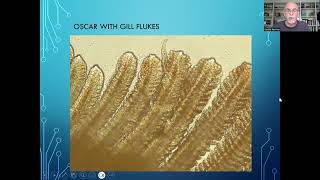
YouTube case presentation (Gerald Bassleer) of Fish Disease Case No. 269: an Astronotus/Oscar Cichlid group where one fish showed early signs (sluggish, emaciated) and another was found dead. Diagnosis: gill fluke (monogenean) infestation observed on gills with secondary bacterial infection causing damaged gill filaments and internal organ lesions (liver, spleen). Risk factors cited: overcrowding, overfeeding, dirty water; flukes can reproduce and rapidly reinfect (within 1–2 weeks). Recommendations: treat parasite and bacterial infection together, consult a pet shop/veterinarian, consider supportive functional food (Dr. Basler bi fish food garlic), and consult the author’s books or Patreon for more details.
Questions this video answers
Case 269
September 16, 2024
Dr. Basler bi fish food garlic
Chapters
Hello, dear acurist, welcome again to one of my videos on the cases of fish diseases. And today it's about an Oscar Cichlid. And I will share you my PowerPoint so I can show you my findings that I obtained during my research in fish diseases. I'm here case 269 Koskorchiclit with Gill flukes and a bacterial infection. Of course I received fish during my work as a fish doctor and it's interesting to collect these details and share with you so you can learn lessons how to detect the fish diseases and what you can do as treatments. Many details are available in my books on fish diseases. They are available in different languages. You will see the link below where you can order them. Here we see the Astronautus Oscar Cichlid in the aquarium. And yes, it seems that they do okay so far. They are a little bit sluggish maybe. Do they behave normally? Well, we check further and we see one. Well, one who is skinny, suffering, not behaving well. We can see weakening and others are still okay. Yes, that means it's the beginning of the infection. It's one fish that is suffering. That is the one who shows the first signs that you have to take action. Here we see the group again and we gonna take a look at other parts of the akarimor. Well, there is the sick one separated, sitting on the side and there is already one dead one laying on the bottom. Well, time for you to take action and to take them out and to start checking. And look what we found in the gills. We found kill flukes. A few kill flukes, yes. And it can become a rapid infection within a week, sometimes two weeks when they reproduce and put out eggs and reinfect the fish in the aquarium. And particularly when there are many fish together in one tank. An ideal situation for guilt flukes to grow is overpopulation, overcrowding, overfeeding, dirty water conditions. Now, what can happen when you have a gill fluke infection is also a bacterial infection? Sometimes, yes. Secondary you see the gill arches or the gill filaments broken apart here. Also getting holes and getting a risk that the bacteria gets inside the fish and infects the organs. Like we can see here at the left, the liver and lateritis spleen with Milano macrofar centers is a kind of reaction of the organ against bacterial infections. So suggestions for treatment? Well, treat the worm infection combined with an antibacterial treatment. So treat the worm and the bacterial infection together. We recommend it because then you will not lose time because the fish eventually will die quickly. Because of the bacterial infection that is particularly killing the fish rapidly. Ask your pet shop or your fish doctor or your veterinarian for a good medication. Or you can read it or find it in my books. You also can help with a functional fish food that helps the fish to repair. And in this case we could recommend Dr. Basler bi fish food garlic. So more details available in my books. You can order them and you can get more specialized information. You also can get yourself a training for fish doctoring or other solutions for solving or preventing fish diseases at my Patreon Channel. So I hope this video helped you to understand this problem. On the Oscar Cichlids. Thank you for watching.