Gerald Bassleer examines green tiger barbs with capillaria worm infections. The fish show isolation, surface hanging, and emaciation; necropsy reveals intestinal worms and eggs. He recommends biosecurity measures, antiparasitic drugs like praziquantel and levamisole, and recovery feeds with pumpkin seed extract.
Chapters
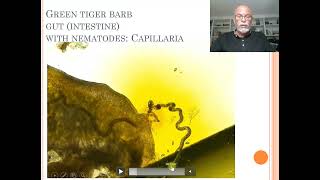
Hello, dear. Fish keeper or aquarist, I know you're concerned about fish diseases and you want to solve your problems. Well, today, case 27, it's about the green tiger barbs which were infected with worms. And as you can see in the video, they're behaving very abnormal. Some do quite normal here below the more normal colored ones. But there are some dark ones here. You can see separated from the group. They were having a strange behavior. Look at that shaking hang at the surface, becoming very skinny. And we could see in other particular signs just this kind of strange behavior. Well, it's the time for you when you're a fish manager in a wholesale facility, particularly to take out one fish and to do an examination. And we didn't find anything on the scales or on the gills, but we could find this kind of animal here. It's a worm, worms. Look how many worms inside the intestine here. All moving around. And here there are plenty of worms. Let me show again from the beginning. Even what we show here, I put this pause on it. We see some eggs here, which sometimes things we can find if we select excrements, fresh excrements collected from the fish. So this is typical for the capillaria nematodes. See, it's very long one here. Here's more. There are plenty in here. And I show you on the next video here, we'll see how many are in here. Plenty of worms. This is a very heavy infection due to the way where fish were kept. Probably at the breeder or at a wholesale facility getting the food which was already infected with capillaria eggs, or they were transmitted by keeping fish together with other fish which had capillaria because the eggs can transmit to other fish. So when you have a case like this, like this green tiger barb with those nematodes, capillaria worms. Look for the origin. Is it alive food? Who caused it? Is it other fish? Which could have brought in the capillaria worms and the eggs? So maybe a lack of biosecurity or transmission risk from one tank to the other. So sometimes you have to think about biosecure measures, particularly keeping nets separated. Each tank should have a net. So the nematodes capillaria can be treated with several medications. Prazicantel, piperazine, levamizole, which are all explained well in my books on fish diseases where I give the correct dosages to be used. We recommend to combine this treatment with a food to help the fish to fight off the worms, such as the pumpkin seed extract which we have in our Dr. Basleer Biff pumpkin, which helps to fish to expel the worms. But you need still to mitigate. Our food is not a medication. And after a few weeks of treatment, or a few days of treatment, depending on the situation, you can use another food to repair of the gut and to repair the immune system of the fish. Because the fish usually have been weakened. And we recommend for this the Dr. Bazley advises food alloy in or forte. So this was my next case and more cases to come. Please stay tuned in my Patreon and you will become a more professional aquarist. Thank you.