Gerald Bassleer (YouTube) presents fish disease case #270: a Myxocyprinus with blind eyes caused by metacercaria (trematode) larvae in the eye, accompanied by secondary bacterial infection, gill pigmentation indicative of chronic stress, and poor kidney condition. He documents sampling (eye removal and microscopy), quantifies multiple larvae (about 11+ in the eye), and discusses limited treatment options (possible levamisole trial), antibacterial control for secondary infections, and supportive nutrition; he also promotes his books and products.
Chapters
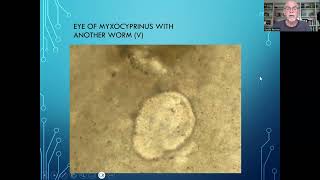
Hello dear Akarist, you selected a video about a special fish. Yes, the myxosyprenis. And those fish had blind eyes. So it was an interesting. Yes problem that presented to me. And of course as a fish doctor I'm always keen on looking what could be the cause, what could be the reason why this mix of cyprinis had blind eyes. And yes, we found a worm infection. Diseases on fish Disfell, solutions, preventions, treatments, all you can find in my books and available in six to seven languages on our website below or you can order them. Here we see the mix of cyprinis with the blind eyes. You see how skinny the fish looked, how he was, I can say wasting away, not doing very well. The blind eyes is of course an obvious sign that something is troubling the eyes. So we're going to check the eyes and we took out one of the eyes and put it on a glass plate for the microscope. We saw a lot of things inside the eye, well, which needs examination with the microscope. We found lots of bacteria. Of course you can imagine that when there is an infection, a lot of cases bacteria is combined with other things that were happening in the eye. That is a worm. Well, we found a worm on this particular part of the eye. It was covered between the necrotic tissue. You can hardly see the worm. Here he is below, of course, that's how you take a sample. It's not always perfect, but you could see that there is a little animal, it's a worm. We can see another one in another part of that eye. And you can see here it's a kind of metacercaria, a trematode larvae. Here we can see it how it looks like that little animal in the eye of that myxosyprenis. And in other parts of that eye we found 10 more of those kind of worms. You can count them here. So there were pretty quantity of worms, small metacercaria larvae infecting the eye of this mix of cyprinis. The gills had a bad history, as you can see. We found here all those black pigmented areas. And when we see that in organs like the gills, that means there had been stress situations, bad environmental or nutritional or chemical or other unhealthy situation that affects the guilt tissue. And then we quite often see an accumulation of black pigments. Here we see the kidney which is in bad condition. This is not a healthy kidney. You will see in my other videos what healthy kidneys look like. But this is a bad kidney which is not working properly. And of course, due to that bad infection, that bacterial infection that also occurs on the fish. Well, due to the damaged eye, due to the worms fissures, not feeling well cannot be repaired. The treatment of the worms is a big question. How you gonna get a medication into the eyes? There is not much knowledge about that. Some people had experience with Levamizo. It's worth a trial when you have a lot of this or when you have breeding facility that you should try this kind of treatment. If you have a hobby, as a hobbyist, a fish like this in your aquarium, well, it's very unlikely you're going to be able to treat it. Maybe an antibacterial treatment could help to control the secondary infection. Ask your pet shop or your fish doctor or your vet for a good medication. Or you can see it in my books. And at the same time, you can help with a functional fish food that helps to develop a good immune system of better defense. And we can recommend for that like our Dr. Basler biofish food Forte or other kinds you can check for biofish food what it can help your fish. So books can help you to understand better fish diseases, how to prevent and how to control. You can also go to my patreon and learn more about the fish doctoring and get yourself a training. So I hope this video helped you to understand this problem of the blind eyes of the mixosiprenus. Thank you for watching.