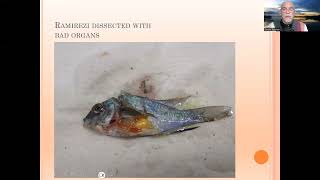
YouTube video by Gerald Bassleer describing a disease case in Mikrogeophagus ramirezi (Ramirezi dwarf cichlids). The presenter documents clinical signs (skin lesions, pale gills, abnormal organs), microscopy findings indicating heavy bacterial colonization and organ degeneration, and suspects an iridovirus with secondary bacterial infection; he emphasizes laboratory confirmation, prevention, and proper husbandry and refers to his books and Patreon for treatment protocols.
Chapters
Hello, dear aquarist, you want to see this video because you might like dwarf cichlids like the Ramirezi cichlid, the Microgiophagus Ramirezi. Yes, those fish are popular and they sometimes have serious problems. In this case, I will show you one well, that had well, causing some losses, which I don't like that this is happening in the industry, but this is part of breeding fish. This is part of our industry, that you have healthy fish, but sometimes fish that has problems. And I share you my PowerPoint where I show you my findings of the fish in the aquarium and the fish with the use of a microscope. And this Ramirezi Blue had most likely a viral infection, irredovirus and a bacterial infection. Details on prevention, good diagnosis and the use of medications, how to use properly are explained in my books. And here we see Deramirezi suffering. You see some patches on the fish. Sometimes we see a little fin rot. But you can see the respiratory behavior in bad condition. You see losses here, more fish are dying. Some are in the back here, not behaving properly like a fish should behave. That is curious. Looking for food, swimming around. But those fish were in bad condition. We found on the skin scrapings colonies of bacteria affecting the health of the fish. On the scales, we could see here the bacteria on the scales, you see the black patches, is a whole big colony of bacteria. And you can see in the movie here, the video, that all those moving particles are bacteria. The gills are very pale and reddish in the center and pale at the edges. So that means the gills are not properly functioning anymore. The organs had bad colors, blurry, pale, a lot of fluids, not healthy looking. And we use those organs for examination. You could see already all the pale organs, no nice red spleen or nice red brown liver, all having a bad appearance. And that was proven in our microscope. We could see here the spleen on the left with melanoma centers, or the liver with a lot of vacuoles opening, not good, healthy, strong tissue. Even the gonads, the gonads of this female was badly affected with bacteria. And the liver, I mean the kidney at the right had some waterish, not sturdy, good tissue appearance and some black areas in it. So all those organs were in poor condition, the whole fish. And it's known that a virus can be a serious problem in these Ramirezi cichlids, particularly these that came from Asia. Most likely iridovirus that's been described. A laboratory can confirm this. I cannot confirm this. I only can suspect because when I see the symptoms and the problems Appearing on the organs and on the fish. Only a laboratory can do a proper diagnosis, not even a microscope can do it. So a molecular lab can help you. So you can inform the supplier, the breather, about this problem, because he can correct something about it. It's preventing at his fish farm. So the secondary bacterial infection that appears that you can try to control and that might help the fish. Because the fish needs to build up its immunity to defend itself against the viral infection. It's the same for mankind. When you have a good immune system, you are able in most cases to fight off a viral infection or a bacterial infection. Depends on the immunity of the fish. But if the fish was kept in poor condition, bad feeding programs, etc. This can also make a reason that the fish get easily infected with the virus. You can help during this problem with the fish with a functional fish food like our Dr. Basler Bai fish food, professional treatment or herbal things that can all help your fish. Particularly try to inform the breeder. My books explain about viral infections, but also many other diseases, diagnosis, prevention and the use of medications. At my Patreon you can learn many different things. Try to list to subscribe to my Patreon channel and to stay informed. Well, I hope this dwarf cichlid Ramirezi teached you a lesson about the risk of a viral infection and bacterial infection. And that can be serious and difficult to treat, but important to inform your supplier. Thank you for watching and greetings from the Amazon. Here behind the Amazon River. At the morning.