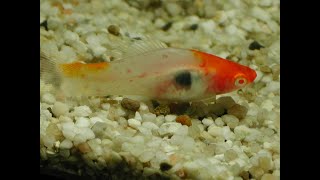
Gerald Bassleer examines a swordtail dying from wasting and scale holes caused by amoeba, with tubercles throughout its organs. The diagnosis is fish tuberculosis from Mycobacterium, likely from the breeder. Heavily infected fish should be euthanized; less-affected ones may survive with excellent care and specific diets.
Chapters
Hello, dear Aquarist. You selected this video because you might like life bearers. Because it's today about a swordtail, exifo a nice color variety, the XIVO koi tricolor, which was breaking down, wasting away and dying. And. And then of course they call me the fish doctor. Please Gerald, try to find out what is going on. So I made examinations and I show you in this video my findings what the koi could have been coming down with. So the xipho swordtail koi was wasting away with tubercles. Tubercles in the organs. Most likely fish tibi or mycobacterium or fish tuberculosis. You want to learn more about fish diseases, about diseases of life bearers or about mycobacterium fish tuberculosis. Well, I have a lot of details about that in my books. Also how to prevent and how to make correct treatments. Here we see that sword tail that is wasting away. It is not behaving normally anymore and it will die in the coming hours or maybe minutes. Some other ones here is another one in the back. And some look well, pretty healthy. But this might be not the case in the coming weeks or months. Here we see it again. See that swordtail getting skinny, wasting away, probably not eating anymore. And other ones look on this moment healthy, but they might be carrying the disease at the same time. When we check the scales, we found some holes in the scales. You can see them here. You can see them here. All the holes. That's not normal. This is a problem that I described already several times and also in my books. And it's little holes caused by an amoeba. An amoeba is a kind of, how can I say, maybe look like bacteria that is causing those holes and holes. And the fish can lose scales by this and can be damaged. So something that is caused by the breeder. Here we see it at the higher magnification. The holes here on the left and here on the right we see scales that are deformed or damaged. And that is usually something that appears when the fish come down with mycobacterium fish tuberculosis, the scale starts to get. Having big gaps, losing their normal constitution. Here we see the gills which. Which is showing not normal tissue. Here we see the same thing. We see some stressed blowing up parts of the gills and some pale tips. That means functioning may be caused through internal problems. Maybe the kidney is causing this kind of deterioration of the gills. Look at this. These gills will not have a. Not have a good chance of a good gas exchange internally. We found some tubercles here and Here next to the spleen. This is the spleen with a lot of MMCs. Here we find many small tubercles in the kidney of the sore tail. Also the liver and the mesenteria had a lot of large tubercles. You can see them all here. So. So that liver is practically not functioning anymore. And here, more in the mesenteria. Here more next to the intestine, you can see all those tubercles. And here. And also here, the right. So treatment for the swordtail. Well, it looks like the bacterial infection Mycobacterium or fish tuberculosis. Usually it's caused at the breeder. Also the holes in these scales is something which we found on this fish. The very badly infected fish cannot be cured. You can maybe try to treat the holes of the scales with some fmc. But anyway, when they are so badly affected with those tubercles that are destroying the organs, you can expect that the fish will come down with many different kind of diseases or parasites or other bacteria. So the very badly infected ones, we recommend to put them gently asleep, euthanize them. The less infected fish, they can live for a long time on the condition that you give them good conditions, good food, no stress, good water quality. So like I said, the loss of the scales is usually due to amoeba that is causing the holes in the scales that you can treat with fmc, the general health of the fish, you can help with a functional fish food. And in this case we would recommend the professional treat of our Dr. Basler biofish food or the Fuko. So this is information on a disease on a sword tail. Many details on fish diseases and treatments are available in my books. The link is below. And at Patreon Channel I give a special training for those that want to become more professional. More information on private videos is available there. So thank you for watching this video on a sword tail that was coming down with most likely fist tuberculosis. Thank you for watching.