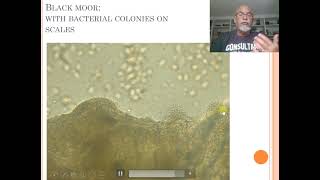
Gerald Bassleer examines a Black Moor goldfish with Columnaris, a fast-spreading bacterial infection. The treatment: lower tank temperature below 24°C, add 3-5 g/L sea salt, use antibacterial medications like neomycin or ofloxacin, and feed therapeutic diet for about 20 days.
Chapters
Hello. Today we are at case 31. Today it's about the goldfish, the telescope. Blackmoor. Blackmoor goldfish, a very common fish in our industry with a columnaris infection. And columnaris is specific bacterial infection which I hopefully can explain you very well with my microscopic observation. The fish I received had a lesion like this. You can see the wound, the whitish necrotic tissue. The fins still look okay, not much damage, but it was the wound which was typical. And the fish farmer who informed me also had some losses in the tank. This fish was affected, not dying yet. So we examined the fish after taking some shots like here, the video. You can see here clearly the, the whitish necrotic tissue. The problem is this kind of tissue. Within a couple of hours or one day, it becomes very fast, a very large, whitish necrotic tissue. As I explained in my YouTube videos on columnaris disease, bacterial diseases. Here we see a close up shot of this wound. You know, a fish cannot live that long with that wound because it's a leaking barrier of the fish. Or the fish will lose its salts, its fluids will pass on through and the fish will die. And the bacterial will go all around inside the fish, in the gills, all over the place. So what you should do is take a screen scraping. And that screen scraping can help you determine what you can see, particularly with columnaris. And that's why specifically today I want to talk about columnaris, because in those microscopic observations, you can determine the bacteria due to its formation of colonies. These are these groups at the edges here of the scale of the fish. Here is a group of bacteria. And if you can see very clearly, you can see like tubifex colonies. Tubifex. And I show you in the video here. Here you see the video, you can see the bacteria moving and they're moving like tubifex. People know of tube effects here you see it also here. All colonies of columnaris bacteria. And columnaris bacteria are a very serious infection because it loves tropical water and it expands very fast and becomes a very serious infection within a couple of hours and days, affecting one fish, within the next day, 10 fish. So it goes very fast. So watch very careful for those colonies where you take a skin scraping and they can help you to determine it's a columnaris, because columnaries you can attack specifically with good treatment. So the first thing again I will recommend to improve water conditions. And in this case it's also lowering the temperature below 24 degrees Celsius, good cleaning of the filter, avoid overcrowding. So these are all things that can help the fish or the group of fish like we have a few hundred of those blackmores in one tank. Well you have to be careful. It goes very fast so avoid particularly the overcrowding and apply an antibacterial medication or antibiotic we recommend for such kind of infections. Neomycin androfloxacine, veromore. I forgot to mention on the writing. Also adding on salt, 3 to 4 to 5 grams of sea salt also helps to control of this bacterial columnaris infection. And we have also specific food that helps the fish to fight off these kind of bacterial infection. Is our Dr. Basler Bajus voit Foucault. And you should at least feed this food 20 days and no other food during that treatment time. So application of a good water quality, adding on salts, adding on antibiotics, feeding with food. This will help you to control this infection. Do it as soon as possible. The longer you wait, the heavier this disease can affect other fish in the aquarium.