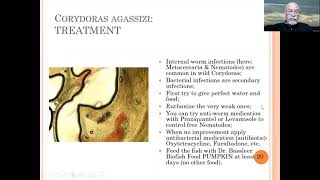
This YouTube case report (Fish disease case nr. 32) by Gerald Bassleer documents parasitic and secondary bacterial disease found in wild Corydoras agassizi. Externally some fish appear darkened or tail-damaged and weak; internal examination revealed multiple encapsulated metacercaria (digenetic trematode larvae), free and encapsulated nematodes, heavy bacterial loads, and kidney calcium deposits with necrosis. Recommendations: improve water and feeding, euthanize very weak individuals, treat free nematodes with praziquantel or levamisole, consider antibacterial drugs (e.g., oxytetracycline, ferrotodone) if bacterial infection worsens, and use a phytobiotic feed (Dr. Basler biofish food with pumpkin seed extract) for ~20 days to support recovery.
Questions this video answers
Case number 32.
Gerald Bassleer; created/uploaded May 10, 2022.
Encapsulated metacercaria (digenetic trematodes) and nematodes (some free-moving, some encapsulated).
Calcium deposits in kidney tissue and pathological necrosis indicating impaired kidney function.
Anthelmintics: praziquantel or levamisole for free nematodes; antibiotics if bacterial infection worsens (oxytetracycline, ferrotodone); improve water/feeding; euthanize very weak fish; feed Dr. Basler biofish food (pumpkin seed extract) for ~20 days.
Chapters
Well, today we will have our next case of fish disease, which is number 32. It's about Corydora ageschizi, wild ones which had parasitic worm infections, which is quite often the case with, well, with wild corydoras. Here we see the fish in the aquarium. You can see that some are very dark, some still have a very good shape, but not all of them. There is a certain percentage which is damaged, showing this shaky behavior. And some of the species, like here you see the tail is already damaged. So look at this dark one here. It's not all of them, it's just a few here. This one in the back particularly, and they look weak. You have a percentage loss every day. A few die, only fewer few stay alive and well. Obvious. Nothing else we can see on the skin over externally except that tail rod and the darkling. But if we try to examine the fish and use a microscope, we found here, taken a sample of the gills, it was a little damaged, but not that majorly as a problem. We didn't see any major gill rot or no parasites. A little damage here, but nothing obviously as a disease or a pathological symptom. But internally important, when you have a wild Corydora, you must really check internally the organs, particularly the guts. You see all the encapsulated worms here, 1, 2, 3, 4, 5, 6, 7. And here that's all metacercaria encapsulated digenetic trematodes. It is a worm larvae which will develop in an adult worm larvae when the fish has been eaten by another fish or by a bird or by human, can become a big worm. And here we see also nematode here being nearly encapsulated. We see other parts of the intestine. Well, we see encapsulated metacercaria around, but we also found a few small nematodes still moving around and causing damage. Here we see another one which is free around, moving again. And there's another one here which is a large nematode which is encapsulated. So we found two different types of worms, maybe three. We didn't do a diagnostic. What is really the kind of worm we know which are nematodes and metacercaria, some free. And you also found that some bacteria around here, a heavy bacterial load. So we see a combination of problems. We also had a chance to check the kidney and we found a lot of calcium deposits here in the kidney tissue. That means that the kidney is not properly working anymore and causing of course, organ failure. We found a high load of bacteria and then pathological Necrosis in the kidney, that was another problem which was maybe secondary after the worm infection or combining together. But usually parasites and bacteria are coming together on fish diseases. Same for skin or gill flukes. Usually bacteria join the parasitic infection. So sometimes you have to treat both. What can you do as a treatment in this case here? Well, we can clearly identify that there are nematodes and worms, metacercaria playing a role. Bacterial infections can be regarded as secondary. Yes, because of the collecting, the transport, the stress, the weakening. Secondary bacterial effects are very often secondary after weakening of the immune system or parasitic infections. So the first thing you should try to do, like I explained here, try to give perfect water conditions and a good food supply. The very weak ones, you better euthanize them, put them asleep because you will not cure of any medication or any food. It's better to get them out of their suffering. And it's a small percentage which you could check daily and take them out. You can try an anti war medication like Prazikantho or Levamisole to control the free nematodes because the encapsulated worms you cannot treat because they are encapsulated and the medicine will not reach there. But the fish is encapsulating it. So he's protecting himself against the parasites. But still this can be organ lesion. So and secondary bacterial infections can come up. So that's why we recommend that you apply an antibacterial medication if the fish getting worse. So like oxytetracycline, ferrotodone and we have a fish food which is called Dr. Basler biofish food, Pumpkin seed extract to feed at least 20 days which helps the fish to recuperate, regenerate or defend themselves against internal worm infections. So it's a helpful tool as a phytobiotic treatment for the health of your wild corydoras. So this is a case of Corydora agassizi, but I'm sure many more wild corydoras are suffering from this kind of problem. So stay tuned. You will have more of these kind of problems certainly coming up when you're importing wild fish or dealing with wild fish. Thank you for your attention and see you for the next video.