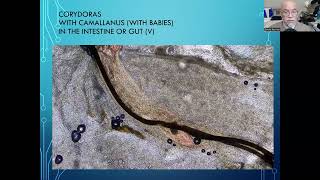
Gerald Bassleer dissects a wild Corydoras from Colombia infested with Camallanus nematodes and metacercaria larvae. He shows the parasites under microscope, explains why wild-caught fish carry these worms, and recommends repeat anthelmintic treatments with Praziquantel or Fenbendazole plus pumpkin-seed extract feed.
Hello, dear acurist, thank you for watching this video because as my work of Fish doctor gives me opportunities to collect material with the help of my microscope and a computer program, I can show you my PowerPoints that I prepare to teach you something about fish diseases. If you maybe already had a chance to have my books on fish diseases, this gives you an extra teaching tool by observing the videos I make on fish diseases so you become more professional and more experienced in dealing with fish problems. So I share you my PowerPoint because today I will talk about the Corydoras deckery with worm infections caused by the nematode Camelanus and Metacercaria. My books on fish diseases talk about these diseases, talks about what medications to use and what you can take as actions also to prevent these diseases to attack your fish. Below is the link where you can purchase them. And here we see the Corydorus decri, which are wild, they came from Colombia. And because they're wild fish, they have a chance to eat well larvae of worms and have a chance to become infected. You can see here like this skinny one changing color, the weaker ones at the end. And that's the one, she will die the coming days that waste away. And that's the ones you should take out to examine. It's what I did when I took out the intestine, the internal organs. After dissection I could see right away something moving here. Large red worm in the intestine of the gut. Here is the spleen. And here next is the liver. And here is the gut. And that is what we examine. Here is also more spleen. And then we found inside in the intestine a large red worm with babies worms already inside. And here is the video of our observation. And it's the parasite nematode Camelanus here, where already one is getting free of the baby worms. You can see how many hundreds of worms are there, which will spread into the aquarium and infect also other fish in the aquarium when they eat those worms. Because fish are always picking on everything what's moving around. And a little worm. Well, this looks like food, but becomes a parasite. And at the same time you see here some encapsulated worms in here also. So I show you the next picture. Here next to the intestine you see 1, 2, 3, 4, 5, 6. Already here, six encapsulated metacercaria, which are worm larvae from the digenetic trematode, which is another worm typical for wild Corydoras. No chance to treat if the fish is healthy and well taken care of good food, good water. He can survive it for a long time. Except when he is too badly infected. Particularly that roundworm. The big nematode Camelanus is something else. This is really troubling the fish. If you see this well, we can imagine that the fish will be bothered by something big like that. With all those babies. Here we can see one more tubercle. Sometimes you see tubercles next to it in the intestine here, other parts. But you see this big large nematode. Well, treatment. Don't forget. I keep on repeating that. See all my videos on corydoras, Particularly the wild ones that have very often worm infections. And the nematode Camelanus you can treat. But do not forget to retreat or repeat your treatment. To kill the offspring the babies. Because they can reaffect the fish in the aquarium. Drugs that are recommended. You can see it in my books. Prazicanthal, Fenbendazole, Levamizole, Piperazine. Try to get from your pharmacist. You can help with a functional fish food that helps the fish to fight off the infection. And we can recommend Dr. Basler buy fish food pumpkin. That is with an extract from seeds from pumpkins. That helps the control of those worm infections. My books on fish diseases explains about diagnosis and treatments in detail. You want to get more training, Go to my Patreon to become more specialized and more advanced in fish disease. Diagnosis and preventing of fish diseases. Particularly for pet shops. Also some training courses what you can do in keeping fish. So I hope this video helped you to understand wild corydoras and their risk of diseases. And this was a nice observation about Camalanus. I hope you liked it. And maybe you can subscribe here below. That you can. Here below. Subscribe. Thank you for watching.