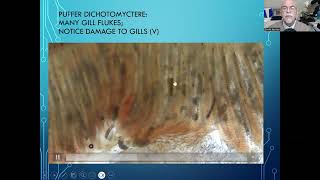
Gerald Bassleer examines a wild-caught puffer fish with severe gill flukes that damaged tissue and triggered secondary bacterial infection. The parasite eggs spread through substrate and filters, re-infecting tank mates. Overcrowding and skipped quarantine were the culprits; praziquantel and garlic-enriched food help, but microscope diagnosis catches it early.
Questions this video answers
Dichotomyctere
A tubercle most likely Mycobacterium (encapsulated) in the gut.
Praziquantel (referred to by the speaker as "Prasi Cantel").
Garlic-enriched fish food.
Chapters
Hello dear Aquarist, welcome again to one of my videos on a case of fish diseases that I came across during my work as a fish doctor. And I share them with you because I want you to learn to understand fish diseases, how to diagnose, how to treat and also some suggestions about prevention. I hope this helps you to understand how to work and deal with fish diseases so we can become a better acoust, a better fish keeper and have interesting and happy hobby of keeping fish. So I share you my PowerPoint of this case of a puffer fish, a Tetraodon, now called Dihotomyctere. What a new name it is. Had a serious infections of gill flukes. Something interesting to show in a video. Of course I also talk about Gulf flukes and other parasites and bacteria and worms in my books on fish diseases. I hope you have them or you cut them in your language. They are available. See my link below where you can order them. Go below. Here we see the puffer. They usually come from wild. This kind is a wild collected puffer. You can see that some are skinny. Let me show you again. And those which are skinny like here, they are chased away by the healthy ones, the bigger ones which have maybe less infection. And the weaker ones, well, they will have less chance to eat. They will be out competed for the food because they're weaker. And it will become less nourished and probably will die in the coming weeks. When we checked the gills, we found all those black things in the gills. Look, all those little strings, animals attached. And of course if you see the video, you might recognize it. If you have used a microscope before that. These are gill flukes, worms in the gills. And look how many. Well, this is here on the next video. Also to see. You can see the damage here. The bacterial infections that come here. Also bacterial infections starting to get into the gill and damage the gill tissue. Well, the gill tissue is damaged by the flukes which are attached with hooks and causing serious damage. Or bacteria can further on infiltrate and cause more damage. Here we can see also here these parts of the gills are gone. And here we see the flukes, massive flukes, already a baby. So there's a cycle going on in the tank that babies are coming out of the eggs produced by these worms. So understand the cycle of guilt flukes producing eggs. Eggs go in the bottom of the tank, go into the filter and later on the worms come out again and reinfect the fish. It has been going on at the same time. We found a tubercle, most likely Mycobacterium encapsulated in the gut. So another problem that has an impact on the health of the fish. So logically, the treatment for the puffer or tetradon. Of course they come from the wild. They can suffer from worm infections. In this case, a severe gill fluke infection can be caused the severeness due to overcrowding, bad handling stress, but certainly a lack of carentine procedure. These fish need a good caratining and you can get that in training at my Petron classes. You could prevent this disease because these fish need a proper treatment against guilt flukes. I have several medications of that explained in my books. And at the same time you can help with a functional fish food that helps to fight off this infection. And it is by fish food garlic that helps the guilt tissue. Particularly with guilt flukes. And treatments. Well, there are many different treatments available in my books. One of them that used to be working is Prasi Cantel. But sometimes it does work and then you have to look at other kinds of medications. Look in my books. I have several suggestions for that. Here are my books and the link is below where you can order them. At my Patreon classes I also explain about diagnosing fish, carening fish, treating fish, preventing diseases. All you can get to learn about caring about your aquarium fish. So I hope this teached you an interesting disease. On severe infection of gill flukes, use a microscope. Because the fish could not tell you what they are suffering from. You could not see it with the naked eye. That's why the microscope is my tool. Should be yours. When you want to be a professional in the industry, in the pet shop or even in the hobby, try it. It's not difficult. Thank you for watching and subscribe to learn.