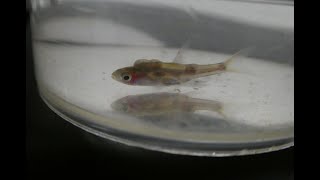
Gerald Bassleer examines wild-caught Boraras infected with metacercaria, parasitic larvae that form white cysts under the skin. The parasite needs birds and snails to complete its life cycle, so it won't spread in aquariums without them. No medication can penetrate the cysts, so prevention through good husbandry and excluding snails and birds is the only option.
Chapters
Hello, dear acurist, dear fish keeper, today you're watching a video on one of my cases of fish diseases. Already case 334. Yes, I have many because I have a chance to examine many different fish during my work as a fish doctor. And I came across this case which is an interesting problem that appears on wild fish. And this is a tiny fish, very popular for the nano aquaria, but has big growths on the body. So I will show you the fish in the aquarium and I show you my findings because it might interest you when you deal with the fish called boras. The boras are wild collected South Asian tiny Rasbora type fish, Cyprinidae borasmera with yellow grip or parasitic worm larvae infection. Yellow grip is the common name used quite often in the hobby and in the industry and well, it's typical and it's caused by a worm. So I will show you my videos. First of all I want to tell you, try to get my books on fish diseases available in many different languages and available in a link below where you can order them. It can help you to understand why fish getting sick, what you can do to prevent and what medications you can use and how to use correctly. And here we see a group of Bararas mera. And then there is one here, look. One in the mid, in the middle. This has those white growths, those yellow grip on the body. I will show again the video. Not all of them have it. Some show it very clearly here and some hardly show it. But they might have it also inside their body or only one on the side. But it means there is a potential risk that quite some percentage of this lot of fish have this infection. Okay, let's go ahead and show the fish in detail. And here we see the big growths on that porara. Look at it. 1, 2, 3 dick balls growing on the body here from the side. 1, 2, 3. Some grove, some something is bothering the fish inside. So we cut it open and came out on each big ball. Here is one still inside. But these two, I well opened it and two little worms came out. Two little worm larvae. Here they are, before I put them on the microscope, two white larvae, quite big for such a small fish. And here is a video at a 40 magnification. You see here the sucker of that metacercaria, that's the worm larvae metacercaria. It's moving. It's alive. Now today it's still alive and it's part of a cycle because metacercaria on the fish coming from on the fish, because the fish is an intermediate host. And here you see the picture of the fish, well, or the drawing of the fish with those little white or large white spots, yellow grip. These groves fish is eaten by a bird, like a heron, for example. The heron has the worm inside, becomes a big worm and the big worm inside. It's a traumatode in this case. The trematode in this picture is explaining Clinostomum. And that might be also the case with the Bora, that it was Clinostomon. But I don't do systematic research and to identify exactly what species it is. I know it's metacercaria, I know it's a trematode. So I know what medications I can use. I don't go systematically in detail, I don't have the time. And well, some experts sometimes do the work. Please do that systematic research. It can help us. But if you work practical on diseases of fish, you want to have solutions to make your fish healthy. You better try to identify with a microscope before you're waiting to get results from a laboratory that can take a long time. So the worms are inside the heron or the bird. It releases larvae which penetrate the snail. The snail again also releases then larvae again that penetrate the body of the fish. And that's the cycle. So they need a fishing bird, they need a snail. So in the wild there are birds and there are snails. So if you're a fish farmer, make sure you don't have snails in your pond, make sure you don't have a heron or another bird coming around to catch fish, and then make a risk of putting larvae in connection with the snails. So the barara, which is here, is a wild caught fish, which is typical to have this kind of infection. It's a risk that wild fish come down with larvae of Metacercaria. That does not mean they will die from it. Many will survive because it has maybe a little impact. This one was very serious and was having more problems to eat properly and will weaken. And that's why this weakened fish will be easier pick picked up by a fishing bird, for example, or a fishing predator. In the fish also can be an intermediate host, but in Clinostoman it's usually the bird. So larvae of Metacercaria are those big roves. The problem is no medication can penetrate to kill that encapsulated worm, because it is a capsule. Luckily, there's no spreading of the disease in the aquarium. So if the fish would have been eaten by another fish, maybe that fish can develop a larger worm, the trematod Clinostomum in this case. But it needs intermediate host to spread to snails, horses with larvae. And that is not possible in the aquarium except when you have a lot of worms. Very rarely predators who eat all the fish and a lot of snails, which is a risk of spreading. But it's very rarely this going to happen in your aquarium. Those fish can survive well if they do well and eat well. Well see it as a part of nature as a natural phenomena. Like my background is a natural phenomena. Accept this natural phenomena and try to keep the fish alive. And it's. Well, it's not beautiful, but it's a normality. A normality from nature. Improve the conditions for the fish to keep them better alive. Some will show nothing or very little. And try to help with a functional fish food to keep the immunity level up. Like with Dr. Basler by Fish food forte. So this is about a wild disease that can occur when you have wild caught fish. But the risk of diseases for humans are furries from all or nothing here. I just don't eat that fish. Of course we don't eat tropical fish unless some people might do. I don't know. But anyway, this is nature telling us lessons what can happen. And unfortunately no treatment can be suggested for this problem. More diseases you can see with treatments and suggestions what you can do. Follow me. Thank you for watching.