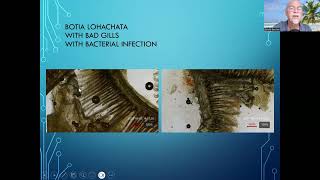
Gerald Bassleer examines a severely emaciated wild-caught Botia lohachata with thousands of bacterial colonies visible on its skin and gills, plus signs of serious internal infection. He recommends antibacterial treatment under veterinary guidance, checking water quality and feeding history, and using supportive foods like Lapacho and moringa.
Chapters
Hello, dear aquarist, dear fish keeper or dear hobbyist. This video will show a boccia loa hata, a fish that usually comes from the wild. And this one was becoming very skinny, emaciated, wasting away and dying. So I have to use or I had to use a microscope to find out what was going on because with my naked eyes, even I have glasses didn't help me to identify exactly what was going on with this loach. And that's why I was called in also as a fish doctor, to use my expertise to find out, well, please help us out what you can do about this problem and what kind of actions we can take to treat it. So it is a clown as a loach, a loajataloach botzia with a bacterial infection and a few gill flukes. A few gill flugs. My books on face diseases help you how to prevent, how to diagnose and how to treat what kind of medications you can use and how to use. And these books are available in different languages. See the link below in the details where you can order them directly. Here is the Luaxata, which is very skinny. This fish is wasting away and dying. Look, terrible condition. Too late to treat you way too long. It's too late to treat. But this fish, use it when you have a microscope to teach your lessons. We took a scraping from the skin and we found all those tiny black spots and here the clumps of colonies of bacteria on the skin of this fish. And here is the video where you can see all these tiny black spots here moving, moving, moving, hard to see. I show it again for those who are interested. Tiny black spots, massive thousands and thousands, particularly around the colonies that is causing a bacterial infection here on the fin, on the skin of the fish. But also the gills. You can see part of the gills are badly damaged. He also parts very badly damaged gills here, this whole part of these gills. And a few gill flukes. Here is one. We found only very, very few. Is it an infection? An infection is quite a few more. But still there is a risk that these flukes can lay eggs and eggs then create larvae that reinfect the fish in the aquarium and becomes a risk of real infection of gill flukes. So you have to watch out for it. But the main problem here is the bacterial infection because also internally in the organs. We found this spleen in very bad condition. This is not a normal, not a healthy looking spleen. This is not a healthy liver. Look at all the reddish spots inside this liver. In my training courses, I patron, I explain the difference between healthy and unhealthy organs. So if you want to learn more, go to my Patreon classes. And inside in the fluid you found inside in the body, abdominal fluid without massive amount of bacteria, massive amount and most logically also pathogenic bacteria. So does boccia the treatment? Well, check the water conditions, check the food conditions, check the history of the fish. Maybe it was due to stress packing, bad shipping competition for food. Because this loach, Boccia loajata, needs to have proper food, usually at the bottom of the aquarium. So if no food comes down to the bottom, all the fish are eating all the food. Before it sinks to the bottom, well, this fish will suffer. So think about food competition or history of bad water or stress. Apply an antibacterial treatment. Usually an antibiotic will have the best result. Consult your vet, your fish doctor or your aquarium shop. At the same time, you can help the fish with a functional fish food that helps to battle disinfection and to improve the immunity. This food Dr. Basler buys his food Lapacho moringa. Sorry, Lapacho is commonly used also, but moringa in this case I recommend sometimes we supply it as a Korean soup combined with grapefruit seed extract. Outside of Europe is still available. Inside Europe it's not allowed anymore because of pharma restrictions. So the moringa helps the fish to do better. With this kind of bacterial infection, it's not a medication, it's just a tool. A food is a tool to help the fish to become better and healthier and fight off the effects in combination with a treatment. My books on fish diseases available on this link kasslerpunt. Com different languages, order them so you can learn more. Or go to my Patreon link where you can get advanced training on preventing fish diseases, keratining fish, etc. Many opportunities for you to learn more. So stay tuned to my videos, subscribe to be updated and inform the new videos I present on other fish, other cases that might interest you, depending on the fish you like. Thank you for watching.