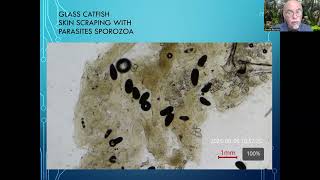
Gerald Bassleer presents a case of a wild glass catfish (Kryptopterus) showing tiny dusty, velvet-like spots that are often misdiagnosed as oodinium/velvet. Using skin scraping and microscopy he identifies large, non-motile organisms consistent with sporozoa—likely a myxosporidian—and explains that no reliably effective treatment is known; he advises supportive care, isolation if uncertain, and improving nutrition (recommends his Dr. Basler bifish food with aloe vera).
Chapters
Hello. Dear acurists, this video will show you a glass catfish with tiny dusty pepper look like spots on the body and easily misdiagnosed as velvet disease or oodinium. And that's why we have to use a microscope or let somebody use a microscope to help you to make a correct diagnosis. Because the treatment depends on the parasite or the disease or the bacteria that you find. If it's a bacterial infection or a parasitic infection, what kind of parasite that determines what treatment you can apply. In this case, it's a specific case on this wild class catfish. So I will show you the videos of the fish in the aquarium. The class catfish, cryptotheris, with a sporozoa infection that looks like velvet disease. My books on fish diseases talk about velvet disease, available in different languages. The link is below where you can order them or get more details on my website and you can learn about prevention, good diagnosis and specifically about what kind of medications to use and how to use. Here is the glass catfish. You can see the tiny dusty spots on the fins, on the body and looks like velvet disease. So many people will go ahead and try to treat with oodinium treatment or copper sulfate treatments. Yes, it's of course appropriate to react as soon as possible and to try to treat. But if it's like in this fish, remains skinny, becomes weaker, will eventually die. Even if you did the treatment and you did the treatment properly and it still is on there, well, you might suspect that it's something else than velvet disease or oodinium. And that's why you have to use a microscope and then you take a skin scraping and then you see these kind of large black organisms which are not velvet disease. Don't look at oodinium. Check my videos on oodinium, then you will see and compare that oodinium looks quite different than these black organisms, not moving, not attached, like oodinium. That is sitting with rhizopods inside the tissue. And these are just sitting in between the skin tissue and they are connected with this kind of membranes or what is it to connect between the skin tissue. You can see it also here. That's how they are connected, connected with the skin tissue. It's called sporozoa. And there are many different kinds of sporozoa. Inside are many spores. You can see that's how they attach themselves. And that of course the fish is a host. That's where the parasite can survive on. And here, this sporozoa is most likely a myxosporidia. For those that want to know Maybe what kind of variety or species it is. Unfortunately, there is no treatment that we know that can battle this kind of infection. Some people tried some medications. I mentioned that in my books. I never have experienced good results with the treatment. And I. Well, I mentioned some medications that some people said they had some minimal result with. I don't know. I think the fish can survive when you keep them very well, in good condition, good food, good water, they can survive well, particularly the ones which are little infected, has carrying little infection from the wild and have more luck and more chance to do better. Well, it's typical for wild card fish like this Cryptopteris. So try to keep the fish in good condition and enjoy this kind of natural event. Is it a natural beauty? It's how you look at it. But something natural. And usually it does not spread in the aquarium to other fish. Usually. But you never know. It can. If you're not sure you have a quality, high quality aquarium and you don't want to take a risk. Well, it's better to separate the fish and keep it in a separate tank. Enjoy it in a separate small aquarium and see how it improves health maybe and do better. And you can help with a functional fish food to improve the immunity of the fish. And here I would recommend Dr. Basler bifish food aloe vera because that helps in the repair of tissues and skin. My books help you to understand fish diseases and how to treat. And my Patreon channel offers you courses training for those who want to learn more. So I hope this small video on a glass catfish with tiny velvet look like infection is caused by sporozoa. Subscribe to learn more. And I have so many different cases, maybe of fish you prefer, like a guppy or a discus or an angelfish. I have videos on also those fish. So look it up and subscribe. Thank you for watching.