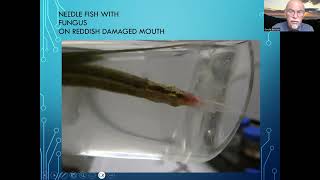
Gerald Bassleer examines a wild needlefish with mouth damage infected by fungus, the ciliated protozoan Hylodonella, and internal worms. He shows microscopic findings and recommends salt plus FMC for the fungus and parasite, antibacterial care for the wound, and anti-worm drugs like fenbendazole.
Questions this video answers
October 26, 2025
Hylodonella (ciliated protozoan) and trematode worms (internal intestinal flukes).
Salt and FMC (FMC to kill fungus and Hylodonella).
Fenbendazole or niclosamide.
Chapters
Hello. Dear Aquarists, this video shows a mix of infections on a needle fish Microphys, which is not a very common fish. But for me as a fish doctor, interesting to see something different than a Neon Tetra or a guppy or a goldfish. And this fish had a particular feature that was very clear to see with the naked eye. But the microscope told us some other lessons. What is causing this problem on this needle fish. So that's why I have to use a microscope and I show you my findings so you can learn from it. When you see a diseased fish in that it is recommended that a fish doctor takes care of a good examination. Because this needlefish called Necrophis, which is a wild fish wild collected, had a fungal infection and bacterial infection and parasites Hyladonella and Trematode worms internally. Wow. It's a whole mix of problems. My books on fish diseases help you to understand the prevention, the diagnosis and. And what medications to use and in what way and how to use medications. Try to get them. They are available in different languages. The link is below. Here we see the fungus, which is not Everybody knows this cotton growth on the mouth, the damaged mouth of this Mycrophis. Here we have a picture of it. You see the large amount of fungus on the mouth, the damaged mouth of this microphysis. Here we can see some reddish part that because there was a lesion. And I think this was due to transport the needlefish transported from the wild through the exporter, through the importer. Easy to damage the needle nose in the transport bag. And then fungus Saprolegnia or else can appear. And that is what we found the fungus infection. We took a scraping or a part of that fungus look like. At the same time we also found parasites Halodonella. All those tiny little bugs eating on debris on necrotic tissue also seems to be eating on the fungus. I have several nice videos about it. Because Hylodonella can become a nasty parasite in this quantity. The problem is with Hylodonella is a ciliated protozoan parasite. It divides in two and becomes quickly a large population of parasites that trouble the fish. And here we see the massive amount on the necrotic tissue of the fish. And of course this is having an impact on the health of the fish. Not only the fungus, but also the Chylodonella. The gills had a lot of pigment, something also typical that I observed in this examination. And black pigment should not be in all that gill tissue. And it's usually due to the history of stress. Maybe the natural water was polluted maybe with insecticides or the collecting method was not properly well done or medications might have an impact that pigments come into the gills usually after history of stress of chemicals. Also the internal organs, the liver and the spleen were in poor and bad condition Bacterial infection and in the gut or in the intestine we found trematodes here like this one here, alive and moving. So the needlefish coming from the wild had a secondary fungal infection after damage. So at the same time there was Hylodoneva parasites. So I would here treat with salt and FMC that kills both the fungus and kills the parasite Hyaluronnella at the same time. You might think about an antibacterial medication because there is a damaged tissue. Ask your fish doctor, your veterinarian or your aquarium shop. Later on you might think about using an anti worm treatment such as fenbendazole or niclosamide. See my books or ask your veteran or fish doctor. Make sure you improve the water conditions and avoid overcrowding. All things you can think about when you take care of your fish. Specifically good conditions makes the fish restore quicker and makes the medications work better. My books on fish diseases all explain that available in different languages. Order them in the link below. You want to get more training, more advanced information about quarantine, importing fish and what you should do preventing fish diseases. Many different courses are presented in my Patreon classes, so I hope this video helped you to understand this fungus growth on a fish. But that fungus comes from somewhere secondary after damage, bacterial infection and at the same time maybe parasites. So I hope this teached you a lesson. Subscribe To Learn More. Stay Tuned thank you for watching.