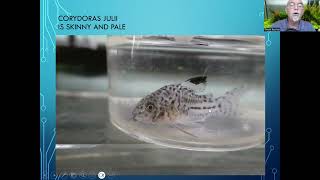
Gerald Bassleer examines a Corydoras julii with bacterial gill rot. The fish shows isolation, pale color, and emaciation. Necropsy reveals degraded gill lamellae and rod-shaped bacteria in internal fluids. Treatment requires antibiotics from a veterinarian plus better water quality and nutrition.
Chapters
Hello, dear aquarist, dear fish keeper, dear catfish lover. Yes, you might have seen already that it's today about Corydoras, Corydora catfish, very popular fish in the aquarium hobby. But the corydoras can have problems. And today I will show you a problem which is rather common when you keep corydora fish. So I show you my findings of the fish in the aquarium and with the help of my microscope, what I did find on this Corydoras julii, which had a bacterial infection, especially in the gills, affecting the health of the fish. My books on fish diseases also explain a lot of the diseases of catfish. I have in the new illustrated guide a specific chapter on catfish, also corydoras, which are the most common diseases. So if you don't have the book yet, try to get it. It's available the new Illustrator guide in Dutch, English and French. The other book, the practical Guide, is available in seven different languages. So check the link below in the description. Here we see corydoras in the aquarium. And if you look at this group of fish, you can see at the left here, this one here, it's at the edge, it's getting in a different swimming behavior. Here is a few again which are different, separating from the group, not joining the group, looking for food, because usually they are a little bit together searching for food. And like this one in the back is getting skinny. Here we see again that skinny one here, the weak pale one which is wasting away and is dying. And the next day or the evening it will be dead. And there are many different ones like that in the aquarium. And that's the ones we take out for examination. Skinny, pale color, sunken eyes sometimes and gills tells us the pathological observation of Gil Lamellae, which are gone, are gone here, gone there, here affected badly affected gills, Gillmonia fish will die. And in sight a bad spleen, not much left over. A liver with one tubercle. Where did that come from? Well, usually from a bacterial infection, some cases, many cases mycobacterium, but here only one. But it's a sign that something is going on with bacteria. And when we took some fluid from the internal organs, we could see many bacteria, many different type of. Also small rod shaped bacteria moving around in the aquarium water. Let me show you again the little spots, the black spots, the white spots, the little rods you can see all around in the fluid, which is causing and affecting the organs. So our observation told us there is a bacterial infection and that can be treated. But you have to do it as soon as possible before there is too much damage. When the fish are too badly damaged, it's too late. Try to get a good antibacterial medication. Most likely an antibiotic is needed. Ask your vet or fish doctor for advice. Try to find a reason why these fish became so sick. Poor handling, poor water quality, poor feeding, holistic thinking. Think about why before you start treating. You can help with a functional fish food to improve immunity and to repair the fish. And I can propose Dr. Basler biofish food, Fuko or forte or grapefruit seed extract, moringa. All helping with bacterial infections. Also professional treatment might help. Different things can help. My books certainly can help. Maybe the book you looking for are in your language. Check for the link below or go to my specific training to become an advanced acurist or a fish doctor where you can get training on quarantining fish, fish diagnosis, preventing fish diseases, etc. Etc. So I hope this video on these corydoras help you to understand a bacterial infection. Bacterial infections are common in our aquaria. Why? Because it's tropical warm water and that is helping the bacteria to grow faster. So try to understand fish diseases and think about a holistic approach. Why did the fish get sick? Maybe just a good water change might help or changing food quality. Thank you for watching and take care of the.