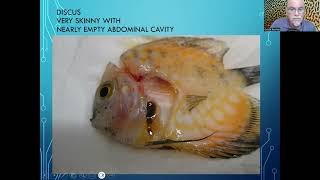
Gerald Bassleer examines a severely emaciated discus with gill rot and kidney failure. A gill fluke damaged the gills, allowing secondary bacterial infection. The fish's empty abdominal cavity and liver lesions suggest stress from poor water quality or overtreatment.
Questions this video answers
December 21, 2025
Chapters
Hello, dear aquarists. And I think you are somebody who likes discus fish. And maybe you have seen other videos that I already made about diseases of discus fish. If not, subscribe or look at my playlist of discus fish. I had already many different diseases found on discus fish. Many different kinds. And today it's about another case of a diseased discus fish that might help you to understand what problems can occur with our discus fish and can be treated. Lessons to be learned to become a more advanced acrist or a discus fish keeper. Watch my video and watch the PowerPoint that I present for you to give you more details about a skinny discus fish that had a severe bacterial infection with gill rot and a blocked kidney. My books on fish diseases talk about prevention, diagnosis and what treatments you can use. And the new illustrated guide talks about discus diseases in many details, many problems well explained with photographs on disease, the discus fish. And today a discus fish that becomes skinny, particularly this one here, becomes very skinny and is going to die in the coming days. He. He's not eating properly. I show you again the other ones. Some look still fine for today. But this one shows the most badly moment of his life the last few days. And when we checked that fish, we found that the gills were rotten. Kilmonia. Look how badly the gills are affected. Look the other part, other gills. All the lamellae are gone. More parts of the gills, more lamellae gone. So those fish had severe problems, particularly the one, the skinny one. That's why he was not eating, not feeling well. And we found one gill fluke. Yes, because they were treated against gill flukes. And one is still there. Maybe not anymore necessary to treat. Because the bacteria is the first thing you should try to treat. Because that is affecting the health of the discus fish. It's not eating and it's going to die. When we examine the internal body of the fish, the internal organs. When we open the fish, we found a very empty abdominal captivity cavity. Captivity cavity. Abdomen was very small. Oh, not. The organs were not well filled. Not much fluids wasting away, becoming skinny. Why the fish was not eating. And the organs here on the right, the spleen with a lot of melanoma centers MMCs also in the liver, bloody patches, very poor organs. And the kidneys, blocked tubes, a lot of deposits. So non functioning kidneys, bad gills, bad kidneys, bad organs. Well, this fish was in terrible condition. So blocked kidneys has a different origin. I will explain poor kidneys to discuss. What can I suggest for treatment? Some are looking good. You can save them when you Take actions on time. So before it's too late because the very skinny one might be too late to treat because he's not eating. And that's the important thing. They should try to eat at first. Try to find the reasons why this all happened. Stress, too many fish, poor water quality, poor food quality, too much frozen or live food contaminated with bacteria. Excessive treatments like these fish were treated against flukes. Maybe too many medications, too high dosages. Or only treating against the flukes and not against the bacteria that usually come on the lesions caused by the gill flukes. Gill flukes have hooks cause lesions in the gills and that's where penetrate bacteria. So you should be aware bacteria bacterial infection is usually associated with gill fluke infection. The blocked kidneys, that's another thing. Might have multiple reasons or one specific one. Depending what you can check what happened in the history of the fish. Chemicals which have been applied, certain treatments might cause this or an amount of calcium in the water or other minerals that are in the water and should not be there in excessive dosages. I think usually the history is the apply of certain chemicals or treatments that can have an impact on the kidneys. So try to get a good antibacterial medication. Most likely an antibiotic is needed. Ask your vet or fish doctor for advice. Maybe they can send it to the laboratory and find out when bacteria is having an impact on your discus fish. And try to help with the fish food and the repair and immunity of the fish. Dr. Basler Bay fishwood, Fuko or forte or grapefruit seed extract moringa are all helpful for your fish. Try to get my books many details on discus fish in the large big book big chapters on discus fish and other cichlids. Try to get my training. Try to see what you can learn on what I present on my Patreon on prevention of fish diseases, diagnosing fish diseases, how to put fish in quarantine. All things that can help you. So I hope this video made you understand what can happen with a discus fish. Here with a bacterial infection and a bad kidney, two different things maybe together cause the same problem. The origin you have to check the history of your fish but take actions as soon as you can. So I hope I help you and try to subscribe. Try to check my other videos in the playlist of the discus or the cichlid list that might interest you. Thank you for watching.