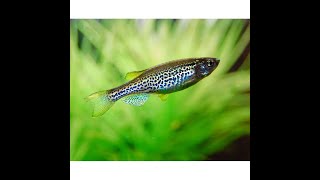
Gerald Bassleer examines a dead leopard danio with three simultaneous infections: Oodinium parasites in the gills, capillaria nematodes in the gut, and bacterial rods. He recommends copper sulfate treatment, salt, and antibiotics, but warns against combining anthelmintics with other drugs.
Chapters
Hello, dear aquarist, a video about a deceased danio leopard. The leopard Danio or Brachydanio franchise. Well, this fish had several infections and interesting to show with my microscopic observations. And at the end I will explain how what you can do as a treatment. So the Leopardanio, the franke had Oodinium or velvet disease. Worm infections caused by nematodes and a bacterial infection. Read my books on fish diseases, on prevention, on diagnosis, how to recognize fish disease. Because of the many photographs I made and published in the books, and also the many recommendations of practical treatments and medications. Here I show you the brachidaneous. They became weaker, irregular swimming. And you will see here in the middle there will be one scratching. Look, the scratching behavior in the middle here of this aquarium, which is typical for certain parasitic infections. And that's something you have to learn to observe when you have an amount of fish, while some are getting darker, irregular swimming. But when they start scratching, they are irritated. And that teaches you a lesson that you have to open your eyes and look for potential diseases. Maybe some you can see with the naked eye. Unfortunately, Oodinium, it's difficult to see with the naked eye. And here in this case, we only found very few Oodinium parasites on the scales. Here is one, only one on the scale of Odinian velvet disease. But in the gills we found many. Look at how many are here infaded in the gills. And they have an impact on the health of the gills. They cause damage, you can see here already some lesions in the gills and some other gills are badly destroyed. Having a bacterial infection that usually appears after the damage caused by the parasites. At the same time, we found a bad spleen in one of the leopard danios. In another leopard danio, we found another very bad spleen. Might be possible, a viral infection. But I wasn't sure, because only a laboratory can determine that for me. And we are not able to send it to a laboratory in many cases. But still we found a lot of bacteria. Look at the bacteria, there are many rods, the many little pointed movements. Well, at least we know we can control bacteria and a viral infection. The fish must control by giving it good immunity, by giving it good health program, with controlling the bacterial infection, the parasitic infection. And then the fish might be able to control also the viral infection. There is hardly any potential medication for fish to control the viral infections. And internally, in the intestine, in the gut, gut, we found worms, the capillaria worms, many different ones. And of course also having an impact on the health of the fish. During My examination, we found the gonads of this female leopard, Daniel and you see the sperm moving here. I just want to show you that because these are not parasites as something you might learn to detect when you examine male fish, that you look at the sperm that it's not regarded as a potential parasite. Some people misdiagnose that. Well, the leopardanio, the treatment well, the Odinium and the bacterial infection, they should be treated as soon as possible. Your aquarium shop certainly has good medications to control that and they are usually based on copper sulfate ingredients. Also salt might help. I give recommendations and details on the Odinian treatment in my books. Also, bacterial treatments will be necessary, particularly the internal bacterial infection. Asking your shop or your fish doctor or your veterinarian for the potential drugs they have available after the oodinium and the bacterial treatment try to treat the nematode, the capillaria infection, I would suspect or expect that if you combine the capillaria treatment or the worm treatment together with the copper sulfate and antibiotics, it it might be too much for the fish. See my books. I give a lot of details on that. And at the same time you can help with a functional fish food like our Dr. Basler, Bai fish food, Matrine and Fuko and also maybe forte to improve the immune system. My books try to get them available in different languages and the link is below or specific training you need go to my fish doctrine classes at my Patreon. So I hope this video help you to understand the mix of diseases that can appear and also the different approaches of treatment you have to apply. Thank you for watching. See you next time.