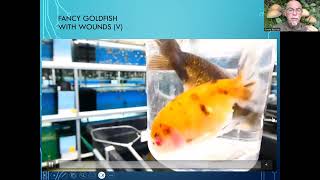
In this solo educational video, Gerald Bassleer presents a detailed case study of a fancy goldfish suffering from severe bacterial infection (likely Mycobacterium spp., causing fish tuberculosis) and a heavy infestation of gill flukes. He begins by situating the case within his larger series of 354 fish disease cases and emphasizes the risk of disease propagation in breeding facilities. The visual examination shows two fish with external wounds: a red dorsal wound and a swollen, inflamed eye. Microscopic scrapings reveal tubercles embedded in skin, scales, and gill tissue, as well as large gill flukes that facilitate bacterial entry. Internally, the liver, kidney, and spleen are riddled with tubercles, indicating advanced systemic infection. Bassleer explains that antibiotics are largely ineffective against encapsulated mycobacteria, recommends euthanasia for severely affected individuals, and suggests anti‑fluke treatment with repeat dosing to address egg shedding. He also promotes functional nutrition (specifically Dr. Basler by Fishfood Fuko) to support immunity, and advertises his illustrated guide on goldfish diseases, his books, and a Patreon channel for further training. The video concludes with a call to action for viewers to subscribe, like, and continue learning about fish disease prevention and management.
Chapters
Hello, dear aquarist, again, you're watching my case on fish diseases. Maybe it's the first you're watching. Well, I made already 354 cases on fish diseases. And maybe you can check to find the species of fish that I examined. I listed them in different playlists, like tetras or cichlids or gouramis or barbs, you could call it. And today it's about the goldfish. And maybe you like goldfish or you sell goldfish. Goldfish are very popular, but also popular in breeding most. Well, all the goldfish are pond raised, A few are tank raised. But that is also a risk of creating or breeding diseases. And that is something I emphasize in several of my studies and several of my cases, that we have a problem in breeding facilities that breed fish with diseases. And today I show again a fancy goldfish that is suffering from a bacterial infection causing massive tubercles, most likely mycobacterium or fish tuberculosis. And the fish also had flukes. My books on fish diseases also talk about goldfish, also about all different fish and all also available in different languages. And the new illustrated guide specifically talks in detail about goldfish diseases. Also koi carp, fancy goldfish, about the diseases that are common in this variety of fish and how to diagnose with a lot of photographs and what kind of medications you can apply. The link is below, or you can order them here. I show you the damaged goldfish. The black one has a big red wound and a bump on the dorsal. And the calico has a bad eye, inflamed, reddish eye popping out, damaged. So two different signs or wounds caused by something that I can only identify when I use a microscope with my naked eye. We would say, well, it's a wound. I give an antibiotic, yes, might help. But in this case the problem was more serious than just an external wound. We took a scraping from the fish and we found already tubercles in some of the tissues. We scraped off some skin tissue was invaded with tubercles. And here also one scale with a tubercle inside. The gills were in bad shape. A lot of extra mucus, some deformed gills. Some gills had gill flukes, the big gill flukes here causing damage, causing a risk of infiltration of bacterial, infectious, molecular, more other kind of bacterial infections. Internally we found tubercles in the organs, in the liver on the left, on the right here in the kidney, all tubercles causing serious damage. Here in detail, the liver, not much healthy tissue is left over. It's invaded with tubercles. Large tubercles, small tubercles. This is something I've rarely seen so big amount or I mean such expanded large tubercles and also in the spleen that is causing the weakening of the fish pronable to more other kind of infections. Because the organs are invaded with bacteria and capsules are made. The trouburgas are made by the organs to defend against the invasion of those bacteria. So the badly damaged fish that are suffering badly, you should put them gently asleep or euthanize. Some fish might be less infected and with proper good care can have a good longer healthy life. Well or semi healthy. They might still have some tuberculosis, but again survive it as long as you take good care of the fish. Usually an antibiotic has no impact on the fish infected with mycobacterium. Because the bacteria is encapsulated and no medication can go through the tubercle. The anti fluke treatment will be necessary to kill the gill flukes. Watch out when you treat gill flukes because they lay eggs and they can come out after seven or 10 days. So you have to retreat, follow the directions of the medicages you obtain. A functional fish food can help to improve the immunity and repair of the fish. In this case I would recommend Dr. Basler by Fishfood Fuko. My books help you to understand fish diseases, pre prevention, diagnosis and what medications to use. The link is below. If you want to get more training specific on carotening fish or good diagnosing, go to my Patreon channel. Here is the link and I hope this video help you to understand what kind of disease a goldfish can suffer from. Just havocs on wounds. Well, we are recommended like most of the books tell you to use an antibiotic. But in this case the antibiotic will only save some of the fish but not handle the problem with the tuberculosis and that is created by the breeder. The breeder is breeding this problem inside the fish. I have several videos on that. Look at my specific video on fish tuberculosis, where it comes from, what you can do about it. And I'm happy you watched until the end. That means you want to learn more and that you learned maybe a little bit more today. If not, try to subscribe. Try to like this video. I appreciate watching and following me on my content on fish diseases. Take care of your fish. Bye bye.