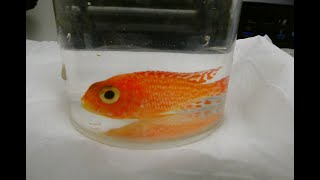
In this video Gerald Bassleer presents case 359, an Aulonocara (Malawi cichlid) suffering from severe emaciation and organ lesions. He shows macroscopic findings: damaged gill lamellae, a spleen riddled with tubercles, tubercles on the mesentery and gut, and internal flagellated parasites identified as Cryptobia jubilans. Bassleer explains that these tubercles differ from classic Mycobacterium (fish tuberculosis) lesions and are likely caused by the Cryptobia infection. He advises sending organ samples to a laboratory to confirm the presence or absence of Mycobacterium. Treatment recommendations include antibacterial medication for secondary gill bacterial infection and antiparasitic therapy—specifically metronidazole at a dose about 25 % higher than used for Spirulina or Hexamita—to target Cryptobia. He also suggests supportive functional fish food (La Pacho) to boost immunity, quarantine practices, and further learning through his books and Patreon training. The video serves as a practical lesson on diagnosing, treating, and preventing internal parasitic infections in cichlids.
Chapters
Hello, dear aquarist! Welcome again to one of my cases of fish diseases. And today you selected one about a Malawi cichlid, an African cichlid, Aulonocara. Can be very beautiful, very colorful, but today unfortunately I have to show you a sick one. And it can become sick, of course. Fish is life, and a breeder can breed fish and also can breed or cultivate fish diseases. And I show you my PowerPoint where I can share you my findings. What diseases we found on this Aulonocara. In my case 359, we found tubercles in the organs. An internal parasite, Cryptobia jubilans. Interesting, interesting parasite to observe. So I hope my macroscopic findings teaches you lessons how to identify. Read my books on fish diseases, available in different languages, about the diagnosis of fish diseases. A lot of photographs telling you what you can see, how to prevent fish diseases, and also a lot of information about treatments. Here I show the Aulonocara orange who is becoming skinny, in bad shape, and will eventually die in the coming hours. You can see this more, more healthy one here in front, but this one, it's getting skinny. Emaciated and separating from the group and die. And that's the ones who telling you, well, something is going on in the aquarium, please check me out. Here we see it again, how skinny this fish look like. This is not a normal Aulonacara look anymore. And we found that the gills were damaged. See how bad the gills are here and here. Lamellae are gone, so bacteria playing a role. Badly damaged here also, intrusion of bacteria. Why? Well, maybe we have to check further why the gills are getting so badly damaged. The fish is getting weaker, vulnerable to diseases. Well, we found a very bad spleen with tubercles. Look at that! Very bad spleen. We found tubercles in the mesentery outside here, those few tubercles. We found tubercles in the gut, very specific tubercles. Doesn't look exactly like the typical tuberculosis tubercles. Well, maybe we found something that could be causing it, and that's those tiny little internal flagellated parasites Cryptobia. Those tiny Cryptobia look different than Spirulina or Hexamita. They behave different, they are also flagellates, turning around slowly on one side, circling more, not moving quickly like a Spirulina. And that might be a cause of the tubercle like this one here. It's known that Cryptobia jubilans probably is causing or can cause tubercles. So what can you do? Well, understand that tubercles might be caused by the Cryptobia, that it's not fish tuberculosis, but still you can send samples to the laboratory of the organs with tubercles, and that can help you to identify if it's Mycobacterium or not. The damage to the gills is usually secondary and should be treated with an antibacterial medication because it's killing the fish. But certainly the parasites need to be treated with an antiparasitic product like the ones you use against Spirulina or Hexamita. You might need maybe 25% higher doses. That's the experience we have with Cryptobia. It's not so easy to kill like Spirulina. So you might need to use a higher dosage. Ask your aquarium shop or your fish doctor what products they have. Usually it's metronidazole that is doing the best job. Ask your fish doctor or see the details in my books. And at the same time, you can use a functional fish food that helps to improve the immunity and the repair of the fish, like Dr. Bassleer buy fish food La Pacho. More details on fish diseases in my books. The link is below, or go to my Patreon training on fish doctoring, on prevention of diseases, diagnosing fish diseases, how to keep fish in quarantine, how to prevent diseases, understanding why fish getting sick. All training in videos I have available for you. So I hope that this video with an Allanacara sheklet with a Cryptobia parasitic internal infection teaches you a lesson. And I teach you many lessons. I had already more than 700 videos, so subscribe. More videos to come, more lessons to be learned. Thank you for watching.