Gerald Bassleer presents case #39, a wild-caught Baryancistrus (L-177) from the Rio Negro basin showing external fin/tail rot, rapid respiration, sunken (hollow) belly and internal bacterial infection. Microscopy and dissection revealed necrotic gill lamellae, heavy bacterial colonization of the liver, and an encapsulated intestinal nematode. Bassleer attributes disease to stressors from wild origin, collection/transport/acclimation, poor water quality and possible microbiome disruption (including prior antibiotic use). He recommends low-light/dark acclimation, soft slightly acidic water with wood/leaf litter, preventative and restorative use of probiotics/prebiotics (Dr. Basler biofish foods: 'green' with moringa/chlorella), herbal/supportive treatments, and cautious targeted antibiotic use when necessary followed by microbiome restoration.
Chapters
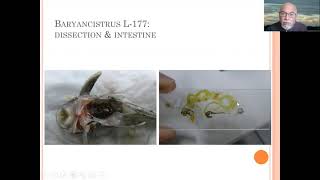
Dear fish keeper, today we will discuss a very interesting fish which is very popular in our aquarium industry, which is the Barry ancestors or the L177, a common fish in our hobby. Because of the beauty of this fish coming wild from the Amazon, from Brazil, so far hardly any barian sitters have been tank raised, so this one is still wild, collected in good quantities from different river systems in the Rio Negro basin from Brazil. And I will share my screen and show you my videos about this bary ancestors. Unfortunately, this fish is very proneable to get bacterial infections. It's because of the kind of fish, like I explained in my book the Illustrated Guide of Fish Diseases, that certain fish are pronable to get certain diseases. Some species are easy to get, like hexamethous pyronucleus infections like the cichlids. And some other fish are easy to get Pleistoph, Pleistophora infections, the neon disease, like ruminose or the neon tetras and like the bariances or ancestries in general are easy to get bacterial effects. And it's the way they have been kept, collected, shipped and acclimated in our industry. And I explain what we can do about it and how we can detect and how we can work to improve the quality of this, of this fish. And here we see this Baryensis was presented to me. You see the damaged tail, you see some tail rot, you see some fin rot. We didn't observe that much outside on the fish. No ulcers, no bleeding wounds. Maybe the eyes were a little bit sunken, but not yet really. I tried to explain you what I diagnosed on this fish. Even when we noticed them swimming in the fish tank. You see me here with a piece of wood. You see the excrements and the pieces of wood in the tank. We didn't see anything particular on this group of bary ancestors, but we had every day one or two dead fish, one week or two weeks after arrival. And that of course needed examination. And when we look at other bariances at the same tank, but at the corner we saw how stressed they looked. Look at respiration, how fast respiration is. You see the fish are a little bit clamping their fins. This one is open, this one, you can see the frayed finch fish tail and the dorsal fin. Here we see another one, you see the respiration, stress. I look at the sunken belly. You know, he has a very hollow sunken belly. So he's very skinny, so he's weak, he's prone to get diseases. And this might be the history of the fish in the wild not having enough food. Because the wild nature is not always abundant of food. There is always a survival of the fittest, surviving on the availability of food. The weather can be different, the water system can be different, can beat competition. And the fish have been handled of course after that is probable to get the disease. So we exact those fish and we saw the hollow belly because the fish was of course weak. When the fish is weak, we know when the human is weak, the fish is weak. You're easy to get an infection. It can come because your immune system makes it possible to defend yourself. But it's not working. The immune system, when it's lowered in your defense and not working well, you make your body open for infections, viruses, bacteria, parasites, fungi, etc. Not easy to see. There are a few red markings on the belly of the fish. And here is a red marking inside. Sometimes very difficult to see. Sometimes this is secondary. What we notice is was the behavior that stressed gill respiration and the hollow belly and the fin and tail rod. So we could see some signs of a problem. And when I took sample of the gills here before I put it on the microscope, you see the. The different in coloration. It's not smoothly nice red colored. It has some patches. You see there's some gills are look already damaged. On this just macroscopic observation of the gills. And we put them under the microscope. But we can see here the. The real damage in this gills rotten away. You see here already this part, the bottom of the gill here is completely gone. The lamellae are necrotic, eaten away by bacterial infection. And that bacterial infection can appear here on this part and on this part due to poor water conditions, the weakening of the fish. Maybe the transporting water with too high ammonia. Maybe that's the history of the fish. You can check with your supplier and when the fish arrive. So these are conditions that of course causing a serious damage on the fish. We did a dissection on this body ancestors. You see here the gut intestine, which is filled with green fluid, of course is eating. Likes to eat a lot of algae and debris in the. In the water system of the river system where he lives. He likes to chew on algae, but he also likes to eat on dead fish. Here we see the excrements, the black parts. You see the green parts here inside the fish. So we examined the intestine and we found next to the intestine an encapsulated nematode. Just only one. Why you find nematodes? Well, because the Fish lives in the wild, he gets everything he gets from nature. And it's not well disinfected food. It's everything he can get, like worm larvae. But here the worm larvae was already encapsulated, so it was not causing any damage. So encapsulated means the fish build up defense. And here we see some excrements very well digested in here, not yet digested excrements passing through the intestinal wall of the fish. Then we examined also the liver. And we saw the liver here, millions of bacteria. And we also saw the site of the liver already getting necrotic, getting damaged. So there were a lot of bacteria we found in the gills, we found inside the fish, in the. In the organs. So just examples we showed you here on the liver. So our conclusions we made for this L177. Well, like I showed in the video, stressed fish, hollow belly, bacterial, infectious, external and internal is the major problem. It might be due to the history and stress factors handling maybe antibiotic treatments to make too much antibiotics that killed the microbiome in the gut, making the fish pronable not to be able to absorb the good micronutrients. Because when the microbiome is destroyed by antibiotics, it has to be repaired. And the fish can do it when the water environment is natural. But when it's too hygienic, it has not enough bacteria from nature to accumulate and repair the microbiome of the gut. So you can help with fish food with probiotics and prebiotics. So parasites. Well, you find quite often in those L177 parasites. Why? It's wild. So in the wild you find quite often parasites. If they are the cause of this disease? No, I would not think so in this case. The thing you have to think about is acclimation procedure for this kind of fish. Are they well worked out? I prefer to give to this fish a dark environment with brown, soft, slightly acid water and with wood and leaves. That helps the fish to try to give a good environment. Sometimes this problem already started at the exporter and at the importer. So when the actions are taken care well at the exporter and the importer, the risk of damage and the risk of disease are much smaller. But the axis must be done properly. What can you do as a treatment suggestion for this fish? Well, it's doing a good unpacking method. Unpacking in a not very straightforward light, take off the light unpacking keeping the fish in a darker environment. This is a fish that doesn't like too much light, needs Some darker areas, they like to sit underneath the wood. They they don't like the light can be a stress for them. Give good water, avoid strong light. The good water quality is important. That fish needs proper water and to strengthen the immune system. I recommend for the importers and exporters to use our professional care of Dr. Basler by fish food, which is a broad spectrum preventative with chlorella and probiotics and prebiotics. And when you see disease, apply a treatment with professional treat. Because that helps to repair and helps to fight off the infections. With herbs, with garlic and with prebiotics. These are things that are necessary to help a fish to fight off. Of course, you also can use an antibiotic like tetracycline. But be careful. Antibiotics can kill part of the microbiome or disturb the microbiome. Not always killed, but disturbed. Some studies say tetracycline changes the microbiome. So you have to implement a good pro and prebiotics afterwards. So some antibacterial medications. In this case, when the fish were badly infected with the bacteria you should do, of course. But also the food then should be a help to repair. Like I said, the encapsulated worms you cannot treat because the capsule is there. You cannot penetrate with medication. And after you make a treatment, make sure you restore, like I said, the gut flora. The microbiome. Recommend for the L177 Barian sisters or other Barian sisters to use our Dr. Basler biofish food green, which is green is the moringa and the chlorella. Or just use the biofish food chlorella which helps good for repair with pro and prebiotics for the fish. So these are suggestions I can give you to keep the bariances in the best condition. So this is the case 39. And I certainly have more cases to come because every month I have a few interesting cases that come up during my work as a flying phase doctor. So stay tuned and be part of the community of taking good care of your fish. Thank you. Bye bye.