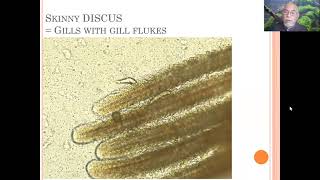
Gerald Bassleer (case #40) presents a clinic-style YouTube case about tank-raised discus with multiple concurrent infections. He shows live fish and necropsy images revealing gill flukes, intestinal nematodes (Capillaria), Spironucleus (formerly Hexamita), and internal granulomas consistent with mycobacterial/tuberculosis-like disease, plus secondary bacterial presence. Clinical signs include emaciation, damaged fins, flared gills, and poor condition; very sick fish may be unrecoverable and should be euthanized and examined. Recommended actions: identify source/breeder biosecurity, prioritize treating gut parasites (e.g., praziquantel for worms, metronidazole for Spironucleus), support immunity and repair (speaker recommends Dr. Basleer Bypaccio containing lapachol, garlic, chlorella), and consider that granulomatous mycobacterial infections are difficult to resolve once established.
Questions this video answers
August 8, 2023
Praziquantel and metronidazole
Capillaria (a nematode worm)
Spironucleus (previously called Hexamita/Hexameter)
Dr. Basleer Bypaccio — contains lapachol, garlic, and chlorella
Chapters
Dear fish keeper, we are again at our next case of fish diseases. And it's a special case about discus fish. You know, many discus people are breeding fish and many discus fish are coming from large facilities, also from Asia, also from East Europe or from Israel you call it. But there are certainly many problems when you're breeding fish. Breeding fish is also not only breeding fish, but also a risk of breeding diseases. This is a case I will show you and explain the different diseases we can find on a lot of tank raised discus. Let me share my screen and show you here in case number 40, the discus fish tank raised with multiple infections. Here we see the fish swimming in the fish tank. And some look pretty healthy, but some are looking a little bit skinny. Look, one in the back here. Usually the ones which are separated from the group, we're not swimming together. Many of them look pretty. And so in the first study it looks well, my fish look okay. This is a good supply. You know, only have one death every day, but one death every day is one too much. That means something is going on also with the healthy fish that there is a problem. And when fish coming tank raised, they often have a variety of diseases introduced in the breeding facility through the parent fish because the parents can also transmit disease or through the fish food that is supplies. This is mostly the case here. You see again a bunch of discus. Look how healthy these ones in front here, look, looking for food. But here, look at this skinny one here. Losing his body structure, getting some damage at the tail, I mean in the dorsal fin. It's getting darker in color. His gills look a little bit flared open. Let me show you again. This one here. If you see this one already appearing in a lot of fish, like this one here. Well, this one you might be certain it will die within 24, 48 hours. And it's better to, to take that fish out and, and use this discus for examination to try to save the other ones which are still healthy. But look at this one here. That's the one you should call out and, and use for your, your, your, your tool of becoming a fish doctor. When the fish are still healthy, the medications can work. The medications you will apply and the treatments will have a chance to give the fish a good possibility for recovery. This one, which is too weak, it's too late to treat. He will not react on the treatment. It's too far gone. So you better put it to sleep maybe, but use it for examination. Well, the first things we found in the gills were gill flukes. Quite a few gill Flukes, as you see here, are damaging the gills, causing a risk of secondary bacterial infections and gill flukes. While this is a common problem in discus. Why? Because the discus is pronable for Gulf flukes. That's the kind of fish like a goldfish can often have gill flukes or skin flukes. The discus have a lot of chances to have a gill flukes. It's to do with the breeding facilities which have Gulf flukes going around the parents which have Gulf flukes and luckily you can treat them. We checked further dead fish and we found in the internal organs we saw tuberculosis granulomas, all the dark encapsulated parts in the organs, in intestine, in the liver. It's taken away healthy tissue. This is not normal. This should not be there. What exactly it is, is it a bacteria or a viru can be examined or diagnosed by a laboratory. But in many cases we found this in tank raised fish. Even the spleen is very badly, how can I say, in bad shape. You see a lot of melanomic fark centers and that's the macro. Farcs are defending the organ against infiltration of bacteria or viruses. And then they're making this kind of encapsulations and that is causing the organ to have malfunctioning, making the fish weak. And that's why the fish get skinny eating less, becoming weaker, and eventually will die. The other thing we found in the intestine are worms. Look here. That's capillaria, nematode worms. See slowly moving around. And those capillaria have eggs, they lay eggs. Here you see some of the eggs. They lay eggs in the water and they reinfect the other fish in the aquarium. So that's the other parasite we found in this small discus. And then we found in the abdominal cavity next to the intestine. This is the intestine. We found two small parasites, spinal nucleus used to be called hexameter. That's the other parasite we found also some bacteria around in the water. Well, that's another parasitic infection. Here we see how many there are as Hexameta parasites or Spironucus parasites affecting the fish, a serious infection. And this is the infection which is causing on this moment most of the damage. And that will cause the fish to suffer of a poor gut system, a poor microbiome, and having a less chance to have good nutritional benefits. So because the intestine, the gut will not absorb so easily, the good micronutrients, vitamins, minerals, and the fish will become weak. Next to the Gulf flukes, next to the capillaria, the bacteria. So conclusions for the treatment of this specific discus problem is. Well, we see the few that this offers. You have to think about where is my fish coming from? Who is my supplier? Who is giving me this problem. Check for the reasons why the farms maybe had poor biosecurity. Usually it comes from fish food. Yes, usually come from the parents or causing the passing on the disease to their offspring. While you can use treatments to control the gut flukes and the nematodes in the gut, like Prazikantel or similar drug is often used as a medication. The spider nucleus parasites used to be called hexameter. You can control with metronidazole or with hexamor from mycoremunster. You see in the bad spleen, you see the granulomas and the organs, possibly Mycobacterium, which we have seen quite common also in studies done by scientists. That is a common problem in tancre discus. So treatment for this is a big problem to treat when it's already a granuloma. You can try to restore the immune system. Yes. And the goods fish, which have less micro damage will recover much faster. So the very sick fish you better euthanize because they are a risk of spreading more disease to the healthy fish. And if you start the treatment first treat the parasites, particularly the spiruluculus. And we recommend to treat me well with our Dr. Basler Bypaccio that has lapachol, garlic and chlorella, which helps the fight of the parasites in the gut and help the repair of the fish. So it's a complex issue. Maybe see it again from the beginning to try to understand how complex and how mixed this problem is in one little fish. So many diseases going on. So you have not easy approach. The best thing is select your supply. Where is the fish coming from? Because it's the fish farm or the breeder who can do. Who can do something about it. So this was another case of fish disease I showed you. And about the discus. Well, certainly we will have more cichlids in the future about specific problems which appear in my cases. As a fish doctor, thank you for watching.