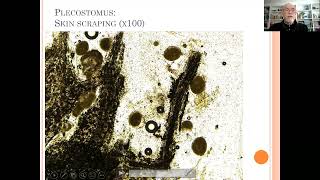
Gerald Bassleer diagnoses white spot disease in a Plecostomus using microscopy, revealing dark ciliated parasites. Treatment requires anti-ich medication, sea salt at 3-5 g/L, raising temperature, and 24-hour lighting for at least 20 days because Neoichthyophthirius is harder to control than classic ich.
Questions this video answers
3 to 5 grams per liter (g/L).
Dr. Besler Biffy food matrine, for a minimum of 20 days.
Keep aquarium lights on continuously (24 hours).
Daily siphoning of the bottom is recommended.
Images shown at 100×, 200×, and 400× magnification.
Chapters
Hello, dear aquarists, you are again interested in another case of fish diseases. Well, we are at number 50 on fish disease cases which I prepared and explained for you in detail what you can do about diagnosing and treating fish diseases. I will have 50 more to come in the coming months because every month I have some interesting work I can record and present. So you become a better aquarist and saving many more fish in your shop, at your wholesale facility or in your aquarium. Therefore, I will share my screen and show you my presentation of today on case number 50 about the plecostomus hypostomus plecostomus with an egg infection. But here it's going to be the Neo ache, the neo ichthyophtherius. Well, the fish in the aquarium, some are getting very skinny, emaciated and die. But with our naked eyes we could hardly observe anything typical as white spots. Maybe when you look very close to the skin you see a few. But it was very difficult to notice anything except the skinny clamped fins on this plecostomus because their kind of body isn't easy to help you to determine if there are clear white spots to see. Maybe if you look very close we could have seen it. But to be honest, I didn't see it with my naked eye until I took a skin scraping. And here you see at 100 magnification those black spots moving around. Well, this is the white spots disease which doesn't look white when you put them on a microscope. And this kind of white spot, the Neo ichthy of therius, is very dark and moving very slowly. Here I show you again at 100, 200 magnification. Here is the 200 magnification. You see nice. The cilia, they're moving around. You can already see the nucleus, that it's not the typical U shaped nucleus. And the parasites are quite different. If you've seen normal egg before, then you know that this one looks a little bit different and darker. And I show you here at the 400 magnification that the body formation is different. The nucleus formation is quite strange looking. And I explained that in detail in my fish diseases diagnosis. That that's my other part of my pattern where I explain in detail the Neo ache and the white spot disease. So what can you do in this treatment here? Well, as I explained, you try to take often skin scrapings or gill scrapings from your diseased fish because in this case it was very helpful for us to identify that there were white spots. There are many anti egg treatments available in Your aquarium shop, like Farnamor, for instance, that are very helpful in treating the white spot disease. I recommend in this case of this neo egg to combine it with sea salt, 3 to 5 grams per liter. That helps together with the medication in the control of this white spot disease. Feed the fish with Dr. Besler Biffy food matrine during 20 days a minimum. Do not give other food me well, because the matrine helps the fish mucus to be. How can I say, repelling for this kind of parasite. So try to feed that at the same time with the medication. During 20 days. Try to siphoning the bottom daily. So you remove parasites physically. And you can raise the temperature with a few degrees. Because if you do that, you you can have a chance that these parasites reproduce faster. And when you reproduce faster, you kill the parasites with the medication. You don't kill the big parasites, you kill the baby parasites. And that I explained if my Dr. Basler anti ick method that during the cycle of the white spots, like you see here in the middle, after seven days approximately, the parasites reproduce and reinfect to fish or other fish in the aquarium. And it's only this stage, the baby stage, this stage that you can use Farnamor in control or protomor in coral or reef aquaria. At the same time you can use the food to make the skin repellent. At the same time you can raise temperatures by few degrees. Use a UV lamp which control kills the parasites passing through the lamp doesn't kill in the aquarium. Only the ones passing through the lamp through the filtration siphoning of the butter, leaving the lights on for 24 hours. Because when the lights are captured, kept on, the parasite will not reproduce. So those are all things that can help you in controlling this difficult parasitic infection. Because neoic is more difficult to control than the normal white spot disease. So I have more cases to come in the coming weeks and I will prepare them for you. And I hope you can learn more from it and stay tuned to be informed. Thank you.