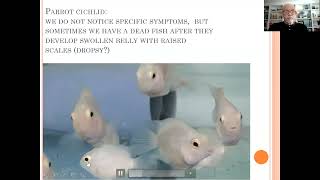
Gerald Bassleer examines a parrot cichlid with bacterial and parasitic infections: swollen belly, raised scales, and lethargy. Necropsy found nematodes, tapeworms, and possible tuberculosis-like tubercles in the gonads. Treatment includes praziquantel for parasites, antibiotics like oxytetracycline, and Dr. Bassleer's pumpkin feed for 20 to 30 days.
Questions this video answers
Gerald Bassleer
Case number 52; parrot cichlid ("Parrot Chiclet")
Praziquantel, levamisole, or fenbendazole
Oxytetracycline or florfenicol/Floreltodone
Dr. Bassleer’s pumpkin feed, given exclusively for 20–30 days
Chapters
Hello, fish keeper. Thanks for following my cases on fish diseases because there is always something to learn. Every case is different. And also in my work the coming weeks, I might have find other diseases, other problems which are common in a recording hobby or not common, depending on the look I have by my experience working as a fish doctor. So I will share you my PowerPoint presentation. And today we will talk about Our case number 52, about the parrot Chiclet. The parrot Chiclets, as you know, are very popular in Asia. It's the mix of two cichlids which makes the parrot look of the fish. And here we found the bacterial and a parasitic infection. In this case of the parasichlids, we did not notice any specific symptoms. Some fish died after becoming disease symptom with raised scales or a swollen belly. Of course, they have big bellies and it's hard to see that they have raised scales. But the fish remaining in the tank, you can see one at the bottom here. It's very weak, so removing. Some have a little bit patches you can see maybe, but some are weak and becoming listless. But they had still a big belly. That belly remained until they died. So what we had to do is, well, we had to make a thorough examination of this kind of fish. And the first thing we found was a slight bacterial infection in the gills. You can see here that gill has lamellae gum by bacteria. Also this part of the gill, so different gill arches, had some slight bacterial infection, which is of course making the fish to suffer. But when we dissected the fish, we saw a very enlarged pale liver. Here we saw a large spleen. And here the female gonads were also very big in size and swollen. So we had to examine the microscope. And the first thing we found in the gut, intestine are all round worms, nematodes. Let me show you again from the beginning. Here they are. Here is a nematode. Here is a nematode. And it looks like it's capillaria, like we seen in a previous case of another fish with this kind of infection. See, there's one here. There's one another one here. See? Let me go through. See? And then we see what we find. The elderly. Good. Well, and then we see to our surprise, another big worm, which is a cystoad. See the cystode, Here is the head and here is all these ligaments. It's a ligamented worm. So here we see it in detail. And you see his head here. He's very big. He moved away from the intestine because we squeezed the intestine and broke the wall. So the worm did get out. So that is something. Well, if you have this kind of worm in your fish, you might serious know that he's suffering because that's a big one. And he is eating on the food. The fish gets. He's damaging the cell wall and the fish gets weak and he gets secondary bacterial infections next to the nematodes. Yeah. So. Well, this is a mix of problems. Then we also check the organs here on the left, the liver. The right. Sorry, the liver. We saw some dark specks in there or most likely due to bacterial infection. And the same here. On the left of the spleen we see the dark accumulation of blood clots, some melanomacrophage centers which are showing that the organ is in bad shape and most likely due to bacterial infection. The female gonads we found here some eggs which are badly developed. And we saw tubercles in between. So it might have been a mycobacterial infection. The lab can define that. But those tubercles in between the female gonads is very bad. So the reproductive organ is in very bad shape. So this mix of problems. What can we do with this? Parrot Chiclet. Well put the fish that suffer asleep. Treat the fish with an anti worm medication like Prazicantel, Levamizole or fenbendazole. It's Levamizole. I put an L too much here. Treat with an antibiotic like oxytetracyclone or Floreltodone that you can get from your vet or your aquarium shop to help to control the secondary infections which appear because of the worm infections. You got easily secondary bacterial infections. So the fish is weakened. The treatment of the tuberculosis like mycoputer is not possible with antibiotics. Like I explained in other cases that they are encapsulated those bacteria Mycobacterium. And it's difficult to get the medication through those capsules or encapsulated bacterial colonies. We recommend to feed to fish with Dr. Basley adviser's food pumpkin. That helps in removing the worm infections and strengthening the fish. Try to feed for 20 to 30 days while giving no other food. The problem of this disease is the breeder. So the supplier you have to check, give feedback that you found this problem and that the breeder eventually got the message that something is wrong with his fish and that he's causing disinfection in the fish due to the food or parent fish which are already sick or mixing with other fish which are carrying diseases, so he has to look for the origin of the problem, and that is sometimes not easy. Finding the cause of the disease is something worthwhile investigating when you're dealing with fish diseases, so you can take proper actions in preventing. For the next time, thank you for watching.