A short narrated case (Case 56) by Gerald Bassleer describing a common parasitic infection of black mollies caused by Ichthyobodo (formerly Costia). The speaker documents clinical signs (weight loss, clamped fins, heavy respiration), microscopic findings on gills (small motile parasites at ~10–20 μm, seen at 300x) and rapid progression to gill destruction and secondary bacterial infections. He recommends early treatment with antiparasitics (formalyn/malachite green combinations), sea salt baths (3–5 g/L for 3–5 days), possible antibacterial therapy for secondary infections, improved filtration/avoid overcrowding, and a 10-day garlic feeding to alter mucus and deter parasites.
Chapters
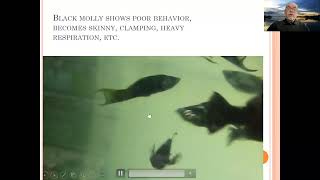
Dear fish hobbyists, today we have a case of a very common fish we see often in aquarium shops or we have in our aquarium and also a very common disease. So I hope my video will help you this today to solve certain problems which occur quite often in our aquarium and that I will select my PowerPoint for you. And I hope that the case I bring today, it's already case 56 about the black Molly or black Molly lartale. Any kind that was infected with the parasites. Ichthyobodo, that's the new name for the Costia, a parasite we know for many years and it's common in our hobby and coming in our industry. And here we see the typical behavior of those mollies is that they become skinny, they're clamping, they're heavy respiration. You can see here, like this one here, clamping the finch together. And you see some fraying the finch see like this one here, getting skinny. Well, we know there is something going on. And in fact if we see already this kind of of fish, you're reacting in this way to getting skinny, clamping the fin. That means you've seen it too late. You should have seen it sooner that the fish was not behaving well, maybe not eating so well. And that is something you have to check when you look at your fish. Because any moment you treat too late, it will be more difficult to cure the fish. And we examined here the gills of that molly. And you see the tiny parasites here in slow motion, moving by here. They're all very tiny. They are about maybe 10, 20 mu as micro type fish only can see with the microscope. And this is here at 300 magnification. And here we see it also better. See the parasites here moving large quantities. They are inside the tissue. They are attached to the gills. They are destroying the gills. Look at this gill here. And causing then also secondary bacterial infections to come in. And then the gills are rotten away and the fish will die of suffocation. The fish will die of pneumonia, you can say a kind of pneumonia that the gills are not functioning well and causing very quickly dying off. If you really are acting too late. So what can I suggest for treatment? Well, there are many antiparasitic medications available in the pet shop. Ask the pet shop what medications you can use for ichthyoboto. Usually at our combinations like formalin, malachite green or Malachite green is good. Also we recommend the use of salt. That parasite does not like salt. I recommend to use sea salt, which is more stable for Your PH in your water. Sea salt at a dosage of 3 to 5 grams for each liter. And that certainly can help. And you can leave it in there for about three to five days. See how the fish react. Always check your fish, how they react on the salt. So if any stress, extra stress would come under the fish, you can. That you can do a water change. You never know. That's the same for medications. Always check how the fish respond. You never know how a fish would react because that treatments are a kind of stress on the fish. But like I said, try to treat in the beginning stage. The beginning stage. If you do, the faster you do it, the better your results will be. Maybe you need to apply an antibacterial medication like I showed you. The gills were also already damaged and that might be needed. That you also need to apply an antibacterial medication. Avoid overcrowding. Overcrowding and also poor dirty filtration because that stimulates that parasite to multiply and to become an infection of the fish. Make sure that the filtration is good and the water quality. And feed the fish during minimum 10 days before Dr. Basler buys his food. Garlic. Because the garlic changes the mucus of the gills and the skin. And so the parasites do not like to be attached to that mucus which has a garlic taste or garlic smell. So I hope this video helped you as a Patreon and that you can enjoy the care of your fish with the kind of information I provide here. So stay tuned. Thank you for watching.