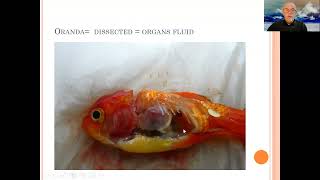
Gerald Bassleer examines an Oranda goldfish batch with tubercles in gills and organs, showing weakness and daily deaths. Necropsy reveals destroyed gill tissue, fluid in the abdomen, and enlarged kidney. The diagnosis is Mycobacterium, fish tuberculosis, with euthanasia recommended for terminal fish since antibiotics rarely help.
Chapters
Dear aquarist, our dear fish keeper today already on next fish disease case. And it's going to be about Oranda lionhead, which is, well, a fish which is much liked in the hobby for those that like to keep fancy goldfish. And this one we had a case with tubercles we found in the organs. And explain you our findings in my case today. And the fish was showing abnormal behavior, was getting weak fast respiration. And there were some losses. Every day in a tank. About a few hundred of those are on the line head you see the other one swimming below. But this was the one we examined and he was very weak and ready for our examination. And as a case to present for all of us and also for the fish keeper and the shop who was keeping those fish and want to have a treatment or a result. The first thing we noticed was in the tubercles we found. I mean in the gills we found tubercles, see in the gills here, here, here, here, here and there. And that's not normal. You know, some of the gills are looking normal, but some have a tubercles inside. And that is very seriously. That's why the fish was wasting away, so he couldn't have a proper respiration. Here we see a detail of a tubercle which is encapsulated in the tissue. And that cannot be reached by any treatment. But it's taken away healthy tissue of the gills. And that's causing of course respiratory problems. Here is one more. All that part is gone of that gill. All these lamellas are gone and not used anymore. Not available. Here is another one. So that's tubercles in the gills. And when we dissected the fish, the organs had a lot of fluid. Here was the swim bladder. Nothing specific, but there was a lot of fluid in the abdominal cavity. Here you see the watery content in the abdominal cavity. We saw a lot of black specks all around into the organs. And we saw the kidney here, which was large, very, very fluid, very loose. And it would be more concise organ. So that's all the things we pulled out of the fish to check in the microscope. And in the organs we found tubercles as expected because we saw them in the gills. Well then you can expect that there will also be in organs inside the fish. See there's more of these tubercles here. All in the fish available. The kidneys are very bad. There were some calcium formation where blood clots and at the beginning of tubercles. So this is all showing that there is no nice red colored kidney. But A kidney which is not properly working and then at the same time the gills are not properly working, you can imagine that the fish is suffering badly. So what could we recommend in a treatment for a fish like that? Well, the fish that suffer badly, you know, a treatment will not help. You better put the fish asleep because we act too late, we sour too late. But this fish, in a batch of a few hundred sacrificed himself to give us the information we needed to treat the rest of the tank. And the first thing we had to check or ask ourselves what is the origin? Most likely it is the breeder. Breeders can supply fish, can breed fish. But when the mother fish, the parental motor fish, has Mycobacterium, which is properly in this case or bacterial infection, it can pass it on through the babies, through the eggs, through the gonads. Another source could be bad, bad food, that is pollutative bacteria. And here most likely, like I mentioned, this Mycobacterium, it's the first tuberculosis. Why do I think it is most likely? Because in it's very common in our aquatic tropical fish industry. It's just common also in the fancy goldfish. They do mostly came from Asia. Treatments could have little success. Some people try minocycline, oxytetracyclo, canamycin, you can check with your vet, but it has no help. To be honest, it's very little help. And it's. And using antibiotics these days is under a lot of discussion. You can help the fish with a food. Therefore, we developed the Dr. Basler biofish food, which is a Fuko Iran, which has an ingredient that helps in control of internal bacterial infections. It's not a medication, but it's like a phytobiotic, a plant that helps the fish to control the bacterial infection. So I hope this information helped you in this case of the Red Lion Head more cases to come on other fish. What's going to be next? Well, you will see in case number 62. Thank you for watching.