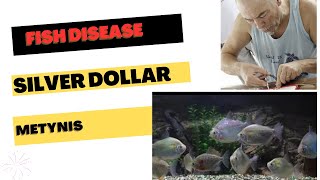
A YouTube case presentation by Gerald Bassleer describing bacterial infection in silver dollar (Metynnis maculatus) aquarium/pond‑reared fish. The video documents abnormal swimming (heads down, upside-down), gill destruction, internal organ lesions, rod‑shaped bacteria observed microscopically, and successful treatment with oxytetracycline; it also discusses likely breeder-origin and husbandry risk factors and supportive feeds/supplements.
Chapters
Dear Acharist fish keeper, today on fish disease, case number 63, it's about the silver dollar. Silver dollar tank raised or pond raised Metinis maculatus, which has been creating losses. In the background you see another Amazon picture. We see a fisherman. They're in the background. I'm not at the Amazon, I'm at home. But it's one of the collections of my pictures I took during my traveling. So now I'll show you my, my PowerPoint which I made on the silver dollar which had a bacterial infection. Case number 63. You see how abnormal the fish are swimming very strange with the heads down. So there was something bothering the fish. There were a few losses, some are looking okay, but every day there was one or few which is showing that strange behavior. So we start checking them and we found that some parts of the gills were destroyed and it looked like a bacterial infection. See this part is gone. Here we see some healthy parts, but not all the gills were so healthy. See here more. This basic part is gone. Here at the top is wasting away is here the video shows you the different parts. See the top is taken off by bacterial infection. See more parts of the gills are gone. So that's not normal. And we see that, that it's of course eventually killing the fish. The organs had very bad shape. Some holes here in the liver, some bleeding parts, most likely bacterial, like I say, I say most likely bacterial because the virus we cannot see with a microscope. This is only could be detected by laboratory research, a specific laboratory and still not easy to find virus like this. We found a lot of bacteria massively inside the fish and certainly also infecting all the organs, the kidney, the swim bladder. And that's probably why the fish were suffering from it. We couldn't really see much onto the swim bladder. It had some fluid. And this is the kind of fluid we then pull out from the different organs, including the swim bladder. And it might have caused the infection. And there are a lot of rod shaped bacteria and this probably came from the breeder, the breeder who was breeding a fish with this kind of poor quality. And that could be brought in by different reasons. And so this is what we could conclude from this silver dollar. And that the very badly suffering fish, like the ones who are swimming upside down, it's better to put them asleep because they eventually will die. And maybe after they die they spread more of their bacteria. We notice a serious internal bacterial infecting all the organs, including the swim bladder. We can treat with antibiotics for this kind of infection. We used oxytetracycline with success. But you can ask your vet. If you are a breeder, check to the help of a lab what bacteria playing part of a problem here. The food also can help. We recommend to Dr. Besley Baifish food Fuco or the biofish food grapefruit seed extract polynga that helps in controlling the bacterial infections by the fish. It's not a medication, but it's a help for the fish in the control with those feta biotics to fight off a bacterial infection. But the main problem of hero origin was again the breeder who was keeping the fish. Maybe too many together, poor food quality, many too many sick fish, poor selection, etc. So that was another case on a silver dollar. Not so very common in the market. These fish were particularly in America and Asia. It's kept as a common fish. And as I told you before in my previous presentation, bacterial infections are common. Why we keep them in tropical water. Sometimes we are feeding with fish food like frozen alive food which is carrying a lot of pathogenic bacteria. This is a risk, so try to exclude the risks so you avoid problems of diseased fish and that you don't have to treat the fish. So I hope my video helped you again to become a better aquarist.