Gerald Bassleer examines a mass-mortality outbreak in Russian sturgeon with respiratory distress, heavy mucus, and foul odor. Skin scrapings showed ciliated protozoa, but necropsy revealed swollen bleeding gills and internal hemorrhage, suggesting primary bacterial or viral infection. Treatment included parasite control and empirical florfenicol while awaiting lab results.
Chapters
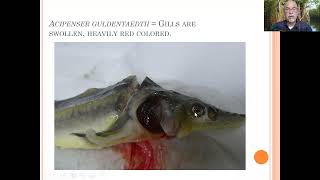
Dear fish keeper, today our case of fish disease number 66. And it's about a pond fish, a cold water fish, something which I also encountered during my job as a fish doctor when I help out importers or distributors of ornamental fish. And this was a special case that I would like to show you, although the results were not very much confirmed, exactly what was the cause. But anyway, I wanted to share this case. It's about the sturgeon, the acapentur guldensteti, which had high losses, we suspected at the end a viral or a bacterial and a parasitic infection. Well, I explained you what we did and what we found in this case. Here were the fish in the tank and you see them suffering, hanging at the surface, upside down, and they were dying. They look very wasteless, listless I could say. And it happened quickly and high losses in a short time. And you could see the bubbles, a lot of slime was coming loose in the tank. It was a bad smell in the tank. You can see the bubbles here of the slime of this sturgeon fish. This fish also is called the Russian sturgeon, also appearing in Ukraine during these times when there is a war going on. Well, let's go to something else. It's about fish diseases. And skin scraping is something which we do automatically when we do a diagnosis. And we found some tiny protozoa parasites. You see them moving around in the water here, you see a few here, a few here together. And they were spread in the mucus from this sturgeon. And in a certain location we found them grouped together, a whole bunch of them. And it's a kind of Chylodonella or ciliated protozoa. It might be quite different species, but we don't take the time or I don't bring the fish to samples, to a laboratory to do a real identification or of what's the real name of this parasite. That's not my goal as a fish doctor. My goal is to bring as quickly relief to the fish with immediate action and treatment and to help the importer or the distributor of the fish to bring solutions. So my case is not determining exactly what species it is, but we could see it looks like a Chylotonella, a protozoa parasite, so we can try to treat it accordingly. Well, we found that the gills are swollen heavily, red colored, look very badly thick here you see it in the microscope, how bleeding heavily they are. And here, so that there is of course a bad exchange of gases and the fish is heavily stressed, so causing also kind of suffocation. And when we opened the sturgeon, we found a white liver with white spots all over and bleeding parts into the organs in the intestine. So this fish had some internal serious advanced problems, which made us conclude that the fish were heavily dying due to the infection and not particularly of the parasites. We suspect that it was in general internal case, might be caused by a bacteria and maybe also a viral infection because they were dying so quickly and so fast. It's usually a bacteria that is causing such mortalities or poisoning, but poisoning we can test, we can eliminate because a lot of water changes have been done on that fish tank and still the fish were still dying. A viral infection. Well, only a laboratory can determine this case of a viral infection. That can take a couple of weeks and then it's too late before you get the results and to save the fish. So the parasites presumably are a secondary infection. So you can try to treat for the parasite. Of course, that might relieve the fish. But in this case I got some advice from Adam Rezinyki that suggested that please try to treat with fluorophenicol because he experienced this case like a bacterial infection. And why not? Why not take an action and make a trial with fluorophenicol, which is an antibiotic in the water and in the food. It can be certainly in the help, but you do nothing. Well, you risk of losing it all. At least you did and try something. So that's I can suggest. And then also you can inform the breeder of this kind of cause. These fish came from the fish farm and the laboratory also of course can have give you results in the future. So the breeder, at least he should have taken action to find out what is the cause of the problem. So this was a case for my patreon number 66 and I hope this helps some pondfish keepers that we can also try to examine sturgeon fish and maybe not exactly knowing what's going on. This is of course a risk we run while we're doing diagnosing of fish that we sometimes are countered with nothing real typical as a disease and that we need sometimes a laboratory to help us out to identify the problem. So make sure when you're a serious fish dealer, that you have a laboratory or a good fish doctor or veterinarian around who can help you. Wish you all the best in the care of your fish. Thank you.