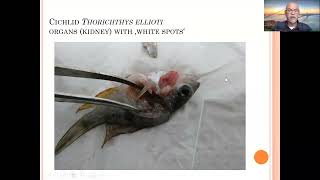
Gerald Bassleer examines a Thorichthys elioti cichlid with wasting, raised scales, and swollen belly. Necropsy showed gill damage and white tubercles in kidneys and liver, consistent with fish tuberculosis caused by Mycobacterium. Treatment focuses on antibiotics for secondary infections, improved feeding with quality granulate, and avoiding live or frozen mosquito larvae as a potential source.
Questions this video answers
Case number 70.
Approximately €150–€200.
Oxytocitracycline and aminocycline (speaker-reported names).
Chapters
Dear fish keeper or a. Today, another cichlid case. Yes. I had the opportunity to have presented a few cases on fish diseases with cichlids. And it's about a Turichtes elioti, which is an American Chiclet, Central American cichlid that was wasting away, most likely fish tuberculosis. That's what we suspected. And I will send you my conclusions when I were diagnosing the fish. Well, here we see the. See the group of fish in the aquarium. Some look very healthy, but in the back you see the one getting dark, having a larger belly. And all the other ones seems to be healthy, pretty hungry, doing normal. But now and then a few fish were wasting away and were dying. I show you again here I see the group. They all look to be pretty okay. But then, you know, every week there is one, there is two acting like this, dying like this. And well, of course, then it's time to do an examination on a fish like that. Here we have that same fish. You can see the slower swollen belly and see the slightly raised scales, the dark coloration. And also some Popeye extend exophthalmia, extended eyes coming up. So the ray scales, those are like dropsy. Yeah, it looks like a dropsy symptom. Slightly dropsy, but not exactly dropsy, but nearly dropsy. Yes. And examining the fish, we could find nothing on the skin, but we saw those poorly damaged gills. Look at the gills here are swollen here. Here's some necrotic damaged gill tissue. Here's some more gills. You see here, the tops, the lamella have disappeared. So the gills are having a problem that the fish, of course, have respiratory problems. And we could see here in the organs. You can see here on the top, we can see here. And that's the part where the kidneys is. We can see a lot of white spots. Here's also some white spots inside the organs after the dissection of this Dorichtis cichlid. Then we could find those spots as tubercles in the kidney, those tuberculosis. In our findings also by other experts, where we see the scientific research done on fish diseases with tuberculosis. It's 85 to 90%. It's mycobacterium identified by the laboratory. We don't send to the laboratory because it takes a long time to examine and a lot of money for a lot of people which don't want to spend those €150, €200. And then still to hear that a treatment is more difficult for this kind of fish to save, because it's coming from the original farming of the fish here you see the tuberculosis in the liver. You can see how many are here and how many healthy tissue of the liver has been taken away. See what happens then. That of course is damaging the fish, weakening the fish, creating a risk of secondary problems in the gills. What can we then suggest for the treatment? Well, the badly wasted fish cannot be saved. Many fish will carry the fish tuberculosis, the mycobacterium and they can survive for a long time. Like I explained in my previous video number 69, about episodic cranialabris, nearly the same case we found on the same day. They can survive for a long time. You don't know how long, but sometimes for a lifetime. Except those which are really have bad organs and bad gills. Some of the secondary infections, like the bacteria here that caused the gill damage, we can try to treat with an antibacterial treatment. You can try like antibiotics, oxytocitracycline, aminocycline. You can ask your vet for some help in this stage because those are prescribed medications. We recommend to improve the feeding program. Avoid the food carrying Mycobacterium. And that has been proven to be found in mosquito larvae, live or frozen. Yes, even frozen mosquito larvae can carry Mycobacterium because the freezing does not kill the bacteria. I have this presented in my YouTube cases on Mycobacterium or the risk of feeding live food. So this is discussed in my bacterial section on fish diseases in my YouTube channel. We recommend to feed the fish a guaranteed safe granulated food, like our Dr. Basler Baiji. For the fuko. The fucal is extract from fukoi Dan which helps controlling the bacterial infection. And professional treat, which also is a mix of different herbs that helps the fish to recuperate or to control the bacterial infection. And meanwhile, do not give other fish food during three, four weeks. Just give the granulate and inform the breeder. Because usually it's the breeder with a poor breeding practice, overcrowding, dirty water, that feeding program that is creating this problem and you should try to go to the source. So that was another case on my Patreon. So stay tuned. This was my case number 70 and I have more cases to come. Eventually we will arrive to 100 cases certainly. And it's all interesting to watch them and to learn about fish diseases, what is going on, what we can take as actions. As fish health manager, wish you good luck in your management of keeping the fish in the best condition. Thank you.