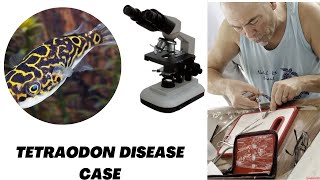
Gerald Bassleer presents a clinical case of nematode infestation in a pufferfish (referred to as Decommysiteri/Dichomycetere, historically Tetraodon ocellatus) collected in southern Spain. He describes external deformities (bumps around the eye and emaciation), surgical opening of lesions that revealed large motile nematodes and many small larvae (microfilariae-like), microscopy observations, and multiple worms recovered internally. The speaker hypothesizes the parasites belong to Filaroidea (microfilariae) and gives pragmatic treatment and husbandry advice (euthanasia for severely affected fish; anti‑nematode drugs like praziquantel/anthelmintics for less-affected fish; avoid the collection site). He also notes intermediate hosts (insects) are likely required for transmission and mentions further training material on his Patreon.
Chapters
Hello again here. I'm back for you to present another case of fish diseases. Again from my location on my vacation home in the south of Spain, Andaluzia Casares. And this case was very special, which I didn't encounter every day. It's a pufferfish, the Dijo micetere. I don't know if I pronounced it correctly, but the dehommysiter used to be Tetraodon. And we found worm infections. Well, worm infections is always spectacular to see. And the fish were in the tank. You can see some swimming here. You see some are very skinny. They look exhausted, nearly, you can nearly say deformed because of the. They are wasting away. And some had extra growths. The deformations here you see on the next video, you see here on the top of the head, here next to the eye here on this fish, you see the bump sitting there. Are we going to examine that fish and see what is bothering that fish, what is troubling? The fish did survive quite a long time. A few died, but not everyone so quickly. So for us such a case is. As a fish doctor, it's unusual. So let me show you what we did. So this buffer, the Decommysiteri ocellatus, it used to be called Tetraodon ocellatus. Some time ago we found, after opening the bump of the eye, we found two large worms, looks like nematodes around. So here they are, the two large red strings we just pulled out on that extra growth behind the eye, something special. So we put them here on the plate and then we will look at it on the microscope. But those were two large worms which are moving around. And in the microscope we saw inside two spurt worms. This is one, one worm, one body. And inside there were all little babies, you can call it baby worms already well, ready to spread, to move out of the fish or. And causing other infections. And after dissection of the fish, we also found internally here you see the white lip here. While we put it on the plate was another worm. Inside also more large nematodes we found. And we pulled out some more, some red worms, some yellowish worms. So many different nematodes we all pulled out of the internal body of this puffer fish. And these babies look like microphyllariae, that's the scientific name of this type of nematode, which is very unusual that this type of family of nematodes would occur in fish. I haven't seen so much or hardly any description of that in scientific literature. Maybe it's the first case. I don't know because I'm not in the science of discovering the new species of worm infections or trying to describe exactly what species it is. As long as I know it's a nematode where it's found and suggests how we can solve the problem and treat the fish accordingly. These babies could have been microphyllariae, which belongs to this worm belongs to the Filaroidea. That's a kind of round worm. Here, see another picture. You see how many small tiny worms are moving around and yes, causing a risk for continuous infection. This is not a beautiful case of infection. Of course, the treatment of such a fish is not so easy because we don't know much about it. But we know it's around. We know it's a nematode, maybe from the family Fila roideia and the bad suffering fish like I always try to recommend. If the fish are really suffering badly, a medication will hardly help. It will even put the fish in more suffering. So you better put gently asleep and you can use for that Narcomor plus from aquarium Muenster for example. And many fish from the same collecting site, which is probably a certain river of part of lake. They can be infected because of the contact they have in nature with possible parasites. And some can survive for a long time. You don't know. It depends how heavily they are infected and how strong their resistance is. You can try to treat the fish which are still looking healthy or pretty good shape with Prancicantele or a similar antelomatic drug. The origin could be infected insects in the river. The fishermen should avoid this collecting site. So that's a message you can give to your supplier. Usually those worms, you know they can spread through insects in the aquarium. But you have as an intermediate host or in nature. It's not like the roundworm Camelanus that it spreads directly from fish to fish. So it still needs an intermediate host. You might have some insects in your aquarium which can be host intermediate host to continue to spreading in the aquarium. So this is one of my cases I studied for you and I show many more in my Patreon channel where you can get your training on the fish diseases. And all about training is about looking at fish diseases, looking at what we found, share the findings and share the opportunities for treatment. And this will all help us to become a better fish care keeper. Thank you for watching.