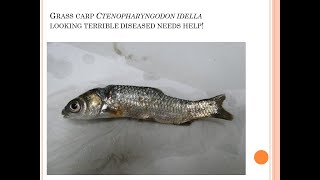
Gerald Bassleer examines a grass carp with multiple simultaneous infections: bacterial colonies, Neo-ich, gill flukes, and trematode larvae in the gills. The fish showed severe skin damage, emaciation, and systemic bacterial invasion of liver and spleen. Treatment requires anthelmintics, antibacterial therapy, salt baths, and nutritional support, though euthanasia may be necessary if recovery is unlikely.
Chapters
Hello, dear aquarists, and maybe today something interesting for the pond lovers, the people who have an outdoor pond and keeping cold water fish or something similar and their ponds. I have a case for you that I encountered during my work and it's about a grass carp, a grass carp that was presented to me and well, let me share you my PowerPoint. It's case number 82. And about the grass carpent Idela, that's the scientific name. Most people only know the name grass carp, which is enough for you that you know you're dealing with that animal that needs special care. And today we had one with a mix of infections. Well, it was a terrible case. Like you see here, his fish. Look at the patches on the body, look at the fins, the pectoral fin, the tail, all damaged, the dorsal fin. And look how badly this fish was damaged. And it was not only the only one was one from a group of fish which was doing very badly and dying and wasting away. So it was even emaciated, very skinny. Of course, when the fish is looking so badly damaged fin rods, well, you can imagine he will not be hungry and eating a lot. And we checked of course, the first the skin. And after the scraping we found lots of bacteria here, all colonies of bacteria, probably also some columnaris bacteria in between, probably two, three kinds of bacteria which are sitting on the scales, the fins of the fish. Here we see it on a video, the whole groups of bacteria here clustered together and of course damaging the tissue, damaging the scales and having a poor impact, bad impact on the fish and keeping it in very poor condition. We also found some black parasites. And between the mucus, between the scales, look, here is one, here is one, here is one tree and there are white spots, parasites not clearly to see because they are inside the mucus and underneath the scales. But if you look clearly you see the organism, the dark brown organism. They don't look white in a microscope, I tell you, they look white because of the mucous layer and the outside of the fish. When we look with our naked eyes, but in the microscope they look dark. And here you see one swimming around. It's a special behavior. It's not the behavior like the normal ichthy of Therius or ich we know, look, looks different, moves very fast, moves strange, not so slowly, circling around like the common white spot we know. And here we see it again. We see it here, sitting more quietly here. And we can see here we notice that the nucleus is quite different form than the U shaped nucleus. Is a U shaped nucleus. We normally know from our normal ichthy of therius. And here is another white spot here. And this one we call the new ich or Neo. Ichthyophtherius schlotfeldi. Nice name. Identified already a couple many years ago and becoming unfortunately more common in our aquarium industry. In an aquarium hobby and needs different care and different treatment. Skin scraping also showed we had a few stalact ciliated protozoa. That looks like epistylis here. They can also penetrate into the mucous. Oh, look at this. There's a white spot quickly moving around. Yeah, this is the unusual white spot parasite. Neo active theories. But what we found else which was very serious were gill flukes, Massive gill flukes, of course, secondary bacterial infections. And look here in the gills. Also inside the gills there are encapsulated metacercaria with worm larvae from the three digenetic trematodes. Look here. All worm larvae deforming the gills. Deformation of the gills very badly. So the fish was already weakened because of those encapsulated metacercaria. And if you know something about the cycle of those metasercaria, they're coming usually from a combination of birds and snails in an outdoor pond. So this is poor management by the farmer where there are birds flying around and snails in the water. And then the fish is an intermediate host where the larvae here are waiting, you can say to be eaten by a larger fish or like a bird in this in most cases. And then it can continue to make a cycle. But look, the gills are badly damaged. Their gill flukes, secondary bacterial infections in the gills. Well, that looks terrible. And then also the organs. Yeah, of course, what you expect. The liver here and the right is the spleen already also invaded with bacteria. So the fish has, wow, very bad case of many mix of infections. What can you do about it? Yeah, yeah. First of all, maybe a poor history of poor diagnosis that it's not correctly diagnosed that maybe people see this fish, you know, within. We just use an antibiotic and we try to clear the fin rot or the tail rod. No, the major first thing is trying to do a good diagnosis and to know when the fish have so many metasercaria you cannot treat. No, but you can control to treat this, the fluke treatment. You know, an anti flu treatment like, like persicate hotel used to be a good one. Check, check with your suppliers. You know, there's many different ones on the market. Sometimes they change because of laws or regulations. Some are permitted or some are not. Ask your veterinarian, he can get for you. An antibacterial treatment is necessary. An anti neoic treatment. You know, neoic treatment is something that needs a lot of salt. Salt. The neo ich the new ick doesn't like salt treatments. I have special videos on that on my YouTube channel on New white spot disease and how to treat. You can of course help with food. Again, like I said, the food is a very important part of caring for your fish because the fish has to repair itself. The medication kills maybe bacteria or parasites, but the food is something that the fish needs to repair and help to fight off the parasitic and bacterial infection. And in this case, I would recommend the biofish food, garlic or the matrine or maybe professional or professional range. But it's the matrine which is also going to help against the white spot and a very weak fish. Well, better put it to sleep. It won't help. So this was a case for the cold water fish lover. And of course I have more to come. Some might be about goldfish, some maybe about koi. Stay tuned and hope you can learn more about my cases that I counter during my work as a fish doctor. Thank you for watching.