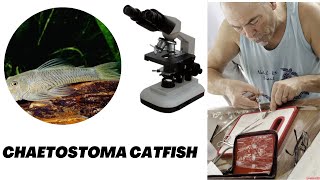
Gerald Bassleer examines a wild-caught Chaetostoma catfish with a bacterial infection marked by a red belly spot and bacteria-laden spleen. He traces it to collection stress and poor water conditions, then recommends antibacterial treatment, special feeds with prebiotics and probiotics, and better exporter practices to prevent it.
Questions this video answers
April 11, 2023.
Oxy tetracycline and ferreltadone (as named in the transcript).
A red spot on the belly.
Colombia.
Chapters
Dear aquarists, Hello. Welcome to my next video on a case of fish disease, which you might like when you deal with some wild fish and some wild Loricaridae. They are very common in our hobby and most like by people who want to keep community fish, particularly fish who are dwelling around and cleaning the bottom and your decorations for the algae and other leftovers. So in this case, I will show you my PowerPoint which I made about a schittostoma, which had a bacterial infection. And people will say, well, Gerald, it's again a bacterial infection. Why always bacterial infections in most cases? Well, because bacterial infections are most common in our industry, in our hobby because they're tropical fish and tropical fish live in tropical waters. And tropical waters are ideal, ideal for bacteria to grow fast and to live better, particularly in shipping conditions with polluted waters, food content in the water, debris. It's all ideal environment for bacteria to live with the fish and to come on to the fish as an infection. And particularly here, the schittostoma, which we encountered, we had a few losses every week and they were sitting here in the wood on the path on the side. We couldn't see anything particular here. We took one out and they look pretty okay. Not much we could see on this shetto, stoma, pierside or perse, but some were dying. This is a fish, comes from Colombia. It's a wild fish. But when we turned over, the fish turned around and we looked at the belly. We could see here. I hope you can see it clearly. I just point out for you. We see a red spot at the belly. Now when we notice red spots like on the belly, it's usually coming from an internal infection. Of course, we can take a screen scraping, looking maybe that there would be a parasite causing this damage and causing secondary bacterial infections and wounds. We couldn't find anything as that specifically on this cytostoma. We had to look inside and we found out that the spleen was in very bad conditions with a lot of bacteria inside the abdominal fluid inside the spleen. So bacteria here moving around here is part of the spleen on the left. And here are the bacteria. We suspect two, three different kinds. Usually it's not one kind of bacteria, so different kinds of bacteria which has impact on the fish and that can have different origins, that the fish is infected with a bacterial infection. And that's why I present this video. It's for you to be aware that these infections can come onto our fish and usually it could be after distress. Like I say in many of my videos. Stress is a big part of the origin of fish. Getting weak, more prone to get infections and particularly bacteria. Certainly during transport or after transportation. Poor acclimation, poor feeding conditions. Like I say in my the germ theory or the terrain theory, Is it the bacteria which is the cause, or is it the terrain? And the terrain that means, is it the way you handle the fish, the way the fish were collected, transported, shipped maybe two, three days under its way to become a New York aquarium. And of course that terrain is creating a serious impact on the health of your fish. So that's why these kind of fish get easily bacterial infections. You can of course first start to help getting a good aquatic environment with good healthy conditions, with good food and overcrowded. So the fish can recover and recover his immune system. You of course can help with a food. We particularly develop food for that. So the fish can be helped with Dr. Basley Baijers food treat, which has nutrients and pro and prebiotics that helps the fish to overcome its health poor, poor conditions. We also have the fuko. We also have the grapefruit, cedar stack, moringa, all different feed that can help in this condition. Why not want food? Well, because the impact can be different. The bacteria can be different and we develop different kind of foods. You have different opportunities to help your fish. You can apply an antibacterial treatment. Usually good antibiotic that works well on wild caught fish is oxy tetracycline or ferreltadone. Because the bacteria usually has never encountered an antibiotic. So ask your fish topic and advise you how to apply the treatment and what is a good choice. So wild fish I can tell you are easily to treat when you do it properly and quickly and on time, with the help of a food and a good healthy conditions. So all things you can handle as a fish keeper. So these are things I try to explain in my cases of fish diseases. So you're aware that the problems come with the fish, particularly wild fish, which come from a long way. Collecting the river, going to an export station, to the airlines, packed in boxes, shipped for long days. But you can prevent this. Good exporter takes good care, good water. They have taken care of the fish at the export farm. That's why these days there's very little losses. Because losses is a high cost. And if fish shipments come in with high losses, it's a poor shipment. You will not buy anymore from that supplier. You will. You'll buy from a good supplier which takes care of his fish. Because the freight cost is also part of the cost of shipping. So it's all about the welfare of fish. Think about it. The welfare is the germ theory. The germs are possibly there and the terrain theory. You have to prepare that the environment where the fish are kept in are taken care of. So some advice for you. You are part of responsibility of taking care of your fish. And by watching this video, you take care because you learn things to take care of the quality of your fish and try to think about prevention. Thank you for watching.