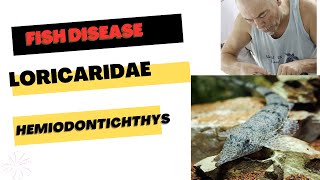
YouTube video (Gerald Bassleer) describing a wild-caught Amazon/Orinoco catfish (Hemiodontichthys, Loricariidae) suffering heavy internal parasite burden (nematodes and digenetic trematode metacercariae). The presenter documents necropsy findings (intestine, liver, many larvae and nematodes), explains how heavy infestations cause wasting and secondary bacterial infections, and gives practical treatment/advice (pumpkin feeding, anthelmintic consultation, antibiotics like oxytetracycline or Furaldime/feraltadone, and humane euthanasia/narcosis for hopeless cases).
Chapters
Dear Aquarist, today I'm showing here my background after enjoyed several Amazon trips on the Rio Negro, starting from Manaus. Because today I will talk about Amazon fish, more Orinoco fish, a fish coming from South America, from a beautiful area where many fish are coming into our hobby. But some of those fish are coming in with problems. And I want to share that with you. Not sharing my experience during that trip, but that's my souvenir, but sending you my souvenir of a face disease that I encountered with a very special fish that called Hemiodontictis. With worm infections? Yeah. Why worm infection? Because it's a wild fish and that is of course quite common. And I want to share that with you because you can learn lessons from this kind of cases. And Eusemiodontitis asipenserinis here called. You can see not much at the fish somewhere dying. Some were getting skinny. Nothing specific we really could notice on the outside, but they were not looking perfectly. They hardly moved. Well, this is the kind of fish, it's a webtail fish, which is belonging to the Loricaridae, which is a very specific item. And the gills were nothing badly to see. Maybe some dirt inside the gill, some clumping together, but no particular pathogen we could notice. A few parts were at the edges, how can I say, damaged, not yet. The bacteria maybe have had an infection, maybe is gone already. But some little damage that can happen during the collecting of the fish, the transport keeping at the exporter or by the transport and acclimation procedure. So we had to go inside that fish fish and we took out the excrements, we put them on a glass plate and then we press it together with two plates. So I explained that in my Patreon lessons that you can learn how to do this kind of examination and what organs to take. So I give you classes on that in my Patreon classes. And what we could see then in inside the organs, we found worms. Well, it's typical, it's a wild fish, we can expect worms. And in this case that fish that was dying had a lot of worms. Some fish can live a long time with a few worms lifetime. And some die because they have too many worms they received when they were living in the river in the Amazon. Here is a round worm and nematode. And here in between are all Metasercaria larvae, worm larvae from digenetic trematodes, flatworms. He has more all lined up between the intestine and just taking away healthy tissue, causing damage to the fish. Here you See the nematode moving and let me show you the intestine. Here you see Ameta circadia moving around. Some are encapsulated, some are free living. So there's quite a few. There are hundreds in this fish, which is an unusual thing to find so many. But that's why I want to share that with you. It's possible to find and well think about it. It's a wild fish, so you can find a very wild problems with many, many different worms. And here we see one of those with the cercaria digenetic trematode, which is as a larvae moving around. And when this fish will be eating, eaten by another big fish, giant, giant like arapaima or something like that, or by bird. This worm larvae becomes larger adult trimatoid. Here it has a larvae but still it's affecting the health of this fish, particularly when they are so many. And at the same time it causes damage to the organs causing stress to the fish. The fish will become weak, become skinny and die away. And secondary bacterial infections can invade into the organs. And you can see here the liver which has a lot of vacuoles, large spaces. Here are a few worms and that organs are getting also affected. So the fish will become in a very weak states with of course the risk that bacterial infections also occur. Like here, all those different tiny spots I show as bacteria. So what can you do as a treatment for this hemiodonticis? Well, we have to understand it's a wild worm infection and the secondary bacterial infection occurs. Then you cannot try to treat with an anti worm treatment. Why not? There are some worms free moving around. Ask your fish doctor like Brazil Cantel is a practical one to use in this case. You can help with a fish food like the pumpkin that helps in the control of internal worm infections in fish. It's not a medication, but it's a help for the fish to fight off the worms. And after the 20 day cure treatment course with pumpkin, you can start feeding with the grapefruit sea distract moringa which helps for the fish to repair during or after bacterial infection. Well, during or shortly after the anti worm medication, you can also apply an antibacterial treatment. Usually a good antibiotic for the wild fish is oxytocin or ferraltadone as your fish doctor. So that's some advice on those wild fish and you can save many, but the weakest ones, well unfortunately they will die. You can put them gently asleep and you see they're really wasting away. You can use a narcos treatment a narcotic treatment sleeping drug called Narcomor plus for Makora Muenster. So that's some advice I can give you on this specific wild fish, which I rarely encounter in my work because it's a very unusual fish. So this was a case of fish disease coming from the beautiful Amazon. And of course, for me as a fish doctor, with very interesting diseases can happen. It's part of getting fish from all parts of the world, not only from the wild, but also from fish farmers. We learn lessons and you can help to take care of your fish by watching my videos. Thank you for watching.