Gerald Bassleer presents YouTube case report #91 (uploaded Apr 26, 2023) about rainbow Labeo (rainbow shark) aquaculture fish showing wasting/skinny individuals. Microscopy of gills revealed encapsulated metacercaria (digenetic trematode larvae) embedded in gill filaments with hyperplasia/inflammation and secondary gill damage. Bassleer explains the trematode lifecycle (bird → snail → fish), states there is no effective drug to penetrate the cyst capsule, and recommends prevention by excluding birds and removing snails, humane euthanasia of weakened fish, and supportive measures (immunostimulant feeds and probiotic nutrition). The video targets fish farmers and aquaculture diagnosticians, with practical husbandry and prevention advice.
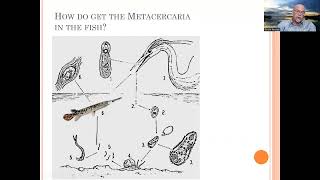
Lifecycle: bird (definitive host) → snail (intermediate host) → fish (metacercaria encystment in gills or other tissues).
According to the presenter, there is no drug or medication that penetrates the capsule to remove the encysted metacercaria.
Chapters
Hello, Dear Akarist, today, with a beautiful background of the Amazon river in Brazil, beautiful skyline and talking about fish diseases is part of my job which I bring to you today. Again with a case that it encountered in the industry. A case of a fish which has been tank raised, pond raised and showing serious problems which you cannot see with the naked eye what is the real cause of the disease? And that's why you need to use a microscope. In this case, 91, it's about the rainbow Labeo. It used to be called Frenatus Epalzeurhus frenatus, with a metacercaria infection in the gills. Well, let me explain you what I found. Well, first of all, we observed a fish in the aquarium where a few were getting very skinny. You can see it here in the back, this one here at the end. There's a few here also swimming in the group which are very skinny. But look at this one, that one is very skinny, wasting away. And here you can see one few more here between the group of more healthy fish. And of course, those very healthy fish are eating away all the food. And the weak ones will get no food. So you have a competition that the strongest fish, the most healthy fish, which are probably less infected, have a better chance to take up all the food. And the ones who are skinny and weak will get less food, of course, and they will die eventually. So we examined the gills and what we found. You can see if you observe clearly here, the gill filaments. You can see here, there are organisms inside. See this here and here, encapsulated larvae of a worm, a digenetic trematode called Metacercaria. They are encapsulated here, all encapsulated here. The next one also see, they are encapsulated. You also can see that some of the gills are stressed. You see the red inflammation part, the hyperplasia, which is causing a malfunctioning of the gills. It could be due to different reasons also the weakening of the fish people because of the lack of food, the lack of immunity, and of course of the damage caused by those larvae which are taking away healthy tissue of the gills. And they are not treatable because there is no drug or medication that penetrates through the capsule, the capsule which is around that larvae. And to explain you a little bit about that cycle, how do the metacercaria get into the fish? Well, they get into the fish because there is a bird on the pond and the bird releases larvae which go through any snail larvae from a worm. The diegetic trematode which is a big worm. This one here, you can see here on the top, which is living inside that heron or another bird. And drops then here the larvae which go into the snail and the snail produces another larvae which goes into the fish. And that's what it goes. Here you can see it at number six in the gills or in other tissue internal or in the gills, depending on the different species. But this explains you the cycle. If you would take away the bird. Well, you interrupt the cycle so there will no more parasites going through the snails. And if you interrupt the cycle of the snails, you get rid of the snails. You also interrupt the cycle if a bird would come along. So the best protection for any people breeding fish in a pond is get rid of birds and get rid of snails at the pond. So make a good covering. And that's what a lot of fish farming are doing with indoor farming, like they did in the south of Florida or when people putting in Asia. Nets around, nets around and other kind of measures to prevent that birds arrive to chase them off. They have dogs running around or other things like that. And get rid of the snails. Of course the snails is not a big problem as long as there is no worm larvae getting into the pond by the birds. So you can try to get rid of two of these. It's a choice you have to make as a fish farmer if you want to produce this kind of fish. And unfortunately it's still happening in many parts around the world. It's happening in Brazil, it's happening in Asia, it used to be happening in Florida. That these fish are living in ponds when there are birds and snails. And that's how those metacercaria, those worm larvae get it to the fish and make the fish unhealthy, unhealthy with bad gills and makes them suffer so badly that you have to put the weak ones asleep. No choice because there's no treatment. So the origin check with the breeder. Where are birds and snails in the pond? And the weak fish should be gently put to sleep. Yes, you can use Narcomore plus I recommend to help the fish with a good food and stimulate immune system. So the ones which are still capable of living with a few or limited quantity of worms, they can do very well. And they can fight off the secondary bacterial infections which can come up. You can see here at the gill that can come up eventually or internally. So we recommend to feed the fish with immunostimulant food like the bai fish with forte with yeast extracts, beta glucans and probiotica, the pediococcus bacteria or the green which is the chlorella and the moringa and the professional care which has a mixture of probiotics, prebiotics and nutrition. So many choices. You have to keep the healthy ones pretty well in shape because you could see the tank originally. Some are doing very well. They're well fed, they're doing well so they can cope well with the problem but you can help more to keep them longer alive. But important you tell your supplier serious problem here, sir. Try to avoid that this is happening again with your broodstock. Okay. I hope this helped you this information for the vips who are listed on my Patreon. They have weekly new cases they can watch and also my training on fish diseases. So I'm happy to share you my information that I found by working with diseased fish and I hope you do the same and trying find out the problems and applying the correct cure. Thank you for watching.