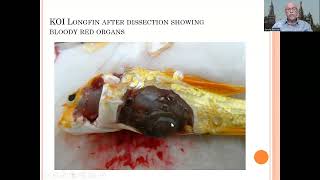
Gerald Bassleer examines a long-finned koi wasting away despite eating normally, with daily deaths among the thinnest fish. Necropsies show bloody organs, enlarged kidneys with black inclusions, and a swollen spleen, pointing to internal bacterial or viral infection. Treatment involves isolating weak fish, reducing crowding, and adding probiotics or herbal feed to support immunity.
Chapters
Dear fish keeper, I'm happy to tell you that I'm still working and capable of helping you with some advice on fish diseases. And today we will talk about a koi carp. A koi carp which was suffering. And we examine for the problem, which is not always easy to find, the exact origin or the exact pathogen. And sometimes it's complicated. So I show you my work with sharing my screen in my PowerPoint that we will talk about a long finned koi Cyprini scarpio with internal problems. So I explain you in this case 95, what I found. They were active and healthy. You can see here in the big vat or the pond where the fish were kept in. And you can see them actively swimming around, not showing really health problems. But every day a few were dying. And we find out that particularly the ones who were dying were the very skinny ones. This one was becoming very skinny here in the body, not having a strong structure. And it seems to be that they were weakening externally. We couldn't see anything wrong at the fins or the scales of the fish. But look, these fish were emaciated and not looking as a normal body what a koi carp should be. We found that the excrements were very dense and, and looked like it was a lot of undigested food. That's what we observed here in the microscope. A lot of food was undigested. So undigested means there could be an intestinal problem or internal problem having an impact on that fish. And when we dissected that koi, we had a lot of bloody red organs, look very bloody reddish, which is not normal. Normally you see a clear intestine, you could see a clear liver. What we also noticed was here in the dorsal part, a very enlarged kidney. Some things we could observe by just doing a dissection on the fish. Looking at the condition of the kidney, we could see there was a lot of black inclusions, there was a lot of blood clots or how you can call it, obstructions in the kidney that they were not clearly like here. It's more clear kidneys in this part, kidney cells and that tubuli, which are more perfectly healthy. But this was not so healthy looking. And also the spleen, which was very enlarged, was very reddish and had some holes and vacuoles. So this was not normally looking as a good spleen. Same for the liver. The liver had those black vessels you can call. So there is some to be a blood issue, a blood health issue causing this kind of conditions. So what we could do is telling the people Were keeping these koi. Put the weak ones asleep, get them out of it, put them separate because they might be a spreader of diseases to the other healthy fish. We could notice that there was some aggression between the koi for food. Food competition. So the weak ones could be becoming more weak. No chance to eat, having aggression. So that could be a trigger of an infection to appear on the fish. And so maybe a recommendation for this case is select the fish according to the size and avoid overcrowding. So put the big ones together and separated from the small ones. That might already be a physical action you could have taken. Avoid overcrowding. Help the immune system, Help the gut microbiome. The gut microbiome is the most important part of the immune system. And like we looked at the excrements, badly digested. It could have been a problem with bacteria or a bad microbiome. So you could help that with a fish food. A fish food like we have with our Dr. Basler Bai fish food professional treat on herbal helps the immune system and regeneration of the microbiome and helping the fish to survive. Still further lab research might be interesting to check for the viral and bacterial infection. If the problem continues and if the fish are still valuable to invest 150 or €200 for doing that kind of investigation at a professional laboratory. So that's some suggestions I can make here. After seeing this problem and more cases you can see on my my Patreon channel. Here is also the link I provide for you. So talking about fish diseases is trying to solving problems like at the back. My several visits to beautiful Russia told me there are very nice people there and used it. It's a lack of good research and a lack of good communication that can create problems. Let's hope that the problems are soon solved with the fish and with other people and problems in the world. Thank you for watching.