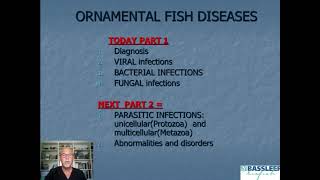
This is a lecture-style YouTube video (part 1 of a two-part series) by Gerald Bassleer introducing diagnosis of ornamental fish diseases. The speaker outlines the course purpose: teach practical diagnosis using microscopy, cover viral, bacterial and fungal infections in this part, and announce a second part on parasitic infections and disorders. Emphasis is placed on using diagnostic tools (microscope) rather than relying on naked-eye guesses; examples and photos are referenced to show how similar appearances can have different causes.
Chapters
In the coming sessions on fish disease.
Diagnosis, I will try to explain you.
More than what you can find in the books. In the books you find, of course.
Interesting information that I published and the.
Three books which are now still available in English.
But to take care about fish, it's something more.
It's by using a microscope and how.
To learn to practically use that tool.
To identify the most common diseases.
And it's not difficult.
It just follows certain rules and certain.
Ways of handling problems. So I'm sure you can learn from my classes.
If not, ask me.
And I can try to help you.
To become a better fish doctor so you can take better care of your fish.
So wish you good luck in following.
My classes on fish disease diagnosis and treatment.
Thank you.
Today we will talk about the diagnosis and the treatment of fish diseases. In part one, ornamental fish diseases, we divide it in two parts. Today, the part one, we will talk about the diagnosis of ornamental fish diseases. How we can do that, what we.
Can learn from it.
We will talk about viral infections, bacterial infections and fungal infections. The next part, in the second part of ornamental fish diseases, we will talk about parasitic infections, the protozoa and metazoa parasites, and also abnormalities and disorders. If we are talking about fish diseases, can be asked the question, are we able to make a correct diagnosis with our naked eyes? Can you see on these two kind.
Of fish what disease it is?
I can't because I will need diagnostic tools. On the left, this goldfish has a viral infection. On the right, this fish looks like he has an ulcer, but it's a parasitic infection. Can you tell what is wrong with this fish? This Colissa blue is fraying the fins. It's having a bad respiration. You can see it's clamping. He's getting skinny. Well, if you look at this, you have to guess. So making guesses in fish diseases is.
Not the best choice.
Like I teached you already in the course, causes and prevention, we have to.
Look first for the origin or the.
Reason of the disease, which is very important before we start thinking about diagnosing. And if we think about diagnosing fish diseases, if it was that easy, then you would not need this course. If this diagram would explain you so easily all the diseases on the fish, the spots, the scratches, the white dusty things, the animals on it, well, then everybody would not go for this course.
And I will explain you.
It's not so easy as you think it is, but with some help of a microscope, you can discover a lot of things.