Gerald Bassleer explains how to identify and treat white spot disease (ich) in aquarium fish, covering the parasite's life cycle and why microscope confirmation matters. Treatment combines medication like Farnamar with temperature adjustments, salt dosing, and a novel approach using special food that changes fish mucus to repel parasites.
Chapters
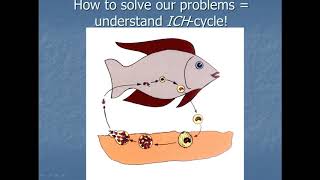
White spot infection. Ich and new ich in our tropical freshwater fish an important disease. And today we will show any information what is important about ich. But also about the new ich neo ichthyophtherius. We will explain a new method, the Dr. Basler Anti Egg method and some advice for effective control and treatment. While the spots diseases or ache. You can clearly see here on the skin on the fins of on this black emperor Tetra. You see here, the clown loach. We gonna try to solve the problems. But if you have a problem with ick, you have to understand. Look for the cause. Usually it are fluctuations due to cool temperature shock, bad water change, open windows, thermostat broken, lack of carnitine, introduction of new fish, new plants which carries white spots or ich a stress factor, bad food or poor feeding. Practice all causes and reason that white spot infection can appear. First make a correct identification. Sometimes diseases look like ich Here this chanda with those crusty white spots caused by a virus lymphocystis. Here are Lipurinus with little white specks in the dorsal finger, which is caused by encapsulated worm larvae, metacercaria. And we have other cases that look like ich here, a peppered appearance on the tita barb, Odinium or velvet disease. And a blue Remiresi with yellowish large spots, which is the new ichthy of theris. We'll talk about it later on. Important that you detect ich in the first beginning stages. Observe your fish daily. These rainbow fish still look actively and can still be treated because we spotted diseases on time. Look at their behavior. The fish are stressed, their respiration is heavy, they're shaking their body. And you see the white spots covered over the body. What we don't see are the white spots in the gills. This is a typical behavior for fish infected with ich. The blood paraphage are hovering in the corner of the aquarium and looking very stressed in the microscope. We can detect ich on a fin. You can see some small spots which are the juvenile stages. And here the large white spot with the typical nucleus. We can also detect it in the gills. And here it was obvious. Nothing to see on the skin of the barbs, but plenty of parasites in the gills which we couldn't see unless we used a microscope. And there is a massive infection of white spots which is causing damage to the gills. And this damage of the gills makes the fish suffer, getting secondary infections and possibility to die. So check your fish daily on their behavior. There is also a new ich neo Ichthyftheria schlotfeldi looks different. Smeary white spots, yellowish. Here on the ram has a different appearance. They look larger here massively on a discus yellowish covering the whole body of the fish. And Neil Ichtef Tiereslot Felde here on Jack Dempsey's you see the yellowish whitish spots covering on the body and causing damage to the cichlids. Important that you watch your fish in your aquarium daily. Here the new egg on a loricari day completely covered with the white spots. The new white spot. To see the difference. In a microscope we can distinguish the typical EU nucleus shape in the normal ichthy of theris. And here is the Neo ichthyophteris. You see, it's a different body, it's darker, has a different form. So they look quite different. But a microscope is the best way to show you this. More white spots here on the skin of the fish. The important thing to know that ich is protected by the mucus. They're sitting underneath the mucus. Look here in the gills. And that's where they are protected from any medications into the water. So the medications cannot reach the parasite. And that's why we have to think about an egg. So to solve our problems, we have to stand to the ick cycle to understand that the little parasite invades the fish underneath the mucus, the skin, the gills. And there he becomes mature after several days. And usually after seven days he reproduces and produces many baby parasites which can reinfect the fish. That's the stage the little baby parasite that we can kill with medications in the water. But we have a new method next to the medication like Farnamor, which kills the parasite. We also can use a fish food that helps to make the mucus repelling so the parasites don't like it to be there. So the use of a bifish food, Metrine is a new way of controlling with a functional food the health of the fish. And the plant extracts is metrine, which is changing the mucus so the parasites move out or do not like to attack. So you can see it as a kind of repellent action with the help of a fish food. So we use this kind of anti ich method with the combination of a medication combination with fish food, together with some actions we can take with temperature and filtration that helps to eradicate the parasite. I will explain you more about this. Now the treatment of ich. Well, you can check first the water quality, temperature. Use a medication, but follow the indications or directions. Minimum 7 days. Raise the temperature with some 3 degrees. Don't use carbon or biofiltration. Add an air pump, add microfiltration to remove parasites and feed only during 7 to 10 days with the biofish food matrine for the treatment of the new ich, which is different in color and appearance. Check also the water quality and the temperature. Do a 25% water change and do siphoning of the bottom. Add salt, 3 to 5 grams a liter and fauna more. Use correct medications, raise the temperature with 3 degrees, don't use biofiltration, no carbon filtration. Add air pump and use micro filtration when possible and during the next 10 days, every day try to siphon the bottle, do a partial water change but add also extra doses farnumar and salt and feed only bifish food matrine during seven to 10 days. We will explain more about antiac methods in the next tutorial about marine egg or crypticarion. Looking forward to serve you better. We are responsible. Thank you.