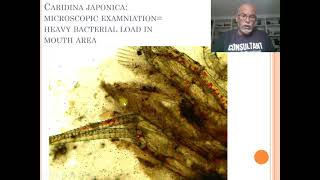
A short YouTube transcript (case #30) presented by Gerald Bassleer and colleagues about Amano shrimp (Caridina japonica) suffering bacterial infections. The speakers describe subtle or absent external signs (paleness, occasional red marks, sudden mortality), demonstrate heavy bacterial colonization around the mouth/gill/feeding particles under microscopy (noting motile and flagellated bacteria at ~400x), and recommend improving water quality plus using antibacterial/antibiotic treatments and probiotic shrimp feeds.
Chapters
Hello, fish keeper.
Well, we know that we have a lot of fish disease cases handled already. And today I will have a shrimp disease case, case number 30, about a Caridina yaponica, the well known Amano shrimp.
With a bacterial infection. Yes, bacterial infections also occur in ornamental.
Shrimps and it's a very common problem. Usually we see no signs or problems on the fish.
Sometimes we can see some red markings around the feet or the head area.
But no more clear signs, just mortalities. Unfortunately, it's not so easy to see. But a microscope can help you and.
I could show you.
Sometimes the shrimp become very pale.
No clear symptoms, which tells us, you.
Know, like a fin rot, tail rod, red ulcers.
It can appear like ulcers or necrotic tissue, but in many cases they just die and getting whitish. But if you examine the organs of the mouth and around the gills and the feeding particles of the shrimp, you.
Can see heavy loads of bacteria. You can see here the loads of.
Bacteria all sitting on the mouth, particles.
Of these yaponika shrimp in the mouth area.
And if we go to a higher.
Magnification of 400.
You can see the millions or tiny spots of bacteria moving around in the tissue.
This is a foreign magnification. There are many multilebacteria, probably two, three.
Different kinds, some with flagella.
So to determine all those bacteria, this.
Needs a laboratory to be done.
But it costs you money, cost you time.
Fortunately, we have no time. We want to cure as fast as possible.
So we could see the mortality case. We find bacteria.
Sometimes we find also worms there in.
Those kind of Caridina japonica.
But in most cases we found bacterial infections. So what we can do with a treatment with a shrimp, the Amano shrimp, Caridina japonica, well, is improving water conditions.
That's always the first.
I recommend water changes, good filtration. Apply an antibacterial medication like an antibiotic.
Because most of those medications are really.
Harmless for the shrimp, you can use them. Antibacterial medications like an antibiotic are usually harmless. It's other medications you have to be careful with. But ask your supplier, ask your provider of medications, they should know, follow the.
Directions very clearly how to use the drug.
And it's usually the similar application as for the aquarium fish, the same dosage. And also for the shrimp, we have a special Dr. Basley Biffruit.
Shrimp sticks with probiotics and aloe vera.
Which protects and helps the fish to.
Survive infections, to become stronger and have.
A good immune system.
Because also shrimp have an immune system.
So bacterial infections are also quite common.
In our Amano shrimps, Caridina japonica, and you can treat with normal antibacterial medications available in the market.