Global aquarium fish industry: data of export & import of ornamental fish
This content was created by Gerald Bassleer. This content was uploaded by Gerald Bassleer. This is a YouTube video titled "Global aquarium fish industry: data of export & import of ornamental fish" created on January 19, 2021. It features Gerald Bassleer discussing the global ornamental aquarium industry, including statistical data, market trends, and future expectations. The talk covers export and import values, challenges in data collection, and the impact of regulations and market dynamics on the industry.
Chapters
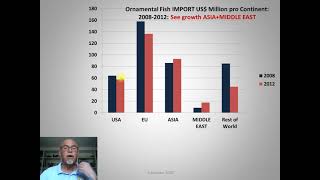
The global ornamental aquarium industry. My name is Gerald Basler. I'm a flying fish doctor traveling around the world to train and to help people to take better care of ornamental fish. The ornamental aquarium fish industry. I will talk today about statistical data, the trends in the market, trends in the aquarium industry and some future expectations and warnings. We have some data recorded from FAO and here we have a summary of the data from 1976 to 2012. With the import and export value going up, going up steadily, steadily, steadily since it has been recorded. And here leveling off. I will give you later on data on the next years. The export fish tray data here from 2008, 2016. You see a nearly leveling off, stabilizing around 350 million dollar of export of ornamental fish. I will explain more of that that in the coming minutes. Some notes about statistical data. Yes. Why? Because we have to be critical about the data we collect. The information we get is from customs. Customs records certain values on the paperwork they get. And we have to realize that is not 100% correct. Sometimes it's not recorded, sometimes they use a wrong code or the freight is not included, or it's included. It's all different method things that make a difference and creates an error in the data we collect. The information from Comtrade is a data we also can collect. And they're using tracking codes. The tracking harmonized system codes from customs. And that also changed during the last 10 years. So even that had some changes in the code tracking in the recording in the data. We got our information from publications from fao, OATTA and ophi. And it's difficult to obtain recent data. Here we collected data until 2016 to obtain data from 2019 or 2018. It's very difficult because it takes a long time before they are published. In general, some data I can tell you that the trait of total of fish export is probably around 500 million US dollar. And approximate price for the live ornamental fish is about 25$ each. The largest ornamental fish markets are China, Europe, the usa, India, Indonesia and Brazil. The aquarium market consists of freshwater fish, 90% freshwater fish with 10% wild caught fish and 10% marine fish with 90% wild caught marine fish from those 10%. So the most largest market is freshwater fish. Still is, but marine fish, I will explain later on is a growing market. More info in the next 15 minutes here. With the estimated export trade of fish in the blue line, about 300 million dollar US and all ornamentals. I will explain what I mean with all ornamentals, all ornamental Live aquatic products which is going up in the years after 2007, 2006 where we could collect data from See it's going up to nearly 450 million US dollar. That's all ornamentals together. So more export of total ornamental livestock. Because most statics are available about fish only, that's a disadvantage. But since 2006 we have statistical recording of non fish things like invertebrates like shrimp, corals, sea stars, hermit crabs, snails and many other things. The invertebrates are now becoming a large percentage of our ornamental aquarium industry for freshwater and also for marine. Conclusion There is still an increase of the ornamental livestock trade although the data of fish don't show it. But in general there is an increase of the total ornamental livestock. Here's some data of the trade of export here the top 10 exporting countries since 2012 to 2016. Number one is Singapore. But we see a steady drop in Singapore in the in the couple years afterwards here Japan has a little bit growth. Malaysia is down. Indonesia is up. The Czech is stable. USA is down. Thailand is going up. Sri Lanka is going up. I explain more about that some comments about the graph. Singapore is 23%, 25% down during the due to competition from other Asian countries who supply directly worldwide their fish. Before Singapore used to buy from Malaysia, Indonesia, Sri Lanka and re export. Now those countries like Thailand and Indonesia are exporting themselves directly worldwide. Israel is specialized in breeding fish like guppy and angelfish, but also including koi and goldfish. Japan is a strong exporter of koi goldfish. Malaysia suffered from a ban of export of koi and goldfish but now seems to pick up of breeding and exporting Asian arowana. Indonesia has more fish breeding going on, more freshwater invertebrates and also many more marine ornamentals. The Czech Republic supplies tank raised fish but now also more imported fish from Asia and South America and this apply mostly directly to pet shops wholesalers. In Western Europe, I'm sorry the Netherlands there is a lot of increase in marine exports and also freshwater exports into the eu. That means the Netherlands import and re export. So that's an export data and import data from that country. Sri Lanka has a good growth in export of tank raised freshwater and marine fish. Mostly wild marine fish but also tank raised. Colombia has a steady growth due to an unrestricted trade including illegal cod, Hippanthisus zebra, L46 and other Brazilian fish which are illegally imported into Colombia and re exported and they re export as a Colombian fish. To give you an overview of the ornamental fish trade pro continent we see that Asia with 74% is the largest supplier of ornamental fish. Then Europe is importing re exporting, particularly in Europe. And then we see that northern and southern South America is only 6%. Africa is only 1%. If you look at the difference between freshwater fish, the red line and marine fish, the blue line, we see the importance still of the freshwater fish. But the freshwater fish seems to go down and the marine fish seems to go up. And that's true. There is a growing demand and a growing market for marine ornamentals. To show this here the comparison in freshwater and marine export in million dollars from different countries. Here is the value in millions of dollars. You see Sri Lanka is the largest larger exporter in marines. And then the Netherlands. But Netherlands is re importing. Philippines is only practically only marine fish. You see Singapore here the other side is mostly fresh water and a little bit marine. Thailand a lot of fresh water and a little bit more marine. So this is give you an idea about some differences in the countries. The rainfish and invertebrates are the strongest growing ornamentals. So you have to think about that. This is a growing market and it's a very big value. At the end. The value of the products in the pet shops is much higher than freshwater. Indonesia is number one. Number two is the many different countries from Central and South America, North America with all the islands. Hawaii and Fiji, Kiribati, venalti, Haiti, Cuba, etc. Many small locations where marine fish are collected. Only Hawaii and Fiji have to tell that it has been restricted that collecting of marine fish and corals has been restricted from those areas due to local laws and regulations. The Philippines is still number three, but it is suffering also from severe restrictions on the collection of corals. But now it's starting to get open again and seems to be that there is a kind of data now control data in the collecting. Sri Lanka is very strong in marine fish, but they also import a lot of marine fish from the Maldives, Australia also from Kenya. And they re export like Singapore does with fresh water. That is what Sri Lanka is doing in the marine fish. The Netherlands the same thing. They re export. So to give you an idea about the import now the import trading data which is the most interesting here is China, which is growing. In the last couple years it had tripled or quadrupled its volume of import. And this will go up in the coming years. The USA is about stable countries like United Kingdom, Singapore, France and so on. They are so what going down in general in the import value. But that's the import value of the fish to give you an idea about pro continent the millions of dollars which are imported Pro continent is that Europe is the largest importer as continent it lost some value in the import of fish. But explain you later on. There is more about products to be sold and fish also the invertebrates. America is about stable. Asia is going up and the Middle east is going up. So these are the two continents to watch for the future. Rest of the world are many small remote areas or smaller countries. Some remarks the USA is the largest importer but European Union is not growing but it is still three times larger than the usa. So as a potential buyer is Europe the biggest. More imports into China and particularly China likes wild fish. There are less imports into Japan because it had an economic crisis but seems now to improve. Some idea about the 25 top sellers in the USA. The neon tetra is the number one then the goldfish is number two. Number three is the gold shrimp, the black neon tetra, the pleco, the tiger barb, the minor tetra, zebra, dania, the guppy, etc. Etc. The dwarf frog is here as number 10. The cardinal tetra is over here. This is in America only about on the 16th place twilight will be in Europe on number one or number two. Then here the fantails, the black tetras, ammonieres, platys, swordtails, corydoras. So that's about the most popular fish in the USA. And on marine ornamentals in the USA which is astonishing is the 60% of invertebrates which are sold in USA different hermit crabs, snails, anemones, shrimps. You can see all these different. Then the assorted damsel as fish, green chromies, firefish, the clownfish tank raised are very popular. Yellowtail, Royal gramma, s' more, shrimps, shrimps, clownfish, call of beauty Angelfish, feather dusters from the Philippines. So that's the marine ornamentals in the USA can be different in other continents or other countries. Now we'll talk about some trends in the market and the factors which has an influence in it. A particular factor that has an influence on the trends is the increased knowledge in our industry. Because our industry is still young. It only exists in the 50s but it's becoming more and more professional. So more to learn in the coming years. We have more high tech, more knowledge about aquarium fish keeping about breeding, aquaria. That's why also university like this university here is giving more opportunity of teaching and learning. So it gives us more knowledge and technology to improve and getting a better industry. The quality of life is getting better all over the world. There's More larger cities coming and there is more income coming in for the people too. And also of course to spend for this hobby. Of course we have to think about laws, regulations, ethics. They can have a negative or a positive influence on the industry. The variety of ornamental fish species give you some idea. There is an increased variety of fish species. They are still increasing. More color strains, more modified species, more new varieties also from the wild. More tank raised marine fish coming in. Increased variety in aquatic life is offered. So it's not only fish, but also shrimps and corals, snails, mussels, lobsters, crabs, plants for aquascaping. And many more different aquatic invertebrates like insects are coming available for the aquatic industry. There is increased buying of smaller and cheaper fish due to the nano aquarium and aquascaping. And it might create lower value of invoices and of course also giving a drop in statistical value. So our statistics can be more products but can be less value. And that may can have an impact on the statistical value in these recent years. So it's a change of product. We have also in our industry, to give you an idea, some goods sales products are the Bettas, which are also popular. A very nice breeding going on in Brazil. Because Brazil also had won some prizes in Asia with attending shows. Many more shrimp are coming available, many more variety. Many nice guppy endlers are coming in which is a nano fish. So many nice varieties, nice varieties. Also the normal guppy varieties with nice tails and colors are getting very popular. Also still popular are wild fish from Brazil like the wild Discus, still very popular, the Loricaridae, different Corydora species, Otocinclus and many more. And the good news for Brazil is there is now a negative list. That means that the old positive list has been taken off and now Brazil is more open to sell a much larger variety of fish. So. So I see a good potential for Brazil to become a larger exporter in the coming years. Nano, Aquario and aquascaping is a trend. More and more of these are loved and liked by the hobbyist. But I have to tell you something short about laws and regulations that can have risk to restrict our trade. Things we have to think about. You have to think about the impact of animal rights groups. They want the trade of fish to be banned or to be stopped. Particularly the wild fish. They want to ban wild fish. Keep it in the wild, don't put it in the aquarium. This is the thinking of the animal rights groups. I don't go in detail on this today. Might be another topic to talk about. There are some Issues about animal health and zoonosis. So animal health, that means fish has to be shipped with health certificates. And we have to be careful with zoonosis that it can have an impact on mankind. There are genetic modified fish species and some countries do not allow the import or the trade of these species. Invasive alien species, species that can invade in our lakes or rivers and destroy the habitat or other species. They can have an impact on the ecology of the local system. So there's some fish or products or plants that can be banned for that reason. There is the excesses benefit sharing process going on. Like going on with the cardinal Tetra which is from Brazil, but now tank raised all over the world. So should be some money not returned to Brazil because it original a Brazilian product. There is a restricted trait in painted fish. In deformed fish such as bubble eye goldfish, in poisonous fish, in dangerous fish. But think about positive actions and we can do that. All we can think about, for example is like done in England that they make advertising not to purchase a tattooed or a dyed fish. This is particularly done in Asia because those fish are very popular in Asian countries but not wanted in Europe. There is a ban on that for most countries. Also here a net caught training program in the Philippines to avoid the collecting of marine fifth cyanide. Very nice programs to make it possible to collect fish on a good manner and a good quality. And our defense for our future is our responsibility or task. Our responsibility to care about the well being of these living creatures we keep in our aquaria. And think about the welfare of your fish. You also you as a student or everyone as a teacher should be an example with a good fish. Practice avoiding negative press. I hope I shared you this information and that you learned from it. Muyo Brigado.
More from Gerald

Sick Dwarf Cichlid Apistogramma. See link complete video. #fishdisease #apistogramma #Cichlid


Fish disease case nr. 365 Tankraised Apistogramma borelli with bacterial infection and few tubercles

Corydoras catfish worm infection. See link complete video. #fishdisease #corydoras #catfish catf

Fish disese case nr. 364 Wild Corydoras concolor with Camallanus and other worm infections


Fish disease case nr. 363 Wild Cardinal tetra, Paracheirodon, with worm and bacterial infection

Fish disease case nr. 362 Sawbwa with gill flukes, Nematodes Capillaria and bacterial infection

Sick Golden Orf with Dropsy. See link complete video #fishdisease #GeraldBassleer

Fish disease case nr. 361 Golden Orfe with dropsy or ascites due to bacterial infection

Fish disease case nr. 360 Apistogramma with 3 different parasites and tubercles in the organs