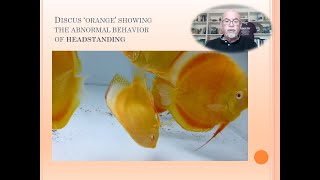
Gerald Bassleer (video author) presents Fish Disease Case #159: “Head standing” in discus. He documents abnormal swimming (head-standing) while externally the fish can appear largely normal; microscopy and necropsy revealed abnormal/necrotic gill tissue, bloody organs (liver, spleen, kidney), melanomacrophage centers, calcium deposits and tubercles, and a partially blocked intestine. Fecal/intestine microscopy identified multiple internal parasites (spoken IDs: “spatio, nucleus”, “decoterus”, and “Protopalena”) and many small spiral organisms. Bassleer concludes the syndrome is a mixed problem: bacterial damage plus several internal parasites, with diet (e.g., exclusive frozen bloodworms/mosquito larvae) as a possible contributing factor. Recommended actions: immediate antibacterial/antibiotic treatment, anti-parasitic treatments for the three parasites, and feeding his functional foods (named products) to support recovery. He also directs viewers to his books, Patreon, and website for detailed protocols.
Questions this video answers
Fish Disease Case nr. 159
Gerald Bassleer
April 12, 2023
Spoken identifications in the transcript: “spatio, nucleus”, “decoterus”, and “Protopalena” (as pronounced/spelled in the video).
“Dr. Basler biffish food lapacho” for control and fascia repair; and “Dr. Basler biofish food fico” for post-treatment bacterial support and repair.
Chapters
Hello, dear Eucharist, welcome to this video, especially for the discus lovers. You will like this topic because I will talk about head standing of discus, which seems to be a problem that breeders are dealing with or people who have imported discus. And I'll explain you with the coming videos and with my PowerPoint, what I examined and what I did found. And at the end I will give you some suggestions how you can continue to make certain treatments and to do some efforts to make your fish perform better and to try to find out what head standing of discus is all about. So I hope you like this video, so I share you my PowerPoint and I hope you watch until the end. Because fish disease case159, I give you the diagnosis and the treatment of this complex fish disease. Yes, it's a complex fish disease. And I explain also many details about discus fish in different languages, also about other cichlids and many other fish in my books about hole in the head disease, head and lateral line syndrome, the discus, pest, worm infections, etc. So get my books to become a more advanced acurist. Well, here you see the abnormal behavior, the head standing of this orange discus. This is from a nice facility I visited and this problem was going on once in a while. You can see the fish's abnormal behavior has a difficulty to swim normal and standing on his head. And that has been described by many people in the hobby and in the fish keeping. Here we see the same kind of discus with another video. And in general that fish looks okay. He has no patches, he has no fin rot. The gills are a little bit open, so he might have some gill problem that we checked that the color of the gills was not normally nice red spread like it used should be. So we examined the gills with the microscope and we saw abnormal gill formation which is not normal. Nice red gills like it should be. And we found some necrotic parts. At the right you can see the necrotic parts of the gill tissue. So there seems to be some bacterial damage going on. And when we opened the fish for further examination, we saw a bloody interior, bloody red organs. Well, that is not normal. So we took some samples of the tissues. And here we see at the left the spleen, in the middle the liver. And at the right we had kidney tissue. And you see the black markings inside. That is not normal. It should be nice smooth orange red liver or nice red spleen for instance. And then we could see in the microscope melanomacrofar cell centers, MMCs. And most likely they are caused by bacterial infection. You see the left, the spleen and at the right you see the liver with the markings. This is taking away healthy tissue. Like it is also here in the. In the kidney you see the block tubuli. You see the black blood clots in it. And we see some calcium deposits. Also we see it on the next video. We see some tubercles also here. We see here the calcium deposits. We see the blood clots. Well, this is abnormal gill made kidney. I'm sorry, it's the kidney and that is affecting the health of the fish. The fish will be not in ease and having internal problems. Liver, spleen, kidney. And then we examined the intestine and we saw a part at the end completely empty. It seems to be here, a blockage passage in the middle. You can see it in the middle. The food seems to be blocked. So we start to examine in a microscope and what we did find there was parasites. Spatio, nucleus, the small tiny ones and then the bigger ones, decoterus parasites. So there were two parasites which we could identify by just looking at this microscopic examination of the excrements. And here in a higher magnification, we see the many thousands of spiral nucleus swirling and moving around in the tissue. See that they're a little bit bright and they're moving quite fast. And here we see also spiral nucleus together with protopalena and another part of the excrements at the blocked passage. So we seen, well, three different parasites. This is the Protopalena, which is the much longer elongated ciliated parasite which we found internally. So head standing is a common problem. See, we also had it on a case of a Marlboro Red. Subscribe to my channel so you can see this one. I will describe this also and I'll show you what I found there some other issues. So the head staining of a discus, the treatment we can suggest. Well, first of all, we can conclude it's a mix of bacteria and parasites. And food. Yes, and maybe other things. Food can be a cause of it. Feeding maybe only with, for instance, like mosquito larvae or frozen bloodworms can be a risk of health problems. I explained that in several of my videos. So the fish are standing up, standing as a behavior pattern. The bacterial infection is very serious and should be treated as soon as possible with a proper antibacterial drug or antibiotic. See my books. I explain that in my books. And the three different parasites should also be treated immediately. Don't wait, because other fish will not show head standing yet, but they will develop it in the coming days. Or they might not show head standing and become sick anyways with other cells, symptoms, other signs. You can help with a functional food and therefore we recommend our Dr. Basler biffish food lapacho for controlling during the disease and also for fascia repair. Do not feed other food. Meanwhile also afterwards feed your Dr. Basler biofish food fico that helps against the bacteria and the repair of the fish. And do not feed other food. I tell you, the discus will eventually eat the granulates. They will eat it. We've seen many cases, maybe the beginning. They have to get used to it, but they will eat it. So my books explain all the treatments you can get for these particular diseases. Also other diseases like hole in the head or the discus pest. I have specific chapters on that. You can join me on my Patreon to learn more and you can find my books on my website. You can see it also in the link. I'll give some links below where you can find more details on fish diseases and on the books we provide for you. So I hope you particularly the discus lover that you like this video. So like this video and subscribe to stay informed about many more discus problems I planning to show for you. Thank you for watching.