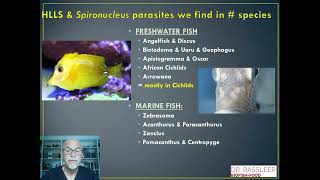
Gerald Bassleer explains hole-in-the-head (HITH) / head-and-lateral-line syndrome (HLLS/HLLE) in aquarium fish, showing photographic examples and linking the syndrome to gut infections by the parasite Spironucleus (previously called Hexamita). He describes symptoms (early pale patches and small holes that enlarge, lateral-line erosion), common affected species (many cichlids and surgeon/emperor marine fish), probable contributing factors (disturbed gut microbiome, stress, poor water quality, overdosing antibiotics, permanent carbon/ozone use, nutritional deficiencies, secondary bacteria), prevention (good water quality, quarantine, avoid contaminated live/frozen foods, improved diet), and treatments (antiprotozoals such as metronidazole/Hexamor plus prolonged feeding with a fortified diet: Dr. Bassleer Biofishfood Lapacho with lapachol, garlic, chlorella, vitamins and probiotics). He emphasizes addressing stressors and nutrition as central to prevention and recovery.
Questions this video answers
Hexamita
Metronidazole or the product Hexamor (Aquarium Muenster)
Dr. Bassleer Biofishfood Lapacho (contains lapachol from Pau d'Arco, garlic, chlorella, vitamins, and probiotics)
Chapters
Fish Food and Fish diseases video number 10. Today we will talk about hole in the head disease or head and lateral Lyme syndrome or erosion. Also the Spironucleus parasite used to be called Hexametha. And we will talk about diagnosis, prevention and cure for freshwater and marina cording fish. Our study and our science and our experience that has teach me many lessons. During my work in 14 years as an import or exporter and also as a consultant for the fish industry. We were always looking for the best solutions to improve the health of our fish and to have less diseases. We have learned that the fish have an immune system and that immune system is so important so that the fish can fight off the pathogens. The influence on the immune system is very important in this regard. We will talk about the food which has an important impact to stimulate the immune system. That means also stimulating the defense. Water quality and the handling and other stress factors can have a negative impact. So those are factors we will look at. And also today about the hole in the head syndrome. We will talk about that around the head area and this is the head area here where we can see the holes appear in part of the lateral line. Here we see an Uru Fernandi Paisi which we see that the lateral line and the head region is eroded, has some damage. And this kind of features we see quite often in this kind of cichlid in certain circumstances, particularly the lateral line which is eroded and the head area. You also can see the holes in the head area on a picture here of a discus. Here you can notice the holes here in the head area. The lateral line is becoming a little bit eroded, but not so badly yet. But here we also can see the larger holes that start to appear around the head area of this discus cichlid. In the beginning they are very small holes, but when the disease advances, the holes become larger. These are the first stages of the whole, the head and lateral line syndrome, or the hole in the head syndrome. We could call it hlls. Few holes usually appear first in the head area. Here we can see a few holes. That's the first symptoms we should detect because that's the time we have to act with medication or to look at the solution of the problem and look at the causes. Here also a picture of the first stages of the head and lateral line syndrome. Holes in the head, some holes here on the side and the beginning of the erosion of the lateral line. These are the things we have to watch for. The lesus and the few holes. The same thing appears with marine Fish here in more advanced stages at this Zoma scopas here. And here the Sparacanturas hepatus. Here in a public aquarium, we see that quite often in certain marine aquaria. You see the large damage which has been done to the head lateral line area here you can see it on the Paracanturus here, this one you cannot see that much yet. But here on this one here on the other side here, you can see very, very badly damaged lateral line region. Also on the Zebrasoma. In the first stages in marine fish, when you are young, we only can see some pale patches appear around the head area, like on the cebrazoma and the paricaturis, and no holes will show. This is also something we have to notice only in more mature fish, like on this Acanthuris. We can see severe damage on the lateral line area, the head area. And here, this lateral line organ at the back of the tail of this Acatoris Achilles. Particularly mature fish show more likely the holes, not the young fish in most cases. When we have the head and lateral line syndrome, we find parasites. We call those parasites Spironucleus. It used to be called hexameter, but recent scientific observations have shown that it's the parasite Spiranucleus. That's what we should call it. Here, the Schittaudopoulos with the heterolateral line syndrome. And here the discus begins. Both these fish were heavily infected with spironucleus parasites. And this parasite we also can find back in the gut and the intestine here, young angelfish which are wasting away, some of them getting very skinny, small, remain small. And every day we had some losses in that aquarium. This is a case where we examined those cichlids. We found a lot of spiral nucleus in the intestine. And here, this dwarf cichlid, apistogramma, you see the large string of excrements, slimy excrements hanging out. And some of the fish were dying at this aquarium. Examine those experiments and then you will find many, many parasites. Then you know spiral nucleus is the cause of this problem. And if you examine the intestine or the guts of a fish, we can see inside a massive amount here in this beautiful observation of thousands of small perricytes, spiral nucleus. This is here, the magnification of 300. They're moving and you see them, they're working on the lateral and damaging the organ here, the gut system. So the gut wall is very badly influenced by this parasite. It causes damage, it weakens fish, It Kills young fish. That's the problem with spiral nucleus. And we can hardly see it with the naked eye. Sometimes we see weak discus which start to show very small little holes. But we see the slimy excrements. So the pericytes we found in the intestine and they cause a bad intestinal wall, they cause diarrhea. And by this it causes that the fish takes less food up, so the fish will have less essential nut. They also can cause the intestine to damage and to leak out so that the parasites can move into the body cavity and into the organs. We cannot see that they cause holes. In my past experience we found some parasites in the holes, but it was usually due to the outbreak into the water in a shipping bag, but not actually causing the holes through the head. The fish will become very weak due to that parasite and the young fish will die. Older fish can live a longer time with those parricides and they show in most cases, damage into the lateral line. Here we see some fish species. We can talk about marine fish. We can talk about freshwater fish, which species we found them. The perdicides and the head and later lines they draw well. Angelfish, discus fish, Phytodoma Waru, Gyophagus, Apostogramma, cichlids, Oscars, African cichlids, Arowana. Mostly it's the cichlids where we found this syndrome. Heterodontal line syndrome, hole in the head syndrome and spiral nucleus parasites. And in the marine fish we found it in Zebrasoma, Acanthurus, Paracanthurus, Xanclus, Pomacanthus, Centropygi, Shetatodopolis. So mostly the doctor, the surgeon and the emperor fish. So it's. We find it commonly, this kind of problem, the heterothoral line syndrome in this kind of fish. What could be the different factors causing this syndrome, this heterateral line damage like here on this discus fish? Well, many different factors I found during my work. First of all, a bad microbiome. That means a bad gut flora, which could have been caused by antibiotic medications applied too often, too high dosage, too many dosages that killed the microbiome or feeding frozen or live food that is polluted with bad bacteria, stress with poor water quality, overcrowding and aggression. Also, the introduction of new fish which are carriers of spiral nucleus so they can infect your healthy fish and the parasites is part of the cause of the heteroater line syndrome in the intestine, the abdomen, the organs, but not in the holes. Secondary bacterial Infections can cause the holes. Permanent filtration of active carbon or ozone, particularly marine fish, eliminates nutritional elements that the marine fish take off by drinking the water. So we think that the holes in the head appear because of weakening of the fish due to a lack of nutritional elements. Maybe some secondary bacteria can come up to it. Maybe a virus which is not detected yet. But it's usually a weakening of the fish. And part of it could be a lack of vitamins or essential nutrients so that the organ is not functioning well and can cause holes. What can we do to prevent the parasites and the head and lateral line syndrome like on this severum here. What can we do? Well, prevent the stress, Give good water quality, give good filtration, regular water changes. Avoid the permanent carbon filtration in the ozone, especially for the marine aquaria. Prevent overcrowding. Use keratin for the new fish so you can prevent that the problem is introduced. Provide food without pathogenic bacteria. Try to give less live or frozen food, such like mosquito larvae, tube effects and daphnia, which I explained in my video. Number eight and number nine, that the frozen food or the live food can be carrier and a risk of introducing bacteria that has an impact of the gut flora. So that the gut is not functioning well. Recommend to use a food like biofish food, garlic or lapacho that helps in the prevention and the defense of the fish against the parasites. And the lesions of the head and lateral line syndrome. What can we do as a treatment for spiral nucleus and head lateral line syndrome? Well, important is to control the conditions of the fish. Control the parasites, repair the damage, but still think about it that when the damage has gone too far, there can be some scarthis you left which can never be repaired. So if you act too late, you will have fish with holes as a scar tissue. Well, to control is to control stress and improve conditions. Stop carbon filtration, stop the ozone. When you want to treat, medicate with hexamor from aquarium muenster or use metronidazole to kill the parasites. Spiral nucleus used to be called hexametha. Feed for 40 to 20 days with our doctor Besler Bicefood Lapacho. And this food contains lapachol which is an extract from Pau d' Arco tabebuya with naphoticulones and benzofuran to expel parasites. And garlic with allicin also helps to expel the parasites. Chlorella with vitamins B12 and antioxidantsia to repair the holes and probiotica to repair the microbiome. So a combination package that helps the fish to repair and helps the fish to fight off the parasites. A food can help in combination with a medication. So together it's combining. You will have a more efficient approach in treating your head and lateral line syndrome with this combination. Scientific study supports our Dr. Baslia Bivosfruit Lapacho. That garlic has an action against spiral nucleus, particularly in combination with metronidazole or products like Hexamore and Lapachol is known to work with an activity against certain parasites. So a combination. Well, what I've shown you are opportunities to keep our fish healthy and that the food can be your medicine that took care of your fish, like Hippocrates said 2000 years ago. And I'm happy you listened to my presentation and that you have an interest to become a better aquarist. I wish you good luck in the keeping of your fish. Thank you.