This short YouTube presentation (Gerald Basleer) argues that many aquarium fish are highly adaptable to seasonal and habitat-driven diet variation—evidence is illustrated with studies on wild guppies, Myelosoma (silver-dollar type), discus, and Acanthurus surgeonfish showing gut-length and diet shifts between high- and low-water seasons. Basleer then introduces his Dr. Basleer "biofish" granulate products formulated to mimic natural mixes (marine fish, krill, algae, cereals, vegetables, vitamins) and fortified with probiotics/prebiotics/phytobiotics (e.g., Paediococcus acidilactici, Matrine, Fuco) intended to improve palatability, gut health and disease resistance; he recommends granulates over flakes, lists product variants for different feeding niches, and offers free hobbyist samples at pet shops.
Chapters
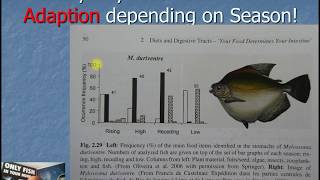
Fish Food and Fish Health Part three of the different video presentations I present recently. Fish food for certain fish, is it really necessary to have a specific guppy food or a specific discus food? Or for any other fish? Kind of. Our aquariums have usually several types of fish available. We usually have community aquaria. And in that case, shouldn't the Aquoridoras touch the food for our Neon Tetra or the angel fish? Can it not eat the food we give to our ancestors? Or the Acanturas shouldn't be allowed to eat the food for our clownfish? Well, I show you here several studies here, a study done in Trinidad on wild guppy populations where they have shown that the guppy populations adapt very well to the diet that depends on the season and the river habitat. If there is there extra green food, the gut will be longer. And you can see it here in the graph on. On the left you see the relative gut length, longer, shorter. And here the diet with availability of invertebrate proportion in the diet, less invertebrates, more invertebrates. And you see if they have more invertebrates in the food in some dry seasons, for example, in certain areas you can see that the gut length is getting shorter. And if guppies live in an other area where there is more green food available and in certain seasons you can see they will have longer guts. So you can see for one kind of species, different gut length, different diets. So the ability of adaption is very big in fish. Another study done on the Myelosoma, it's a kind of silver dollar that the food allows an adaptation of the fish depending on the season and the fish, they have the ability to adapt. And I show you here in this graph the high water season and here the low water season. And on the left you see here the frequency availability of certain kind of fish food. Here we see the black bar is the availability of fruit and seeds available in the water. And this is in the high season a very high portion that is available. And here you see this bar here with the little dots which is the availability of zooplankton which is quite lower in the high season. If you look in the low water season, you can see much higher availability of zooplankton available and a higher percentage availability of plant material. So you see a change of diet between the high water season and the low water season. And the fish can adapt. So he does not have one specific diet. They can adapt the same for discus. What do they eat in nature? Well, they have to adapt because they only can eat what they are available to get in certain times of the year. And I show in yellow the high water season in yellow the figures here below. You see here the percentage of detritus and waste products, which is just leftovers of all materials on the bottom of the rivers or the lakes where the fish can try to get their food. You see also the vegetable products. That is, that's the highest percentage of their diet and doesn't change that much all year round. That's about their basic diet. It's a mix of proteins, it's a mix of vegetables. It's just waste they can pick up from nature. But in other types of the season, see in the high water season there is much less algae and microalgae available. So they will get more of this in in the low water season. In worms, they will eat much less in the high water season and much more in the low water season. Also insects and crustacea from the bottom of the vegetation, they will eat much more of this in the high water season and much less in the low water season. So you can see the changes of diet. So Hibiscus does not have one specific diet. He likes to have a variety of food. Acanthuris, you can see here in a study done on the Florida Keys of different acanthuris that eat different kind of algae. The one likes more the brown algae. The other one, like the Coruleus, has a large selection of red algae, brown algae, green algae. And others don't have this. They only select like green algae, like the Corraleus. So they also adapt what is available in their nature. What do we do with our Dr. Basleer biofish food? Well, we produce the product which is 100% natural. It's a bioproduct that is perfectly balanced. The mix of all ingredients that fish will need. What fish can get from nature, we try to reproduce in our granulates. And it's specifically made of a mix of marine wild fish, algae, fish from scales Scandinavia with krill and algae and cereals, vegetables, vitamins. So a complete mix that is suitable for fresh water and for marine fish. And why do we choose granulates? Well, because they contain more quality than flake food, granulate food. We can supply different sizes of pellets. That is suitable food for almost all fish in all the different water zones of the aquarium. We can add on after the production of the granulate probiotics, prebiotics and phytobiotics, which we will explain in other videos to come. Also in aquaculture they only use granulate food. Because it's free of microbes and it has the best quality granulated fish food. Here you can see it's good for all different fish pieces. Rainbow fish and clown loach here because it's sinking, distributing all levels of the aquarium so the fish have less competition and survive well. Also this granulated food here, fine food distributed for live bearers, for cardinal tetras, for crossychelles rasbora, all floating and sinking. Good for all the different varieties of fish. Here I show you a cichlid with dropsy Tropheus duboisi. And that's usually caused by inadequate food or food polluted with microbes, causing also secondary bacterial infection or parasitic spiral nucleus infection. We recommend therefore our slayer biofish food, Lapacho green garlic and moringa grapefruit seed extract. Because our fish food or biofish food is for those that care. They all contain different. All the different foods we have contain probiotic Paediococcus acidilacteci that takes care of a good gut flora. We'll explain that more in next videos. But we have all different kind of food for different purposes. For the green eaters, for the live bearers, we have some extra algae for example. But we also have the garlic, which is good palatability and good for general healing. We have aloe herbal acai, green green for the green food eaters, the Chiclets Rodicari with some extra green like nature provides some seasons extra green and acai for better coloration. I will not go too much in detail all the different kinds of foods we provide. We will explain it in new videos to come. The new one we have last year is the Matrine which is helping to control the white spot infection. We also have now the Fuco with an extra of marine algae to help control bacterial infections. Cavar for the more difficult eaters, the professionals care and treat. For the professional treaters and breeders, we have the shrimp sticks which is veggie with aloe and beta glucans. And more will come in next videos for you As a hobbyist, we have free samples available in the pet shops. Ask for it for you as a choice to make as a fish keeper. To choice for a good food to keep your fish healthy. Up to you. Because we are all responsible. We'll be keeping our fish in captivity. Take care. Thank you.