A how-to video by Gerald Bassleer explaining identification, causes, life cycle, and practical treatments for freshwater white spot disease (ich and neo-ich) in ornamental tropical fish. Covers visual and microscopic diagnosis, common triggers (temperature shock, new introductions, poor water/feeding), the parasite lifecycle (~7–10 days in tropical conditions), and a multi-step treatment method combining anti-ich medications with a matrine-containing functional food, salt (3–5 g/L for neo-ich), temperature adjustments, siphoning, and filtration/UV recommendations.
Questions this video answers
About 7–10 days (trophone stage drops off, encysts on the bottom, multiplies for ~6 days, then free-swims to reinfect within ~24 hours).
3 to 5 grams per liter.
Malachite Green (Malaga Green) and Furanol/Farnamore (referred to as Farnamor).
Matrine (extract from Sophora/Kushen) in Dr. Bassler's Biofish food; feed for 10 days during treatment.
A study done in 2015 was cited regarding matrine's antiparasitic effects.
Chapters
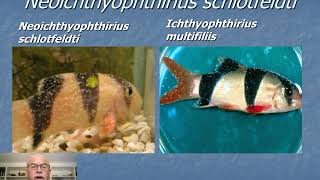
Video number six about fish food and fish health today about white spot infection. Ich and the new ich in tropical freshwater fish. White spot disease or ich we can recognize as these white little spots, dots appear on the body of the fish, on the head, on the fins. Clearly to see here, these are parasites that can infect our ornamental fish and is a very common disease. How can we help our fish when they are infected with ich? Here we see the clown loads covered with many small white spots. Well, it's important for us as a hobbyist to look for the cause. Usually it's due to fluctuations to cool temperature shock by causing too cold water changes or opening windows and having a cold draft or a thermostatus not working. And other reasons could be a lack of carnitine, introduction of a new fish or plants that are carrying ich stress, water quality, bad food and poor feeding practice. Those are also reasons why fish can become sick and infected with ich. First of all, it's important to think about making a correct identification because some diseases might look like ich. Like here we see the Lymphocystis viral infection with the white specks on the fins or those white spots here in the dorsal fin of Oliporinus caused by encapsulated worm larvae meta cercaria or these fine white dusty spots on the cherry barb caused by Oodinium or velvet disease. And here we see the new ich, the new Neoichtheophteris yellowish spots, which I explained later on important for you to detect the infection of white spots or ich in the first stages because then the fish is still healthy enough to be treated or the fish is still healthy enough to eat. Well, here we see that the fish is suffering from respiration problems because there is many parasites affecting the gills and causing damage. And eventually that's why the fish will die because the gills are badly damaged and the fish cannot absorb oxygen or releases gases. So it's an important thing to treat in the first stages. Typical is the behavior like these fish here, the blood parrots here hovering in the corner and they're loaded with egg on the body or in the gills here, difficult to see. But if we look close, there are many white spots causing this kind of behavior. To identify the white spots, the microscope helps us to identify. Here we see a typical egg with the U shaped nucleus. And here we see baby eggs, smaller juvenile stages infecting here on the fin of a fish. Sometimes we don't see any egg, like here on the body of those green tiger barbs. But there are many on the gills. And when they are in the gills with large quantities, that causes serious damage on the respiratory organ. So the fish might suffering so secondary bacterial infections. And this damage makes the fish to suffer so badly that eventually will die from it. And sometimes we didn't see it because it was only appearing in the gills and not on the skin. I talked about the new ich. Well, here we see a picture on the left on this clown lodge with the new Neo Ichthyophtheris schlotfeldi. We are a little bit larger, more smeared out white spots. Here we see the original Ichthyotheris multifides. That's the difference we can see with the naked eye. Or there can be yellowish like on this blue Ramirezi cichlid. Or here we see it on the yellow spots on the discus. In the microscope we can easier identify the difference. You we can see that the new ich. Neo Ichthyotheris, it's much darker, has a different shape, different behavior, is more clustered together. So it's quite a different appearance. That helps us to identify in the microscope. That's how we can see a difference. The microscope helps us. What's the problem with egg when we have to treat? Well, the problem is that the egg is very well protected from medications in the water because it's sitting under the mucus layer of the fish. Well protected here is attached to the gills. And you see he is very well protected by the mucous layer. Here we see on the photograph on the right. And that's how a medication in the water can hardly touch the parasites. So they are well protected. That's why we have to think about how we can resolve it by using treatments. First of all, it's to understand that there is a cycle up to 10 days of this parasite. That depends on the temperature. Usually it's between seven and 10 days. In our tropical water, the trophone stage we call the adult stage drops off the fish and then the fish will drop on the bottom. Within a few hours he will go on the bottom as a cyst and multiply and multiply to many, many large small babies. This takes usually about six days. And then within 24 hours this little baby will have to reinfect the fish again so totally. It takes about seven to 10 days of this cycle. And when we have to treat with medication, well, the only thing we can do is killing this baby stage. That's the only thing we can do. But I will give you some idea on other actions you can take next to medication with a medicine. Well, the one I Can present to you today is that we use an anti ache medication, for instance, like Farnamor, that kills the juvenile parasites. But that we combine this with a food like the Dr. Basler Biffod matrine. Because that makes the mucus where the parasites are attached repelling. And so the parasites don't like to remain. That's actions we can help to take. So our fish recover much faster. And the use of the Dr. Biofish food. Matri is specifically a functional fish food. A granulated food that is freshly coated with a plant extract from Sephora. It's called in Chinese Kushen. And that changes the mucus. So parasites move out or do not like to attack. So it has a repellent action. Scientific studies prove or work that we have tested for one year in different practices that the matrine, which is the extract of the sulphura has antiparasitic effect. This study is done in 2015. And the study showed that there are much less parasites on the fish when we use matrine in the food. And that this fish here on top here is with the feed with matrine is surviving much better. And after 30 days all the fish died when they did not receive matrine in the food. The extra study which we found on Saphora is that it also increase resistance against bacterial infections. So another extra help to keep our fish in good shape. Let me explain you about my Dr. Basler anti ick method. This method consists about feeding the fish and at the same time medicating to kill the baby parasites. Here is the cycle and here is the cycle of the baby parasite where the medication interferes. The reinfection does not occur because of the medication. But the thing with the food is that the parasite easily drops off because it doesn't like to attach to the fish and drops to the bottom. And there we can help with different actions with temperature specific filtration. Also UV lamp might change and help to kill siphoning of the water the bottom leaving the lights on. I explain in detail because the treatment of ich is action you can take. And for the neo ich we can do a little bit different. First of all, check the water quality and the temperature. Check your thermostat. Do a good 25% water change. And meanwhile siphoning off the bottom. Why? Siphoning off the bottom can remove parasites out of the water. And the water change is good to dilute the parasitic content in the water. And to get fresh water for the fish add an anti ich medication like Malaga Green or Farnamore. But important when you Use a medication. Follow the directions. For neoic, we recommend you use extra salt, 3 to 5 grams per liter. We recommend to raise the temperature so the cycle of the parasite goes faster. So if quicker drops off the fish or quicker multiplies, you can take actions. Try not to use biofiltration. No carbon because those filtrations take out medicine out of the water. So then your medicine might not be effective. Add an air pump so you can create extra oxygen. Cause the fish need it. And add microfiltration if you can. Like a diatom filtration because that removes the parasite out of the water. You also can use uv, but not everybody has that. It's good for marine tanks. And I talk about it in the next video. Leave the light on. This is another thing that I can explain. Because the parasites remain on the bottom when the light is on. They only multiply when it's dark. So they can easily be removed by siphoning. So that's an extra action you can take. During the 10 days of treatment. Try to siphon off the bottom every day and do partial water changes. And add the extra doses, medication and salt for the neoic. And of course, very important, feed only with this kind of food. It's Dr. Basler. Buy fish food Martine during 10 days. So the fish has a repellent coating mucus skin. The parasites do not like to attach. So this was about freshwater egg and about marine egg or cryptocurrencies. I explained in video number seven, the next one to come. You want to get more info? Well, look at our books@bachelor.com. you can order them or through your pet shop. You know we are all responsible when we keep fish. Thank you for your attention.