Nr.8: Bacterial infections in aquarium fish: prevention and treatment of these common fish diseases
This content was created by Gerald Bassleer. This content was uploaded by Gerald Bassleer. This is a YouTube video titled "Nr.8: Bacterial infections in aquarium fish: prevention and treatment of these common fish diseases" created on May 30, 2020. It features Gerald Bassleer discussing bacterial infections in aquarium fish, their symptoms, causes, and prevention methods. The video provides detailed information on various bacterial infections affecting different fish species and offers advice on treatment and prevention strategies, including quarantine, water quality management, and specialized fish food.
Chapters
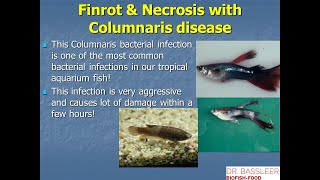
Fish food and fish disease. Part eight of my video presentations. And today I will talk about bacterial infections. Bacterial infections can be seen here on this ornamental tropical fish. You see the Betta here with the white mouth, white mouth disease, the white saddleback here. Both necrotic tissues caused by the bacteria Columnaris. Here is Serasa goldfish with a red ulcer and some red base of the fins. Here. And also the tail caused by Aromonas, also called Furunculosis. Here below an L18 Bary ancistrus with a bacterial infection, red wounds, white patches. And here the black Neon tetra with a red wound also caused by bacterial infection. Here on the marine aquarium fish. Also these kind of red wounds on this Navarcus angelfish. Or here below at the Anthias, the red ulcer caused by Vibrio. Here Acanthuris achilles, the white necrotic dissolvement of the body of the skin is a necrotic tissue caused by the Columnaris bacteria. And here below the Longirostris with very heavy thin rot, tail rot and red wounds, all caused by bacterial infections. And as we can see, it's very often white necrotic or red wound, red ulcers that are mainly predominant as a symptom for bacterial infections. The origin of fish diseases I discussed this in my videos 1 to 4. I would recommend you to see them to understand what diseases can come from. We can explain that the stress is a major cause of disease that weakens the fish so the pathogen can invade and cause an infection. And the same counts for bacterial infections. That's why we recommend when we do a prevention on these kind of diseases. If you have new fish, put them in quarantine, particularly the people having marine tanks, reef aquaria I recommend it. But if you have a fresh water tank, have a small tank and put your fish a few weeks in quarantine to observe and to treat when necessary. What you can do as a prevention plan for bacterial infectious is giving a very good care and avoiding all the stress, especially a good filtration. And water tests are very important so you can survey the quality of your water. And a good filtracer will take care of your good water. We also recommend frequent water changes. You can do approximately 25% each month. In my home aquarium where I have a few fish and a lot of plants. I only do two to three times a year of water change. Why? Because I have a large filter. I have not a heavy stocked aquarium with less food, less fish and have a very large biological filter. So these are Things which can predominate your opportunities to avoid water changes. A good nutrition is another part of prevention. And particularly granulated food can give you 100% guarantee of healthy fish avoiding bacterial infections. Here this yellow goldfish, you see the raised scales, the dropsy, also some red patches. This is ascites or dropsy in fish usually caused by polluted food, food with too much microbes or very bad water conditions. Here this Chitterdon butterfly marine fish, red nose, red wounds. Looks very shaky, very badly damaged. But this was not particularly the cause of a bacterial infection. But probably polluted spoiled water with too high ammonia causing secondary bacteria to invade into the fish. So here, first take care of avoiding the ammonia. Get rid of the ammonia and then you can maybe treat the fish. Talking about or aquaria. They're usually in tropical water and a Ph of 7 to 8 and it means that this is a very big risk for bacterial infections. Why bacteria love to grow in higher temperatures and in ph is 7 to 8. So these are environments where bacteria do very well. And of course also the bacteria pathogenic bacteria who can cause infections. Something you have to remind while we talk about taking care because it's important to detect as soon as possible because with the high temperature they. But here we can explode. And you see one fish in the tank and the rest looks okay. But if you would look very close, the one sick fish is a symptom or a sign that at least 10 other fish are subclinical fish which might show signs or disease symptoms in the coming days. So that's why if you see one fish showing symptoms, you have to act and treat as soon as possible. Because the next days maybe 10 fish are sick and so badly damaged that they're bound beyond any cure. I'll give you an example here. Bacterial infection that starts here on the tail of these anthias. Here this one fish has to have a very heavy infection and here is the second one starting to show. While others have very few infections. So try to check as soon as possible on your diseased fish. Fin rot and necrosis. Here an example of a columnaris disease. On this guppy you see the tail rot and the dorsal fin is also rotted away. The loss of color. Here the betta with a wide mouth and a wide saddle. This is a very common bacterial infection in our tropical fish because that bacteria loves tropical water. The problem is that this infection is very aggressive and cause a lot of damage within a few hours. Here is the same guppy as the one here above. Same guppy after 12 hours lost all his colors and nearly lost completely his tail and dorsal fin. So that's the problem with columnaris disease. It advances very quickly. And the problem with bacterial infections like columnaris damages the gills. You see a lot of bacteria here invaded in the gills and destroyed the gills and also invaded in the internal organs. And this is causing usually the fish to die. That's the reason why they die. Also extreme skinny fish and fish with a swollen abdomen. Here on the right, the discus, often caused by internal bacterial infections due to food that is polluted with pathogenic microbes. Here, dyseliatichthys. It looks like maybe the people say, well, they have worms or parasites. No, it's usually that there are a lot of bacteria internal in that little fish. So scientific studies help us to understand that bacterial infection can come from contaminated fish food. Live or frozen food can do that. Professor Austin discussed that in his book here. And also a study here done in India on different commercial fish feeds showed that there were really about 70 to 80% of the feedback were contaminated with microbes, pathogenic microbes. Also another study here, bacterial infection Mycobacterium or fish tuberculosis, that is due to fish food, frozen or live, contaminated with Mycobacterium marinum and here found in the larvae of mosquitoes. So take care of your life of frozen food. Make sure you disinfect it or you treated it so you can avoid the microbes to be given to your fish. Otherwise your fish can suffer like these here from fish tuberculosis. You see the Ramirezes getting dark color, getting bloated bellies, exophthalmus Popeye getting weaker and dying or getting big red wounds or ulcers, twos or ults, like symptoms for fish tuberculosis. So to talk about problems. Well, when you have a problem and you want to look for it, it's important to understand that you must not just give a drug or a medication, but first of all, do a good thorough investigation before you take any steps of action. Think about what's going wrong with your aquarium or, or the food or the water quality. Just don't buy a drug, don't buy drug like and don't give it just without checking other reasons. So the fish could have become sick. Here an example, the fish has tail rub. Look at the damaged fins on this fish. Well, it's aggression. It's because his counterparts in the aquarium are aggressive and damaging the fins and secondary bacterial infections are coming up. So separate the fish and treat them, then you can take care. Also, parasitic infections do often cause damage and leases that provoke secondary bacterial infections. Here it is ancestry with all those patches and of tail rot. But the primary cause was a parasite Ichthyoboda or used to be called Kostia. So you have to treat first the Kostia and at the same time maybe try to control the bacteria or. Or within a few days also the skin flukes. Here skin flukes damage the tail, not the bacteria. The bacteria become secondary. So try to avoid or treat the skin flukes also. Otherwise the treatment against bacteria has no sense. Some info about Columnaris and the resemblance to the neon disease Pleistophora columnaris. Here on the left I Cardinal Tetra. You see the white saddle necrotic tissue. Also the fin rot. Here the dorsal fin. You can treat this within 24 hours. You might have success. This treatment usually advances with a wide mouth and tail rod. And on the right here we have the neon disease. The real neon disease caused by parasite Pleistophora which is inside the muscular tissue. You cannot treat. And the fish can live many months and years with this kind of bad looking tissue. But it doesn't die so quickly as with Columnaris. Like I said before, bacterial infections, the fish die very fast. Treatment of Bacterial Infections 3 Things to Think about. First of all, good care. Taking good care of water the fish, the filtration. Think about a medication and think also about fish food. Those three together should help survive your fish. Do water changes before the treatment. Do good maintenance of the filter. Try to lower the temperature a few degrees. Try to keep it below 24 so the bacteria don't grow so fast. Add an antibacterial medication like Veramore from Acadia Muenster and do a course of 12 to 20 days with a food that help the fish to cure and to heal. Because the fish only heal by feeding. The medication kills, but the food heals the fish. Like we have a Dr. Basler Bifresh food Grapefruit seed extract Moringa, the professional treat and the new Dr. Basler Bai Fish Food Fickle a 12 to 40 day course with Dr. Basler Bifish Food Grapefruit seed extract Moringa helps to control the internal bacterial infections that are usually caused by food that is polluted with pathogenic microbes and the grapefruit seed extracts as they help the fish and also the moringa together with the probiotics Pediococcus to improve the intestinal flora. These things are phytobiotics that help the fish to repair. Scientific studies tell us that the grapefruit seed extract and the moringa are giving a better protection against internal intestinal bacterial infections. It has antimicrobial activity by the grapefruit seed extract and the moringa helps the immunity of the fish. All things that help the fish to repair and to become healthy during a bacterial infection. Another new food that we have developed is the Dr. Basler Biffish Food Fuko and you should feed this 40 to 20 days to help the fish to survive from bacterial infections like Columnaris or Mycobacteria. Here the granulates are covered with Fucoidan. Those are extracts from marine algae kelp called flam. Also prebiotics Paleococcus and also prebiotics beta glucans, extracts from yeast extracts. All these help the fish to repair. So the scientific studies with Fucoi dan there is a higher survival rate when the fish have had an infection of Columnaris and also the Fucodon has an antibacterial pathogenic antibacterial activity. Here the fish were infected with Columnaris. The the control group had no infection and no food treatment. And the fish which were receiving the Columnaris infection and had no frucoidan food had much more damage. This is the damage score. The more there is, the more damage, the more losses of fish. And here the damage score with the fish that had food with Frucodum is much less. So the survival rate in this study was much higher when fish were infected with Columnaris. Here, another study of Fukoiudan against marine ornamental fish pathogens that shows here in this column very small growth of the bacteria Aeromonas or Vibrio or Escherichia coli, a much larger growth in the positive control group which had no Fucoidan treatment. So Fucodan works like a natural antibiotic. We did an experiment with Dr. Besley Baifishfood. Several we did to test it out. And here we show that the bad tail rod on this gourami, that's on day one and on 12 days after feeding the fish we shall hear the repair of the fish. Also, the fish was getting more body and more healthier. This is one of the studies we do in our laboratory. Another opportunity we can offer you, particularly importers and exporters, is the professional treatment a 14 to 20 day course which has antiseptic against bacterial and viral infections. It's a combination of phytobiotics with garlic, aloe vera and four peppermint thyme, mugwort, chicken, wheat and also probiotics Paediococcus. All these help the fish together to defend themselves against bacteria and viral infections. A kind of cleaning up antiseptic treatment. So you have questions about this food? Well, you can go to your shop and you can ask your shop for free samples available to the shops who can recommend our products. We also have books of more info and advice. They are available at our website, www.basvier.com on freshwater fish and on marine fish diseases. And as you know, we are all responsible where we are accurate in keeping fish because the fish has no chance. He has to survive and he needs your help and you want to have more advice or some information. You also can subscribe to our YouTube channel and obtain more info on fish care and fish health and surviving. The good things in our hobby.
More from Gerald

Sick Dwarf Cichlid Apistogramma. See link complete video. #fishdisease #apistogramma #Cichlid


Fish disease case nr. 365 Tankraised Apistogramma borelli with bacterial infection and few tubercles

Corydoras catfish worm infection. See link complete video. #fishdisease #corydoras #catfish catf

Fish disese case nr. 364 Wild Corydoras concolor with Camallanus and other worm infections


Fish disease case nr. 363 Wild Cardinal tetra, Paracheirodon, with worm and bacterial infection

Fish disease case nr. 362 Sawbwa with gill flukes, Nematodes Capillaria and bacterial infection

Sick Golden Orf with Dropsy. See link complete video #fishdisease #GeraldBassleer

Fish disease case nr. 361 Golden Orfe with dropsy or ascites due to bacterial infection

Fish disease case nr. 360 Apistogramma with 3 different parasites and tubercles in the organs