Nr.9: Mycobacterium or Fish Tuberculosis a common bacterial infection in our aquarium fish&zoonosis
Gerald Bassleer explains fish tuberculosis, a Mycobacterium infection spread through live feed and poor water conditions. Stress weakens immunity and causes ulcers, emaciation, and swollen eyes. The bacteria can infect humans through aquarium water, causing "tank granuloma" on skin.
Chapters
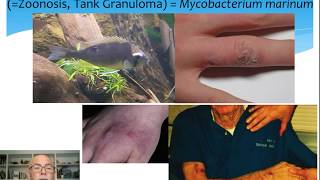
Fish Food and fish disease Part 9 Today we will talk about fish tuberculosis or mycobacterium in aquarium fish. Also with advice for feeding and also about tank granuloma. Fish become sick due to stress and pathogens. I explain that in more detail in the videos 1 to 4 which you can see at my YouTube channel. Because fish live in an environment where stress can be around, caused by humans or caused by the filtration the water. And because there are pathogens around and the stress has an impact on the fish, weakens the fish. So the pathogens can cause an infection. And we know several stress factors for fish which which we can test like ammonia and nitrite, poor water quality, the catching, packing and transport can be a problem. Temperature fluctuations, aggression, overcrowding. And the not well known factor is bad food and bad feeding practice. We call that food stress. I will give you later on some info on that. So the fish have an immune system. The immune system can be influenced by the food given to the fish. Also the stress has an impact on the immune system. But with the food we can help the immune system. So the fish becomes strong and has more opportunities to fight off the pathogens. So when the fish has a stronger immune system, he has a better defense against pathogens and get less sick. Today about mycobacterium or fish tuberculosis. This is a disease which has no typical symptoms. There can be many different symptoms that appear here. Large bellies like on this apistogramma, ascites or droplets with raised scales and eggs of thalamus. Bulging or protruding eyes is one of the symptoms of fish tuberculosis. It can also be extreme skinny fish or emaciated fish like this Malawi cichlid. Or this discus here. Razor blade looking caused by fish tuberculosis. Or this deformed cardinal tetra with blind eyes and deformed crossahelus. Old fish getting deformation caused by mycobacterium or sometimes white necrotic lesions and wounds. On these two cichlids here on the head of this uridichromis. And here these wounds or lesions, necrotic lesions. On this Central American cichlid, sometimes bleeding wounds, ulcers or tumors like on this rainbow fish. All different symptoms of mycobacterium or fish tuberculosis. In younger fish, only a small percentage die. Here we see young cardinals. A few have lesions, others do very well and have no symptoms and do well. And only very few die. But older fish, like this cardinal, 12 years old, is getting deformed. Getting Popeye swimming irregularly. And this fish was majorly caused by mycobacterium fish tuberculosis. So in older fish it's a very predominant cause of disease. Several interesting studies have been done on aquarium fish. Here in Italy, 387 private occurrences were studied and 47% were detected to have a Mycobacterium infection. Also in 127 batches of imported fish, they found that 30% had already Microbacterium. Also in Czech Republic, a study on the 322 freshwater fish, 58% were infected with Mycobacterium. And in Moravia, a study on public aquariums and breeders showed that 43% of the fish examined had Mycobacterium. In Slovenia, 35 different aquarium fish, guppies, goldfish, cichlids, gouramis, sifu or swordtails, corydoras were examined for the presence of mycobacteria by culture and molecular methods. And Mycobacteria isolates were obtained in 29 cases, nearly 83%. This figure is high because when you detect bacteria in a molecular method, it can be that the fish is just a carrier, but not as a disease or is not infected. That's why this high percentage appear. So not necessarily the fish are sick, but our carrier could be carrier of mycobacterium. In Spain, 38 different taxa in various pet shops and private hobbyists were examined and two other different fish were checked for Mycobacterium. And they were found that particularly guppies and plates, swordtails, discusfish, trichogaster and origias had mycobacterium. In total, 40% of the examined fish. In Poland, a study on 136 ornamental fish, 51% were positive for Mycobacterium, mostly neons, guppies, goldfish, zebra, danias, platys, angelfish and mollies. So many of the common fish can be a carrier of mycobacterium. And about 50% can show a Mycobacterium infection, but not necessarily die in the organs, particularly of the older fish, like here. In the liver of this discus, we find tubercles, brown, dark black patches in the organs. And if you study this in a microscope, we see these tubercles here into the liver, which is a reaction of the organ here, the liver, to isolate a colony of the bacteria Mycobacterium. In the laboratory we can do diagnostics. We can use acid fast staining, so you can detect with the microscope the acid fast bacteria, the gram positive bacteria, Mycobacterium. Or we can do PCR testing. That's how laboratory do the work. We also Find out that similar to Mycobacterium, there is also Nocardia has similar symptoms and similar disease. These recent study in 220 Iran showed that they found it also in ornamental aquarium fish. It's not as common as Mycobacterium, but you have to be aware that Nocardia or Nocardiosis can also be playing a role in ornamental fish. The study on Mycobacterium in aquaria in Italy here done on 355 freshwater fish and 32 marine fish, is a very interesting study done in 2008 by Professor Zanoni. And they found out that 170 of those fish were found to have mycobacterium. And 40 of those fish had advanced symptoms, which we could see with the naked eye that the fish were suffering from the disease. And 130 fish had mild symptoms, difficult to see, but the microscope or the laboratory could detect it. And they found it in species like Bettas, goldfish, Colissa, Neon, tetras, guppies and mollies. They found the advanced symptoms and also the mild symptoms. The same for marine fish. A level from the 32 examined marine fish in Italy and the pet shops, two had advanced symptoms and nine had mild symptoms, but carrying the Mycobacterium. Talking about clownfish and Dusculus and Zebrasoma, all different fish, which are common in our marine aquarium hobby, what is typical for bacterial infectious like Mycobacterium? Well, there is a large risk in our aquaria because our aquarium is tropical. So warmer temperature is very much liked for the bacteria. They grow much, much better in higher temperatures. Also In PH between 6 and 8, there's a maximal growth of those bacteria. So think about if you're for instance, a breeder of discus fish or Bettas or Apistogrammas, and you love to breed in a high temperature and in ph around five or six, well, it's a maximum opportunity for Mycobacterium to grow. So there is a larger risk when you keep those fish in these circumstances. This is normal for our hobby and we have to be aware of that. If you see my fish, well, maybe one fish, you can see the symptom of a red ulcer or a skinny or black spots in the organs, that's visible. But we have to be aware that if you actually look at the fish subclinical, or you send them to the laboratory, you find that 10 more fish will carry also the disease. This is the perception of the problem. What you see with the naked eye means one is showing the disease. Very clearly you have to be aware that 10 more of those fish in your aquarium are carrying disease, but not so many heavily infected. A study here, which is important for us to know where Mycobacterium is coming from. Is an infection in aquarium is by fish. Is introduced by live fish food. Here. A study done in Thailand that mosquito larvae and water fleas and Tubifex are a supplier or introducer of Mycobacterium to our fish into the aquarium. Also studied on mosquito larvae in the wild. Here in Cameroon, they found Mycobacterium marina were commonly found in mosquito larvae. So it's coming from nature, it's coming from fish food. So think about prevention in this case, because prevention is better than cure. Avoid food contaminated with Mycobacterium or disaffective food. Especially important when you're a breeder of fish. You can avoid contaminated fish food by buying, for instance, food that has been raised in in good environment and raised in a condition that is free of Mycobacterium. Or you can disinfect it by cooking or heating. Or try to give limited life of frozen food, so reduce the risk. The mother fish, the parents. The mother fish spreads the disease through our gornades and the eggs. So the breeder must select very well. Also for breeders. If you buy animals or fish, try to buy those are that free from Mycobacterium. Lab testing can help you. For the hobbyist and the fish keeper and the breeder. Avoid overcrowding, avoid dirty water and avoid the dirty filter. Because they can stimulate the growth of Mycobacterium. And if you have a very sick fish or a dead fish in the aquarium, remove the sick fish as soon as possible. And try to put the sick fish, but also new fish in a separate carnitine aquarium with a separate fishing net. Try to increase the immunity of the fish, the resistance of the fish. And this can be done with our Dr. Basler biffish food Forte or professional care that has products to stimulate the immune system of the fish. So they have a better defense against infections. Watch out for nets, sometimes the hands and the siphon hoses. Because they can hold diseases and spread the diseases. I recommend to work biosecure avoid spreading disease. For example, one fishing net per aquarium. And what to do to treat Mycobacterium when you have the problem? First of all, do a good water change and a cleaning of the filter. A good maintenance is important. Try to lower the temperature because then the bacteria will grow not so fast or will stop growing. And if necessary, place the sick fish in a keratin aquarium because he or she can spread the disease. I recommend to use a new Dr. Basler Biofilche Foucault. I will explain later on. Sometimes antibiotics can help. Such antibiotics like minocycline, kanamycin, oxytitracycline. Ask your vet too sick fish or too old fish. Treatment has no effect. Even the fish are not eating anymore, so they will waste away. So it's better to put asleep with a good means like narcomore or clove oil. With the feeding of Dr. Basleus Bwesfurt, a cure of 20 to 40 days. You can help to control the bacterial infection Mycobacterium. This food, the Dr. Besley Bivischt Fuko is a granulate food coated with fucoidan from marine algae, kelp or laminaria. It has probiotics, pediococcus and prebiotics. Beta glucans from brevis used extract saccharomyces. These kind of products are from nature and then can help the health of our fish. So the fish have a better control. Several scientific studies are done on Fucoidone. You can look it up yourselves because they're applied also for human health. That seems to have a very good antimicrobial activity. We did experiments ourselves for several months. And here is one example of a 12 days treatment of a gourami with mycobacterium with only Dr. Besley Bai fish food Fuko no antibiotic. You see the skinny gourami here with a tail rod. And after 12 days, that's how the gourami looked like. Much healthier, stronger body and a tail which is nearly repaired. So the help of a food can be a repair of the fish. Now something else which is important for us as fish hobbyists or fish breeders. Because there are bacterial infections that cause a problem in humans. It's called zoonosis here and here. This case is tank granuloma caused by Mycobacterium marinum. This biotodoma here in a public aquarium, with a protruding eye, with a swelling blow, was infected with mycobacterium. And this is a risk that it can infect a wound on the finger here, a mosquito bite, a wound which is irritating. The people scratch open the wounds and it's easy that the bacteria Mycobacterium can penetrate here in these hands, caused by lesions. Working in the aquarium, cutting by the glass or the filter. Here, this acorist working in a public aquarium, you see how many wounds he had because he had an Advanced case of Mycobacterium not well taken care of here. This fish breeder here, which is a breeder of this discus with the holes, big hole in the head, big ulcer. He had the same kind of hole in his head caused by a mosquito bite which he was scratching and opening up for introducing the bacteria. So we as humans are responsible. Look at these wounds here. These are infected by mycobacterium or the tangranduloma is a scald. So for us as humans, as fish hobbyists, try to prevent, because it's better than cure. Because in nature and in aquariums, pathogens like Mycobacterium always naturally occur. And preventing it, it's possible preventing the tendon granuloma. First of all, provide personal hygiene as you do when you have worked in the garden. You wash your hands, you take care when you have a wound. When you have a wound, you avoid contact with aquarium water. The filter the fish, wash or disinfect your hands after use, especially if you have sick fish in the aquarium. We recommend isopropyl alcohol, which is safe for the fish and very good for disinfecting. And in case of infections in your hand or your arms, consult your doctor physician and tell them the story and that you keep aquarium fish. So prevention of bacterial infections like Mycobacterium, it's all about good care, good filtration, proper water changes, really taking out water and replenishing with new fresh water and certainly also correct feeding. We recommend for baby fish or Dektor Basler biofish with baby nano, which has chlorella algae antioxidant to help the fish to grow better, and probiotics Paediococcus. And this ingredient helps to raise the baby fish in healthy conditions because it's 100% safe, no pathogens, no mycobacterium. It's four times cheaper than Artemia and very effective for optimal growth of the baby fish. You can get more info from our books you can obtain through our website balsoler.com books on freshwater and marine fish diseases. You can follow us on YouTube. You can subscribe and listen to more videos and educational info to become a better fish hobbyist. I can tell you to finish that the medicine is a science of uncertainty, but it is an art of probability. So please try and learn from the lessons you have by keeping your fish. So you are the teacher of yourself of becoming a good aquarium hobbyist. Thank you.
More from Gerald

Sick Dwarf Cichlid Apistogramma. See link complete video. #fishdisease #apistogramma #Cichlid


Fish disease case nr. 365 Tankraised Apistogramma borelli with bacterial infection and few tubercles

Corydoras catfish worm infection. See link complete video. #fishdisease #corydoras #catfish catf

Fish disese case nr. 364 Wild Corydoras concolor with Camallanus and other worm infections


Fish disease case nr. 363 Wild Cardinal tetra, Paracheirodon, with worm and bacterial infection

Fish disease case nr. 362 Sawbwa with gill flukes, Nematodes Capillaria and bacterial infection

Sick Golden Orf with Dropsy. See link complete video #fishdisease #GeraldBassleer

Fish disease case nr. 361 Golden Orfe with dropsy or ascites due to bacterial infection

Fish disease case nr. 360 Apistogramma with 3 different parasites and tubercles in the organs